Showing posts with label gas production. Show all posts

Friday, August 6, 2010

Barnett Horizontal Shale Gas Production Holds Steady

There is good news from where horizontal drilling and shale gas production was perfected, The Barnett Shale of north Texas. Even though there has been a dramatic decline in drilling activity because of lower gas prices, the production level of the existing and the few new wells appears to be holding steady. I interepret this as good news for the Barnett Shale and good news for all the similar shale gas plays such as the Haynesville, Fayetteville, and Marcellus Shales. Hopefully once these wells are drilled into the optimum stratigraphic location, properly fracture-stimulated and completed, they continue producing at substantial rates for a prolonged period. These are positive economic signals and something we're all concerned about. (Source) From the U.S. Energy Information Administration.
Peter

Prices, Investment, and Drilling Technology Drive Barnett Shale Production Growth.

Despite a sharp decline in Henry Hub spot prices from the levels reached in the summer of 2008, natural gas production in the Barnett shale in Texas continued to climb through the middle of 2009 and appears to have reached an undulating plateau since then. Production growth in the Barnett shale comes from several large natural gas producers who continued to maintain strong production even in an environment of relatively low natural gas prices (see Figure).

During 2005-2008, growth in the Barnett shale production was driven by high natural gas prices, successful application of horizontal drilling, and hydraulic fracturing, as well as significant investments made by natural gas companies in production assets and state-of-the-art technology. When natural gas prices declined sharply in the second half of 2008, the momentum in production growth continued, in part because of the 3-6 month lag generally observed between changes in prices and a production response. As natural gas prices continued to decline in 2009, so did the number of drilling rigs. However, despite more than a 60 percent reduction in the number of drilling rigs from the peak levels in 2007-08, production in the Barnett shale remained high due to several factors:

  • Increased per-unit production output as a result of improved production efficiencies from horizontal drilling (which allows multiple horizontal wells to be drilled from a single rig) and an improved understanding of how natural gas is produced from this formation.
  • Large operators hedged a significant portion of their natural gas production on the futures market when natural gas prices were higher.
  • Significant capital investments in acquiring technologies, leases, etc., combined with the resultant large debt, required continuous production so operators could service the debt.
  • Contractual lease obligations require operators to continue drilling or risk losing leases.
  • High initial production rates in the Barnett shale wells decreased the number of drilling rigs required to maintain and even to increase natural gas production output.

Rigs

Sunday, June 14, 2009

Gas Production Boom

  • APRIL 30, 2009
  • U.S. Gas Fields Go From Bust to Boom

    CADDO PARISH, La. -- A massive natural-gas discovery here in northern Louisiana heralds a big shift in the nation's energy landscape. After an era of declining production, the U.S. is now swimming in natural gas.

    Even conservative estimates suggest the Louisiana discovery -- known as the Haynesville Shale, for the dense rock formation that contains the gas -- could hold some 200 trillion cubic feet of natural gas. That's the equivalent of 33 billion barrels of oil, or 18 years' worth of current U.S. oil production. Some industry executives think the field could be several times that size.

    "There's no dry hole here," says Joan Dunlap, vice president of Petrohawk Energy Corp., standing beside a drilling rig near a former Shreveport amusement park.

    From Rock to Gas

    Jared Moossy/Redux

    Huge new fields also have been found in Texas, Arkansas and Pennsylvania. One industry-backed study estimates the U.S. has more than 2,200 trillion cubic feet of gas waiting to be pumped, enough to satisfy nearly 100 years of current U.S. natural-gas demand.

    The discoveries have spurred energy experts and policy makers to start looking to natural gas in their pursuit of a wide range of goals: easing the impact of energy-price spikes, reducing dependence on foreign oil, lowering "greenhouse gas" emissions and speeding the transition to renewable fuels.

    A climate-change bill being pushed by President Barack Obama could boost reliance on natural gas. The bill, which could emerge from the House Energy and Commerce Committee in May, is expected to set aggressive targets for reducing emissions of carbon dioxide, the most prevalent man-made greenhouse gas.

    Meeting such goals would require quickly moving away from coal-fired power plants, which account for substantial carbon emissions. President Obama wants the U.S. to rely more on renewable energy such as wind and solar power, but those technologies aren't ready to shoulder more than a fraction of the nation's energy burden. Advocates for natural gas argue that the fuel, which is cleaner than coal, would be a logical quick fix. In addition, billionaire energy investor T. Boone Pickens has been touting natural gas as an alternative to gasoline and diesel for cars and trucks.

    "The availability of natural-gas generation enables us to be much more courageous in charting a transition to a low-carbon economy," says Jason Grumet, executive director of the National Commission on Energy Policy, who was a senior adviser to President Obama during the campaign.

    Just three years ago, the conventional wisdom was that U.S. natural-gas production was facing permanent decline. U.S. policy makers were resigned to the idea that the country would have to rely more on foreign imports to supply the fuel that heats half of American homes, generates one-fifth of the nation's electricity, and is a key component in plastics, chemicals and fertilizer.

    [U.S. Gas Fields Go From Bust to Boom]

    But new technologies and a drilling boom have helped production rise 11% in the past two years. Now there's a glut, which has driven prices down to a six-year low and prompted producers to temporarily cut back drilling and search for new demand.

    The natural-gas discoveries come as oil has become harder to find and more expensive to produce. The U.S. is increasingly reliant on supplies imported from the Middle East and other politically unstable regions. In contrast, 98% of the natural gas consumed in the U.S. is produced in North America.

    Coal remains plentiful in the U.S., but is likely to face new restrictions. To produce the same amount of energy, burning gas emits about half as much carbon dioxide as burning coal.

    Natural gas has never played more than a supporting role in the nation's energy supply. Crude oil, refined into gasoline or diesel, fuels nearly all U.S. cars or trucks. Coal is the dominant fuel for generating electricity.

    Natural-gas production in the U.S. peaked in the early 1970s, then fell for a decade due to weak prices and declining gas fields in Texas, Louisiana and elsewhere. Production bounced back in the 1990s with the discovery of new fields in New Mexico and Wyoming, but by 2002, output was falling again -- this time, most experts thought, for good. Believing the U.S. would soon need to import liquefied natural gas from overseas, companies such as ConocoPhillips, El Paso Corp. and Cheniere Energy Inc. spent billions on terminals, pipelines and storage facilities.

    The supply fears drove up prices, which spurred innovation. Oil-and-gas companies had known for decades that there was gas trapped in shale, a nonporous rock common in much of the U.S. but considered too dense to produce much gas.

    In the 1980s, Texas oilman George Mitchell began trying to produce gas from a formation near Fort Worth, Texas, known as the Barnett Shale. He pumped millions of gallons of water at high pressure down the well, cracking open the rock and allowing gas to flow to the surface.

    Oklahoma City-based Devon Energy Corp. bought Mr. Mitchell's company in 2002. It combined his methods with a technique for drilling straight down to gas-bearing rock, then turning horizontally to stay within the formation. Devon's first horizontal wells produced about three times as much gas as traditional vertical wells.

    The development of the Barnett Shale almost single-handedly reversed the decline in U.S. natural-gas production. Last year, the Barnett produced four billion cubic feet of gas a day, making it the largest field in the U.S. Other companies such as Newfield Exploration Co., Southwestern Energy Co. and Range Resources Corp. found shale fields across the U.S.

    One of the most aggressive companies was Oklahoma City-based Chesapeake Energy Corp., which got into the Barnett a couple of years behind cross-town rival Devon, and was an early entrant into the second big U.S. field, the Fayetteville Shale in Arkansas. In 2005, Chesapeake Chief Executive Aubrey McClendon sent teams of geologists across the country with a mission: Find the next Barnett. Less than two years later, they told him they had it, in Louisiana.

    [U.S. Gas Fields Go From Bust to Boom]

    The Haynesville Shale is centered in northern Louisiana, one of the country's oldest oil- and gas-producing regions. Wildcatters had explored beneath the lush cow pastures and cotton fields as far back as the 1870s. Shreveport, the region's largest city, saw decades of booms and busts until the 1980s, when a glut of cheap oil from overseas all but killed the region's oil industry.

    Oil companies knew about the Haynesville Shale, but it was considered a less viable prospect than the Barnett. The shale lies 10,000 or more feet below ground, where high pressure and 300-degree temperatures are enough to fry high-tech drilling equipment.

    But in 2006, Chesapeake drilled an exploratory well and decided the results were promising enough to justify the higher cost of drilling in such harsh conditions. By late 2007, Mr. McClendon says, "we knew that we had a tiger by the tail."

    In March 2008, as oil and gas prices were soaring, Chesapeake went public with its findings. The rush was on: Dozens of companies dispatched agents to the area to lease land for drilling, turning farmers and ranchers into millionaires overnight.

    "There was excitement in the air," recalls Jeffrey Wellborn, a Shreveport resident who sits on the board of the local Sierra Club. "You thought everyone in the world had won the lottery."

    The frenzy marked the peak of a nationwide drilling boom that was fueled by a combination of soaring energy prices and easy credit. It didn't last. Between July and October, oil and gas prices fell by more than 50%, and kept falling.

    The weakening economy eroded demand for both oil and gas. Natural gas, unlike oil, suffered from a supply glut. U.S. gas production rose 7.2% last year, while oil production fell 1.9%. As a result, oil prices are up 12% since the start of 2009. Natural-gas prices have fallen 41% to their lowest since 2002.

    Gas producers saw their profits evaporate and share prices slump. Liquefied-natural-gas imports plunged, leaving import terminals nearly idle. Worried about a glut, companies cut back sharply on drilling and formed a lobbying group to try to boost demand.

    The growing supply created opportunities for policy makers and environmentalists, who saw natural gas as a possible solution to the nation's energy problems. Some groups suggested burning more gas and less coal for power generation. Others favor its use in vehicles.

    Mr. Pickens has spent millions promoting an energy plan that aims to, among other things, convert thousands of big-rig trucks to run on natural gas. Mr. Pickens has large investments in natural gas and stands to benefit if his plan is adopted. In TV ads, Internet videos and speeches, he emphasizes a different goal: reducing U.S. dependence on foreign oil.

    Mr. Pickens arrived for a recent speech in Dallas in a natural-gas-fueled Honda Civic with a bright blue "Pickens Plan" logo. He told a packed auditorium that the U.S. is importing two-thirds of its oil even as the country is "absolutely overwhelmed with natural gas." If the reverse were true, he said, he would favor burning oil.

    Some environmentalists have embraced Mr. Pickens's plan as a way to fight climate change. Carl Pope, executive director of the Sierra Club, says he sees natural gas as a "bridge fuel" that could help the U.S. burn less coal and oil until renewable sources of energy are ready to take over.

    The dual message of energy security and environmental responsibility has helped Mr. Pickens win powerful allies, including Senate Majority Leader Harry Reid, House Speaker Nancy Pelosi and dozens of elected officials from both parties. A bipartisan bill providing tax incentives for natural-gas cars looks likely to pass this year.

    Not everyone shares Mr. Pickens's enthusiasm for natural-gas vehicles. Major users of natural gas, such as utilities and chemicals companies, are concerned the plan would drive up prices -- an outcome that would benefit producers.

    Energy Secretary Steven Chu and some other policy makers have expressed doubts about the practicality of retrofitting hundreds of thousands of service stations to offer natural gas. Some environmental groups, including the Natural Resources Defense Council, have argued that natural gas is better used to replace coal for power generation, and that cars should run on electricity generated by the sun, wind and natural gas.

    Market forces are already helping natural gas make inroads against coal and oil. Gas is now cheaper than coal in many parts of the country, leading utilities to burn more gas. Of the 372 power plants expected to be built in the U.S. over the next three years, 206 will be fired by gas and just 31 by coal, according to the Energy Information Administration.

    Natural gas is gaining market share far more slowly in transportation. Earlier this year, AT&T announced it would convert up to 20% of its truck fleet to run on natural gas, largely because it has been cheaper than gasoline in recent years. Cities including New York, Los Angeles and Atlanta have converted part of their bus fleets to run on natural gas, for air-quality reasons.

    Shreveport could be the next city to make the switch. In March, Mayor Cedric Glover announced that the oil capital turned natural-gas boomtown would abandon diesel and convert its bus fleet to natural gas.

    —Russell Gold contributed to this article.

    Write to Ben Casselman at ben.casselman@wsj.com

    Friday, April 3, 2009

    Marcellus Shale Gas Play: Part 7

    Natural gas is a preferred energy source with a wide variety of uses. The future looks good for the development of the Marcellus Shale in the northeastern United States.
    Peter


    Economic Development
    The size of the economic impacts from Marcellus
    depend critically on whether the businesses exist
    within the Pennsylvania communities to support
    ancillary economic activity created by natural gas
    exploration and development. The more spending
    that occurs outside the community, the less economic
    benefit will accrue locally since those dollars will
    simply leave the community rather than recirculating
    among local businesses.

    Similarly, to the extent
    nonresidents hold new jobs, the lower the benefit to
    the community. The twofold economic development
    challenge is thus:

    1. Finding ways to help local businesses and workers
    compete for the new business opportunities
    arising from natural gas.

    2. Finding ways to encourage businesses, workers,
    and royalty owners to spend their new dollars
    locally rather than out of town. New business
    start-up and technical assistance should target
    business opportunities related to natural gas, and
    workforce development training should focus on
    the new specialized jobs that will be created (such
    as land men who service the wells).

    General local business and community development
    programs focused on helping local businesses
    or downtowns be competitive could similarly help
    Pennsylvania communities better compete for the
    new spending resulting from the natural gas revenues.

    Environmental Impacts
    The construction, activity, and existence of natural
    gas wells in the community and industry may cause
    significant environmental changes to the areas.
    These issues should be considered when planning
    and enforcing local action to accommodate the
    developing gas industry. Possible environmental
    concerns that could arise from drilling activity
    include:

    • Aesthetics and recreation—heightened noise and
    the effects of drilling may affect the aesthetics and
    recreational value of a resource for both nonconsumptive
    (e.g., hiking, birding) and consumptive
    (e.g., fishing, hunting) recreational use. This may
    affect communities that are promoting natural resource-
    based tourism.

    • Habitat fragmentation—well sites and associated
    infrastructure may fragment Pennsylvania forests.
    Fragmentation will decrease habitat quality for
    many wildlife species that are dependent on
    deep forest habitat; it is also associated with an
    increased spread of nonnative and invasive plants,
    causing further habitat degradation for native
    plants and animals.

    • Water impacts—water consumption and
    wastewater disposal may affect aquatic resources
    both locally and within the larger watershed.

    • Timber resources—access roads and pipelines
    may cause damage to timber stands, resulting
    in loss of forestry income, appraisal, and sale of
    timber.

    • Soil compaction and long-term site fertility—
    well sites may compact the soil, affecting the
    long-term health and fertility of the area.

    Forestry concerns that show effects on forests,
    wildlife, ecology, and local natural balance need to
    be addressed by DEP, Conservation Districts, and
    other associated agencies through regulation and
    enforcement.

    After drilling has occurred in an area,
    proper site restoration is a necessity. The best ways
    to restore sites depend on the location and natural
    surroundings, making it necessary for officials to
    gather information on the pros and cons of different
    methods of site restoration. The type and quantity of
    vegetation replanted will make a large impact on the
    natural ecology and balance.

    What Local Officials Can Do
    Local government officials concerned about the
    impact of Marcellus shale development on their
    community need to greatly expand and upgrade their
    comprehensive community planning efforts. The fast
    pace of gas drilling—and all its related activities—
    means that planning must be done on a continuous,
    daily basis. Every new well that is drilled causes small
    changes in the community. Monthly meetings of the
    planning commission are not sufficient to keep up
    with these changes.

    We also need a new way to think
    about how communities plan for gas exploration.
    Comprehensive community planning is more
    than just the established “comprehensive plan.” A
    comprehensive plan, as permitted in the Municipalities
    Planning Code, serves as a useful tool for
    municipal management by providing a broad, general
    framework for common development issues projected
    ten to twenty years into the future. This would be
    acceptable if things did not change very quickly, but
    that is not the case with gas drilling. Few comprehensive
    plans were prepared with major natural gas
    development in mind, so they are not adequately
    prepared to address the potential impacts of the
    Marcellus shale formation.

    A more comprehensive view must take into
    account all the important issues and how they interrelate
    to one another. This view involves more
    than just land use. Gas drilling brings many new
    factors to communities that have not been experienced
    previously in many areas of Pennsylvania.

    Exploration of the Marcellus shale will generate
    large amounts of money from the leasing of land,
    construction, trucking, commerce, and housing development.
    Some residents will have more money to
    spend, but will they spend it in the community and
    region? Will they take that capital somewhere else
    if there are no places for them to spend their money
    locally?

    New opportunities for business development
    should increase with gas drilling, which will require
    infrastructure investments in roads, water, and
    sewer facilities. Housing needs for gas and related
    workers will increase. Will their needs be met with a
    temporary variety of housing or is the plan to build
    long-term residential areas that will be attractive to
    gas industry workers and their families?
    There will also be new service, public safety, and other expenses
    imposed on local governments that may not be
    consistent with tax revenues derived from natural gas
    drilling or leasing activities.

    To address these complex issues, the comprehensive
    planning undertaken by municipalities and
    counties should have four components:

    1. Taxation and municipal finance: a component to
    examine tax revenues and expenditures related
    to gas exploration and project future financial
    resources needed for municipal and county operations,
    and school districts in the region.

    2. Public investment: for examining and developing
    a plan on how municipalities, counties, and
    school districts can use their assets and facilities
    to generate revenues from drilling, transmission,
    water, and wastewater activities related to gas
    exploration.

    3. Comprehensive land use: a plan to incorporate
    natural gas development as a new and distinctive
    land use and provide for economic development,
    new commercial and residential activity, and
    improvements to the local transportation system.

    4. Municipal management: a component of planning
    to provide personnel that will keep track of
    mining activities, carry out inspections, anticipate
    production changes, and encourage workforce
    development to supply skilled workers. Since gas
    exploration is regional in scope, the management
    process needs to be carried out jointly by affected
    municipalities, counties, and school districts, as
    well as the private sector.

    The vast economic and social impacts related
    to exploration of the Marcellus shale deposit call
    for new thinking. Sound, innovative, continuous
    comprehensive planning is needed for Pennsylvania
    municipalities to maximize the long-term benefits
    from Marcellus shale development while minimizing
    potential negative impacts.

    The experience of some local governments
    with the gas companies has been very positive, and
    many companies have shown a desire to conduct
    themselves appropriately within the community.
    The companies are investing millions of dollars into
    drilling and pipeline construction with plans to remain
    in the drilling areas for years. The length of these
    relationships demands a certain level of cooperation
    between parties, and jeopardizing the ability of the
    companies to operate would be detrimental to a
    productive and beneficial relationship. It is important
    for municipal officials to ensure good communication
    and collaboration, with a method for quickly and
    easily addressing problems if they occur.

    Areas to Consider
    Road Bonding

    The Commonwealth can prohibit the use of and
    impose size or weight restrictions on highways and
    bridges under its jurisdiction in accordance with
    Department of Transportation regulations. Trucks
    considered heavy haulers must pay for the road
    damages that they create; thus, bonding is necessary.

    No vehicles in excess of the size or weight
    limitations specified are allowed on Pennsylvania
    highways unless the department or local authority
    grants a waiver. Local authorities that post size or
    weight restrictions, either in accordance with the
    size, weight, and load chapter or that differ from that
    chapter, must comply with the department regulations.
    Posting and bonding municipal roads is
    authorized in the state vehicle code.

    The PennDOT
    Bureau of Maintenance and Operations is in charge
    of municipal road posting and bonding information.
    You can also find codes for the authorization to use
    bridges posted owing to condition of the bridge and
    to use highways posted because of traffic conditions.

    Some of the key provisions of road bonding include:

    • Posting: a road must be posted with a weight
    limit before a bond can be required of a hauler.
    The steps taken to establish a weight limit include
    (1) completing an engineering and traffic study
    that supports the need for a weight restriction;
    (2) passing an ordinance identifying the road
    segment and setting the weight restriction; (3)
    advertising the posting two times in a general
    circulation newspaper at least five days prior
    to actual posting; (4) contacting known heavy
    haulers who are using the road about executing a
    maintenance agreement; and (5) erecting standard
    signs showing the weight limit.

    • Excess maintenance agreement: after posting a
    road, the local government enters into an excess
    maintenance agreement with each hauler who will
    be operating overweight vehicles on that road.
    This agreement allows the local government to
    shift responsibility for repairing road damages
    on a pro rata basis to the haulers who damage the
    road. Note that haulers are only responsible for
    damage they cause in excess of normal wear and
    tear on the road.

    • Permits: driving an overweight vehicle on posted
    roads generally requires a permit. The type of
    permit depends on the number of vehicles, the
    number of posted roads used, and the amount of
    use. Permits are issued only after an excess maintenance
    agreement has been signed.

    • Inspections and monitoring: before overweight
    hauling begins, the local government inspects the
    road to determine its condition. The hauler who
    pays for this service has the right to be present.
    After hauling begins, the local government is
    responsible for monitoring the condition of the
    road and notifying the hauler of any necessary
    repairs. If the local government is responsible for
    making the repairs under the excess maintenance
    agreement, the local government bills the hauler
    for the costs.

    • Security (bonding): haulers generally must provide
    security to ensure payment for any road repairs for
    which they are responsible under the agreement.
    This security is usually a performance bond, a
    standby letter of credit, or a certified bank check.
    The regulations specify the amount of security that
    may be required for unpaved roads ($6,000 per
    linear mile) and paved roads ($12,500 per linear
    mile) in cases wherein the hauler agrees not to
    downgrade the road. When the local government
    and the hauler agree that the road type can be
    downgraded during hauling and restored after
    hauling ceases, the amount of security required is
    $50,000 per linear mile. If the hauler uses several
    roads for only a short time or makes relatively few
    trips, the rates per mile may be replaced with a flat
    rate of $10,000. By following these rules, local
    officials can assure taxpayers that they will not
    have to pay for road repairs caused by overweight
    vehicles.

    Local governments considering road bonding or
    posting weight limits on bridges should carefully
    consider potential impacts on other road users since
    they may unintentionally affect others. Bridge weight
    limits, for example, could make it difficult for milk
    trucks or feed trucks to reach farms, hurting those
    businesses.

    For more about road bonding, see PennDot
    publication 221: Posting and Bonding Procedures for
    Municipal Highways, which may be purchased from
    the PennDOT store. ftp://ftp.dot.state.pa.us/public/
    PubsForms/Publications/PUB%2012.pdf
    Zoning and Subdivision and Land Development
    Ordinances

    At the time of the writing of this publication,
    Pennsylvania’s Oil and Gas Act and the Municipalities
    Planning Code restrict the ability of local
    governments to zone or permit drilling, so zoning
    has limited usefulness to influence where and when
    drilling occurs. Yet zoning and subdivision and land
    development ordinances remain a vitally important
    tool for influencing the potential secondary effects
    of natural gas activity, such as from possible new
    residents, housing, supporting businesses, patterns
    of development, and the other spinoff impacts. Much
    of the economic opportunity (and challenge) from
    Marcellus will be these secondary effects, which can
    be influenced and regulated through zoning and other
    land-use tools.

    Capital Budgeting
    Capital budgeting is a powerful but often underutilized
    tool of Pennsylvania local governments. By
    planning future expenditure needs for infrastructure
    and other capital expenses, such as road maintenance
    and repair, trucks, and equipment, capital budgets
    allow the local government to ensure it has the funds
    in hand to pay for upcoming needs. This includes a
    schedule of setting funds aside for future needs and
    anticipating spending for future needs in current
    budget decisions.

    Local Natural Gas Task Force
    Given the localized nature of many of these impacts,
    a local, comprehensive, and proactive approach can
    help ensure that a wide range of the community’s
    interests are represented—and importantly—
    taken into account when decisions are made. One
    important way to meet this challenge is to create a
    local task force or a similar organized effort to guide
    community discussions, information gathering, and
    decision making. Members should reflect the broad
    community, including businesses, the chamber of
    commerce, nonprofits, schools, local government,
    and citizens, among others. Such a task force can
    ensure that regular communication occurs among
    local governments, the business sector, real estate,
    workforce development, academics, service
    providers, and citizens, and that the community is
    able to be proactive about the opportunities.

    As of this publication, several counties in Pennsylvania
    have already formed local task forces to
    address gas exploration and development issues in
    their communities. Several counties in Texas helped
    pioneer this approach to responding to the natural gas
    opportunities and challenges and have found it useful.
    For a more in-depth discussion of ways to build a
    successful local strategy, see the Penn State publication
    “Creating and Fostering a Local Task Force”
    available from http://www.naturalgas.psu.edu/.

    Leasing Municipal Land
    Many Pennsylvania local governments themselves
    will have the opportunity to lease their own land, such
    as parks, open space, reservoirs, and other municipal
    property, and may receive substantial royalty
    income in the future. If a local government has this
    opportunity, it is vital to take care during the leasing
    process.

    As with landowners, Penn State Cooperative
    Extension’s Marcellus Education Team recommends
    talking with several companies and with an attorney
    familiar with leasing issues because the typical
    contract offered by the companies may not adequately
    protect or represent municipal interests and likely
    will require some amendments written by an attorney.

    Those issues may include the ability to jointly approve
    the location of access roads, drilling pad locations, and
    how land is cleared (and disposal of the trees).
    Site restoration is another postdrilling issue that
    local officials should try to address. Restoration is
    a requirement for all drilling sites and is regulated
    by DEP. However, it is important for local officials
    to talk with gas companies about the specifications
    of each site’s restoration to ensure that the recreated
    habitat is appropriate for the area. Site restoration
    should be conducted in accordance to the surrounding
    ecology of the well site so that local wildlife is
    provided the proper vegetation species and coverage
    for their environment.

    It is also critical for local officials to carefully
    consider how leasing and royalty income will be used.
    It may be tempting to use the funds to cover current
    operating expenses, reducing taxes in the short run.
    But the dollars result from the sale of a capital asset,
    so they should be used for capital expenditures that
    benefit more than just current residents; the gas being
    sold also is owned by future generations of residents,
    who also should benefit from the sale. Good fiscal
    management suggests viewing these dollars as a
    way to invest in the future of the jurisdiction, such as
    building infrastructure or purchasing land and other
    assets that benefit current and future residents; in
    other words, use the windfall gains to improve the
    community for the long run, not just for the period
    when the gas is flowing.

    Looking Ahead
    Marcellus shale is providing many Pennsylvania
    communities a significant opportunity for strong
    economic development and improvements in the
    quality of life.
    Along with these strong opportunities,
    major challenges will need to be addressed directly.
    The role of local officials should be to help balance
    these challenges and benefits to ensure the focus is
    not just short-term gain. They must constantly keep
    in mind how to use this opportunity to improve
    the community for the long run so that when the
    Marcellus play is over, the community has improved
    and is poised for the future. ■

    Friday, March 13, 2009

    There Is Light At The End Of The Tunnel

    Gas prices and drilling and production of natural gas will continue to increase. Now is the time to prepare. So says a VP for Devon Energy Corp. and reported in the following article from the Oil & Gas Journal. This is good news for the shale gas plays and horizontal drilling and interpretation.
    Peter


    GPA09: Gas recovery coming sooner, not later
    Warren R. True
    Chief Technology Editor-LNG/Gas Processing

    SAN ANTONIO, Mar. 10 -- Rapidly declining US natural gas rig counts and prices are setting the stage for a recovery in both sooner rather than later. That was the message today of Gregory A. Dodd, vice-president for natural gas marketing and supply at Devon Energy Corp. in remarks to the 88th Annual Convention of the Gas Processors Association in San Antonio.

    Dodd sees signs of this eventuality in the rapid pace that gas rigs are being laid down or otherwise pulled away from US gas plays, especially shale areas. He also said many wells are being completed but not yet tied into gathering and transmission infrastructure.

    Today's fuel
    The coming recovery is evident in the accelerating rate of production decline, the increased use of natural gas in electric power generation as falling prices make it more of the fuel of choice, and the inevitable US economic recovery. Devon, said Dodd, is "getting ready for a turnaround" by, in part, increasing its 2009 capital budget over 2008.

    Natural gas, Dodd said, is "not the fuel of the future but the fuel of today." Companies need to be prepared for recovery by reducing debt and reorganizing management structures to speed decision making.

    They also need to shorten response times for rig mobilization once recovery begins and be actively influencing policy making, especially at the federal level. Currently, said Dodd, the story of natural gas is not getting told in Washington, DC.

    LNG will play a critical role, he said, in meeting demand in the recovery, as it will take US production companies 6 months from the time rigs are called back to work and increased production from that new work.

    Contact Warren R. True at warrent@ogjonline.com.

    Thursday, February 12, 2009

    A Look At All Categories Of "Unconventional Gas" Supplies

    How things change, in just one year. The economic downturn has put much of the drilling and production of so called "unconventional gas" on hold. The question is, when and to what degree will the economy recover and increase demand and price? This article, written just one year ago, in February 2008, describes and defines the different categories of unconventional gas. The authors also make projections of future demand and production.
    Peter


    An “Unconventional” Future for Natural Gas in the United States

    Growing demand for energy in the United States is causing shifts in the mix of fossil fuel supplies and creating new opportunities for geological research. Oil, gas and coal are the country’s primary energy sources. Yet the United States faces declining domestic oil production and increasing reliance on oil imports: According to the U.S. Department of Energy (DOE), the United States already imports 67 percent of the oil it consumes. And though we have plenty of coal, it has a bad reputation for not being clean. Natural gas, on the other hand, is relatively clean, and the United States produces quite a bit of it, only importing about 16 percent each year. Furthermore, domestic production is expected to continue to rise in the near future, thanks primarily to “unconventional” gas resources. Such unconventional sources were thought to be noncommercial only a few years ago. Recent efforts to pursue these lower-quality reservoirs, which host huge amounts of widely disseminated gas resources, have been remarkably successful.

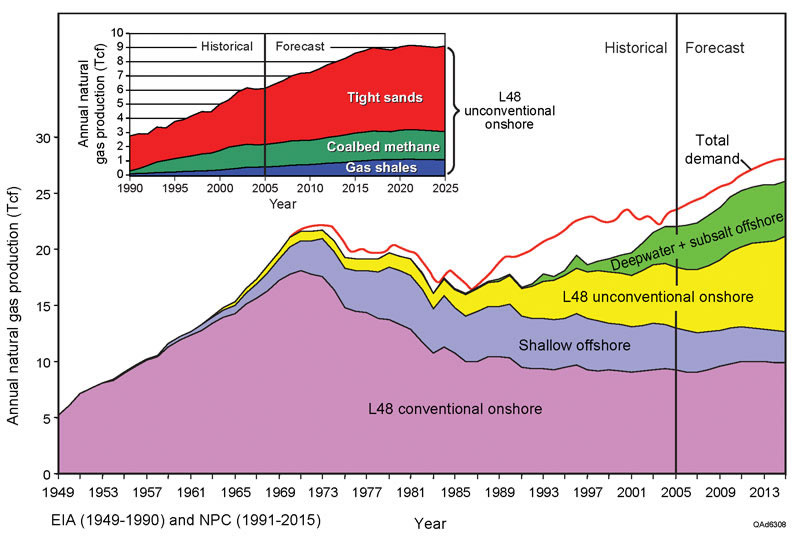
    Today, unconventional natural gas already accounts for one-third of the annual domestic production of the slightly more than 18 trillion cubic feet (Tcf) of natural gas from the lower 48 states, according to DOE. Most unconventional gas is differentiated from traditional natural gas sources in that the gas is produced from reservoir rocks with poor permeability — so poor that drillers must routinely enhance permeability in the rocks surrounding each producing well. Unconventional resources occur in low-permeability sandstones (tight gas), within unusual host rocks such as shales (shale gas) or coal seams (coalbed methane), or within gas hydrates in offshore continental margins and onshore Arctic permafrost. Although the U.S. Energy Information Administration (EIA) and National Petroleum Council foresee slight declines in future production of conventional natural gas in the lower 48 states, both onshore and shallow offshore, unconventional natural gas, as well as deepwater and subsalt offshore gas, will continue to provide a greater share of the overall gas supply in the future.

    The Need
    Natural gas provides about 22 percent of total U.S. energy needs and is used primarily for industrial fuel and raw materials, electrical power generation and home heating, according to EIA. Natural gas is a cleaner-burning alternative to other fossil fuels used in power generation and can be considered, along with nuclear power and “clean coal” technologies, in near-term carbon-reduction strategies. Natural gas is also the best current starting material for hydrogen manufacture for both industrial use and fuel cells.
    Ambrose, Potter and Briceno: Sources: EIA and NPC

    Annual natural gas production in the U.S. lower 48 states in trillion cubic feet. Production from unconventional gas sources (predominantly tight gas) and deepwater/subsalt offshore will continue to increase. In contrast, production from the lower 48 conventional onshore and shallow offshore sources will decline slightly.

    Despite abundant natural gas resources and production capacity in the United States, demand still exceeds supply, with the balance imported mostly via pipeline from Canada. The natural gas supply gap will grow to nearly 9 Tcf per year by 2025, according to Michelle Foss at the Center for Energy Economics in Houston, Texas.
    Liquefied natural gas (LNG), transported from traditional high-quality reservoirs outside North America, is expected to make up for this growing shortfall. LNG is a form of natural gas that has been refrigerated to reduce volume. It is typically transported to coastal receiving terminals via large, double-hulled transport ships. When giant fields of natural gas are discovered far from markets or pipelines, transport of the gas in LNG form is a common strategy, and this form of international gas trade is growing rapidly. Significant sources of LNG include the Middle East, North and West Africa, the Caribbean, South America, Indonesia, Malaysia and Australia. The United States is expected to increase imports of LNG from 0.6 billion cubic feet per day in 2006 to 9.6 billion cubic feet per day by 2011, according to EIA.

    The continuing growth of unconventional domestic gas supplies will lessen the need for LNG. These gas “plays” have already spurred a dramatic rise in drilling activity, with the U.S. gas-rig count surpassing 1,400 since August 2006, double the levels of 2002, according to Jeremy Platt, chair of the Energy Economics Committee of the Energy Minerals Division (EMD) of the American Association of Petroleum Geologists. This upsurge in drilling activity is attributable to rising natural gas prices. The sources of unconventional gas certainly vary, but many are currently economically viable.

    The Sources
    Unconventional natural gas differs from conventional natural gas and oil systems in terms of its “play elements,” or key geologic attributes. Major play elements for oil and gas deposits include reservoir quality, trap, source and migration. In conventional oil and natural gas deposits, most hydrocarbons originate from organic-rich source beds and migrate into either structural or stratigraphic traps sealed by low-permeability shales, mudstones or salt.
    In contrast, unconventional gas systems, such as shale gas and coalbed methane, are self-sourcing, and gas molecules (principally methane) are trapped in pore networks and in adsorbed state on in-situ organic material. Shale gas and coalbed methane production come from a combination of desorbed gas and free gas flowing through fractures (or cleats in coal in the case of coalbed methane), rather than through the types of intergranular pore networks typically encountered in sandstone beds in conventional oil and gas deposits.

    Because unconventional gas resources are generally lower-grade compared to conventional gas, more wells — closely spaced over large areas (whole counties or larger) — are required to produce them. Tens of thousands of new wells have been drilled in the United States for unconventional gas in the past decade. Cost-effective exploration and production strategies must take into account the unique set of play elements that exist for each type of unconventional gas reservoir. An in-depth look at the rock properties is vital to understanding the true complexity of these unusual reservoirs.

    Tight Gas
    Although tight-gas reservoirs — which account for the majority of unconventional U.S. gas production (about 5 Tcf per year) — produce gas from conventional host-rock lithologies (sandstones and limestones), the quality of the reservoir is a major limiting factor for how accessible the gas is. Tight gas reservoirs are commonly so impermeable that fractures, either natural or those that are intentionally induced in the well-completion process, or both, are necessary to boost producibility. Major tight-gas drilling programs are under way in Rocky Mountain basins as well as in eastern and southern Texas.

    Stephen Laubach and his team at the Bureau of Economic Geology (BEG) at the University of Texas at Austin are investigating low-permeability sandstones in the deep subsurface and examining links between mechanical and chemical processes in open fractures that can serve as permeability pathways for gas migration to the well bore. Observations of microfractures in thin sections demonstrate that fracturing and mineral cementation are linked processes. Laubach’s team learned that, ironically, fractures can be both clogged (bad news) or propped open (good news) by quartz cementation. Research efforts are now directed at predicting areas of enhanced fracturing where the cracks remain partially open to fluid flow.

    Coalbed Methane
    Coalbed methane also provides significant contributions to the U.S. unconventional gas supply, accounting for approximately 10 percent of the nation’s methane resources. With at least 750 Tcf of domestic coalbed methane resources recently discovered, more than 550 Tcf of which is in the western United States, coalbed methane production has climbed from negligible amounts in the mid-1980s to almost 2 Tcf per year, according to DOE. Despite this rapid increase, there are indications that production is beginning to flatten, introducing the challenges of searching for new coalbed methane targets and enhancing production in marginal areas.

    Coalbed methane production in the United States and Canada is centered in the West.
    Coalbed methane has a unique set of factors that affect production, including the type of coal, as well as cleat and fracture development, which together control migration of gas to the well bore. Coal-seam thickness and continuity also play a role in coalbed methane resource size by controlling reservoir volumes and extent. For example, the greatest coalbed methane production in the Cretaceous Fruitland Formation in the San Juan Basin in New Mexico and Colorado coincides with thick coal seams that accumulated landward (southwestward) of ancient shorelines of the shallow sea that once covered this region about 73 million years ago.

    Shale Gas
    Shale gas plays have recently made a significant impact on unconventional gas production, especially from the Barnett Shale in the Fort Worth Basin in Texas, where estimated resources are approximately 26 Tcf, according to the U.S. Geological Survey. The Fort Worth Basin is one of about 20 shale gas basins across the United States where total domestic shale gas resources are thought to range from 500 Tcf to 780 Tcf, according to Schlumberger, Inc.
    Despite this enormous resource, the percentage of gas recovered by today’s production methods in shale gas reservoirs is low (typically less than 15 percent of estimated gas in place), and controls on shale gas producibility and recovery are still not well-understood. Work continues on modeling fluid flow in nanometer-scale pores in shale gas reservoirs, where classical equations that describe fluid flow through porous media may not be valid, according to Farzam Javadpour at the Alberta Research Council in Canada.

    Shale gas research is expanding rapidly as a result of successes in the Barnett in Texas and the age-equivalent Fayetteville Shale in northern Arkansas, and the push to repeat those successes elsewhere. This research covers a wide spectrum of issues. Fundamental depositional controls on mudstones are being reexamined by geologists such as Juergen Schieber at Indiana University in Bloomington. Other major areas of study include pore and fracture development, physical rock properties of shales, and burial/thermal history with related hydrocarbon expulsion. All of these areas of research will help determine production strategies during the lifetime of shale gas plays, targeting recovery of a larger fraction of in-place resources.

    Still, there are challenges to this production. The need for safe and efficient disposal of waste water produced during production can be a significant cost factor for producing both coalbed methane and shale gas. Many coalbed methane wells (for example, in the Powder River Basin in Wyoming) require the production of substantial volumes of water before methane becomes mobile and migrates to the well bore. Water is commonly used to fracture the rocks to enhance production in shale gas reservoirs such as the Barnett Shale, where an individual horizontal well can require up to 3 million gallons of water for multiple “frac jobs” in the well-completion process. The Railroad Commission of Texas reports that about 2.6 billion gallons of water were used for frac jobs in the Barnett Shale in 2006. Basinwide, this amounts to 2 percent of total water usage, but in some areas in the Fort Worth Basin, frac water is 10 to 20 percent of the local usage from the Trinity aquifer, according to Jean-Philippe Nicot of BEG. Most of this frac water is produced with the gas and must be disposed of by deep injection. One implication for the oil and gas industry, particularly in the Barnett Shale play, is that operators may eventually have to rely on fracturing techniques that use reconditioned, produced water or less water in general.

    Gas hydrates —The New Frontier
    Although commercial production has already been established from shale gas and coalbed methane, gas hydrates are truly a frontier resource. Hydrates occur predominantly as methane trapped inside ice-lattice molecular structures in deepwater seafloor sediments. Because of the high-pressure and low-temperature conditions of the seafloor, hydrate methane is a concentrated energy source, with an energy density of 42 percent of that of LNG, according to Bob Hardage of BEG. Although estimates of gas-hydrate resources are uncertain, many experts think that these resources are enormous, and the potential North American resource may be many thousands of trillion cubic feet.

    Although natural gas from hydrates is not yet economically feasible to produce, it has been produced successfully in pilot wells in permafrost regions of Russia and Canada. Lessons learned from these investigations could result in viable commercial production by 2015, according to Art Johnson, chair of the EMD Gas Hydrates Committee. However, several safety and technical issues need to be resolved before gas hydrates can become a viable source of unconventional gas. For example, seafloor stability must be assured, as large-scale slumping of shallow, hydrate-bearing strata during production could potentially damage production facilities and release large amounts of methane into the water column and eventually into the atmosphere. Methane, volume-for-volume, is about 20 times more potent than carbon dioxide as a greenhouse gas, so unintended releases must be guarded against.

    Important technical issues for gas hydrates include the need for improved petrophysical characterization — a difficult proposition, however. The three-dimensional distribution of gas hydrates can be complex, occurring either in disseminated or tabular form. Realistic modeling of this distribution has a significant bearing on an accurate determination of gas saturation and, thus, on potential resource size. One step in determining distribution of hydrates in sediments involves the correlation of gas-hydrate rock properties with seismic data.

    The Future
    Obviously, there are several sources of natural gas that are markedly different from conventional gas that may stave off some of the energy issues the United States will face in the coming years. The new unconventional sources are lower-grade, but very widespread in U.S. sedimentary basins. Natural gas consumption in the United States will continue to grow, driven by demand for electric power, home heating, industrial uses and cleaner-burning alternatives to oil and coal for transportation and electricity.
    LNG imports, which EIA anticipates will grow from 1 percent of the U.S. natural gas supply to approximately 15 percent by 2025, will help to meet future demands. As these LNG imports come online, additional natural gas production from unconventional gas plays will help to fill supply gaps for the next several decades.

    Ambrose, Potter and Briceno are all at the Bureau of Economic Geology at the University of Texas at Austin. The authors gratefully acknowledge Joel Lardon, who drafted the second figure, and Lana Dieterich, who helped edit the manuscript.

    Friday, February 6, 2009

    More On The Barnett Shale Gas Play, Devon Energy

    Very interesting. New technology, horizontal drilling, geology, high stakes, big money, Texas. Stay tuned. Note: This article was written "way back" in 2005.
    Peter


    Devon Energy Marks Milestone in Barnett Shale Play
    Aug. 8--OKLAHOMA CITY -- In the third week of July, Devon Energy of Oklahoma City lifted its one-trillionth cubic foot of natural gas from the Barnett Shale field near Fort Worth.

    A "T," as energy people call it, is a milestone under any condition and more so in this case because it represents almost 70 percent of the 1.45 trillion cubic feet of natural gas taken from the Barnett Shale field since 1993. It puts Devon on track to repeat as the biggest gas producer in the Barnett Shale, Texas' largest gas field, and as the top natural gas producer in Texas.

    It was also a payoff for Devon, the acquisitive company that has become both the pioneer and biggest player in drilling and production in the Barnett Shale field.

    Today, the company has 18 rigs working in the Barnett Shale. Most significantly, five of them are in Johnson County, south of Fort Worth. For Devon, the expansion beyond its original base in Wise, Denton and northern Tarrant counties marks a significant turn in the investment it made in 2002 when it bought Mitchell Energy and its pioneering base in the Barnett Shale for $3.5 billion.

    Since 2002, Devon has drilled almost 2,000 wells in the Barnett Shale, more than doubling Mitchell's 2002 production to the current 560 million cubic feet a day. Up to 1,000 more wells could be drilled on the company's leased acreage in western Wise County, as well as Johnson, Parker and Hood counties.

    The Barnett Shale is merely the highest-profile field in which Devon operates. The company, through its 2002 purchase of Ocean Energy of Houston, was already a player in the Carthage Field in East Texas, the state's second-most productive field. Devon also has significant acreage in the Permian Basin in West Texas and in the old South Texas gas fields near the Mexican border, much of it acquired when it bought Pennzoil's exploration and production unit in 1999 (a purchase that had eluded Fort Worth-based Union Pacific Resources two years earlier).

    In addition to the 20 offshore Gulf of Mexico wells Devon plans to drill this year, the company is a big player in Canada and the Caspian Sea region. It is also making inroads in China. Still, 88 percent of its production is in North America.

    This year, Devon received permission from the Texas Railroad Commission to reduce the spacing between gas wells from 40 acres to 20. Although that hardly brings back the early 20th Century practice of drillers putting derricks literally against one another, Devon hopes that the closer spacing will add production.

    Devon, too, is going back to some of its older wells and refracturing them. Fracturing involves injecting water mixed with fine sand at high pressure to create hairline cracks in the tight shale. More than any other technology, it has made the difficult Barnett Shale play possible.

    A "frac" is done after the well is first drilled, and Devon thinks that it can reverse the inevitable production decline (of up to 50 percent) that sets in over the first two or three years of a well's life.

    "We've done some refracs in Wise and Denton counties, and we find that we can take a well that originally produced 1.5 million cubic feet a day and had declined over a few years to about a third of that, and then bring the production back to the original level," said Brad Foster, who heads Devon's North Texas operations.

    Devon has kept its head down in Texas, putting its Barnett Shale field offices in Bridgeport and Cleburne rather than in a higher-profile setting in Fort Worth. The company reflects the low-key style of Chairman Larry Nichols.

    Nichols, 63, is not the kind of Oklahoman to throw his hat into the air and start singing about the wind whipping down the plain at the thought of a Sooner State company being Texas' biggest gas producer.

    Nichols, who has a geology degree from Princeton University and a law degree from the University of Michigan, once clerked for the late Chief Justice Earl Warren. Nichols was working at the Justice Department as an assistant to William Rehnquist, who is now chief justice, when he returned home to join his father, John, in the family's energy-investment firm.

    Nichols may come from a pioneering Oklahoma family, but he isn't one to proclaim an Oklahoman dominance over Texas, at least in gas production.

    "It's a nice thing to be Texas' biggest producer because it means we're doing good work," he said. "But it doesn't go any farther than that."

    Independent energy analyst Kurt Wolff is among Devon's boosters. He describes the firm as "an independent that is still being run by the chief executive who has built its great long-term record."

    At the time Larry Nichols joined the family firm, John Nichols, an accountant by training, had run it for two decades.

    "Dad thought this was a great time to begin raising money in Europe for energy investment in the U.S.," Larry Nichols said.

    The newly named Devon Energy ("We didn't want to call it 'Nichols Energy,' " Larry Nichols recalled), did a nice -- although quiet -- business investing in various drilling and production projects, mostly in the Southwest, but also in West Virginia gas fields. The energy boom of the late '70s and early '80s benefited Devon Energy nicely. Along the way, John Nichols, 91, who remains a venerable presence in Oklahoma City, turned over the company reins to Larry.

    The younger Nichols proved to be an aggressive acquirer of properties, but it was a decision to not do something that saved Devon. In 1982, the company was poised to join the so-called "Deep Anadarko" play in southwestern Oklahoma. The industry was abuzz about the play, which was 25,000 feet deep, and its supporters said it was going to be the next big thing.

    But the Deep Anadarko didn't feel right to John and Larry Nichols. The industry bore all the signs of a boom about to go sour: overproduction, flagging demand and a vast oversupply of drillers. So the Nicholses decided to sell instead of going deep in the Anadarko.

    The sale saved Devon when the price of a barrel of oil plunged from $34 to $10 over the next three years, taking three-quarters of the U.S. domestic energy industry with it. Devon Energy was still standing and able to go public in the late 1980s in order to make its mark as a pioneer in the coal-bed methane gas play in the San Juan Basin of New Mexico.

    Devon's success in the San Juan Basin and other domestic fields gave it the capital to go after some of the goodies that were placed on the table as the energy industry consolidated during the 1990s doldrums: the venerable Kerr-McGee company of Oklahoma in 1996; Northstar Energy in 1998, which gave Devon a major foothold in Canada; Pennzenergy in 1999; Santa Fe Snyder (co-founded by Fort Worth oilman John Snyder) in 2000; and Anderson Exploration in 2001.

    The San Juan Basin success also gave Devon the confidence that it could handle a new, unconventional natural gas play. It champed at the bit when Mitchell Energy of Houston began shopping itself in 1999.

    "Mitchell was interesting because it had opened the Barnett Shale in North Texas, and we watched it closely," Larry Nichols said. "In 1999, when we first talked with them, we didn't think we were quite ready. Two years later, we were."

    When Devon made the $3.5 billion deal to buy Mitchell, the Oklahomans made it clear that the Barnett Shale was, as Nichols said, "the prize of the transaction."

    At the time of the purchase, Mitchell's aggressive beginning in Wise and Denton counties had resulted in 400 wells. By mid-2005, Devon had more than 2,000 wells in the Barnett Shale and had produced a trillion cubic feet of gas. Most important, as Wolff, the energy analyst notes, "Devon caused a lot of other producers to look hard at the Barnett Shale, and most of them eventually got into the play. But Devon was there early."

    -----

    To see more of the Fort Worth Star-Telegram, or to subscribe to the newspaper, go to http://www.dfw.com.

    Copyright (c) 2005, Fort Worth Star-Telegram, Texas

    Distributed by Knight Ridder/Tribune Business News.