Friday, February 24, 2012

Recognizing The Success And Development Of Gas Production From The Marcellus Shale

The development and application of the resources and technology to drill and produce gas and oil from formerly uneconomic rock formations like the Marcellus Shale is very, very significant and should be applauded.  The more this is recognized and shared, the more likely some of our political leaders will wake up and begin to create a better plan for America's energy needs.  I do believe we, geologists, engineers, investors.......everyone can play a role in creating a better future for America by educating others about how important this revolutionary ability to produce oil and gas from shale rocks really is.

An immediate hurdle is getting over the opposition to hydraulic fracturing.  Everyone knows that, but it is difficult overcoming the fear the so-called environmentalists are so adept at creating.  I think it can be done, by careful, patient, and clear education.
Peter


FOR IMMEDIATE RELEASE
February 23, 2012 | PERMALINK | @MarcellusGas
724.745.0100

MSC Founder and First Chairman, Ray Walker, Named “Engineer of Year”
Engineers' Society of Western Pa. honors Range’s Walker for outstanding Marcellus achievements
 
Pittsburgh, PA – At its 128th Annual Banquet, the Engineers' Society of Western Pennsylvania (ESWP) last night named Ray N. Walker, Jr. “Engineer of Year” for his pioneering Marcellus Shale natural gas development work. Walker, who co-founded the Marcellus Shale Coalition (MSC) and served as the organization’s first chairman, is Senior Vice President and Chief Operating Officer at Range Resources Corporation. Led by Walker, Range successfully drilled and completed the first Marcellus Shale natural gas well.

“It’s a real privilege to receive this recognition, and I thank the Engineers' Society of Western Pennsylvania for its great work. More than anything, though, this award is truly a testament to and an affirmation of the tremendous talent and dedicated professionals we are fortunate to have at Range, including some of the industry’s best and brightest engineers,” said Walker. “Natural gas development from the Marcellus Shale has proven to be one of the most transformative and pivotal energy breakthroughs of our lifetime. It’s been an incredible experience, both professionally and personally, to be so closely involved in this positive progress for the region and our nation.”

“Ray’s enthusiasm for the responsible development of clean, American natural gas is matched only by his passion to ensure that our industry remains committed to getting this historic opportunity right,” said Marcellus Shale Coalition president Kathryn Klaber. “This important recognition is well-deserved, and on behalf of the organization he helped to build, I thank Ray again for the enormous steps forward our industry has made, and continues to make, because of his thoughtful leadership and vision.”
Ray_Walker_ESWP_Award 2
Click HERE to watch the tribute video
presented at last night’s ceremony.
Marcellus Shale Coalition | 4000 Town Center Boulevard | Canonsburg, PA 15317 | www.marcelluscoalition.org

Thursday, February 23, 2012

"Unconventional" Resources? No, New And Exciting!

Exactly what we need, a multidisciplinary approach, people working together and solving problems, making the world a better place.  Bravo.  I would love to see you all there.
Peter

Unconventional Resources Technology Conference — a new event from SPE, AAPG and SEG
Tulsa, OK, February 22, 2012: Three of the world’s leading oil and gas professional societies will launch the Unconventional Resources Technology Conference (URTeC) 12-14 August 2013 at the Colorado Convention Center in Denver. A joint venture between the Society of Petroleum Engineers (SPE), the Society of Exploration Geophysicists (SEG), and the American Association of Petroleum Geologists (AAPG), URTeC will for the first time bring together the key disciplines and technologies engaged in the development of North American unconventional resource plays.
“URTeC will offer multidisciplinary technical and applied science sessions of broad interest,” said Ganesh Thakur, SPE 2012 President “and the accompanying exhibition will showcase cutting-edge developments in applications such as horizontal drilling, fracture technology, testing, logging and geophysics.”
“Successful resource plays demand a multidisciplinary approach; it’s the way we’re all working,” said SEG President Bob Hardage. “Geology, geophysics and engineering are essential components, but individual expertise is no longer enough. In order to effectively develop these resources, our members must collaborate across disciplines. URTeC is designed to support that objective.”
The URTeC concept was developed with direction from an industry advisory group led by representatives from Chesapeake, Devon, Anadarko, Shell, Statoil, ConocoPhillips, Schlumberger and many others.
“The oil and gas industry has been encouraging AAPG, SPE and SEG to collaborate in this area for some time,” said Paul Weimer, AAPG President. “Although our societies frequently work together, URTeC may rank as our most significant joint venture in the United States since we all joined the Offshore Technology Conference in the late 1960s.” Collectively, the three societies represent more than 170,000 members worldwide.
Recruitment for the URTeC technical program committee is under way. For more information and/or to participate on the committee visit the URTeC website at www.urtec.org
About the societies
aapg
American Association of Petroleum Geologists
AAPG has been a leading organization for the science of geology worldwide. AAPG fosters scientific research and promotes technology in the field of geology. The Association serves members in more than 120 countries with publications, meetings, professional development and networking opportunities.
seg
Society of Exploration Geophysicists
SEG promotes the science of exploration geophysics and related fields, including applications and research, fosters the common scientific interests of geophysicists, and maintains a high professional standing among its members. The Society, which has members in 138 countries, fulfills its mission through its publications, conferences, forums, website, and educational opportunities.
spe
Society of Petroleum Engineers
SPE serves more than 104,000 members in 123 countries. SPE is a key resource for technical knowledge related to the oil and gas exploration and production industry and provides services through its publications, conferences, workshops and forums.

URTeC is managed by the American Association of Petroleum Geologists
1444 S. Boulder Ave. | Tulsa, OK 74119-3604 USA

Peak Oil? What Peak Oil? When?

Basically I think the following ten points about oil and gas production are correct.  The relatively new process of combining horizontal drilling to provide much greater access to oil and gas reservoirs, combined with multi-stage hydraulic fracturing to enhance flow rates is, as they say, a dramatic "game changer" in America's quest for energy independence.

It is not just the technology that makes this so exciting.  From this geologists perspective, what is really significant is this production is coming from organic-rich shales, arguably the most abundant sedimentary rock type on Earth.  Throw out all the old rules of exploration requiring source rock, maturation, migration, reservoir, structural trapping mechanism, and sealing rocks.  It is much simpler now.  What "Peak Oil"?  It's a brand new ball game.  Re-set the scoreboard, go long the drillers and oil field service companies.  Gentlemen (and women), start your engines.
Peter


10 Points To Consider When Examining The U.S. Quest For Energy Independence

http://seekingalpha.com/article/384031-10-points-to-consider-when-examining-the-u-s-quest-for-energy-independence?source=email_macro_view&ifp=0

We are currently at a time when domestic gasoline and diesel prices follow global fundamentals rather than domestic supply / demand dynamics. We are also at a juncture where natural gas is set to either remain a domestic fuel or become a global piece of the puzzle through LNG exports. At this time of uncertainty, it is good to take a step back and review the facts and forecasts to consider whether the U.S. can become energy dependent, and even if it does, will prices still be dictated on a global scale?

1) Oil production in North Dakota, has surpassed that of Opec member Ecuador, and is set to become the second largest oil producing state in the U.S. this year, surpassing Alaska and California.

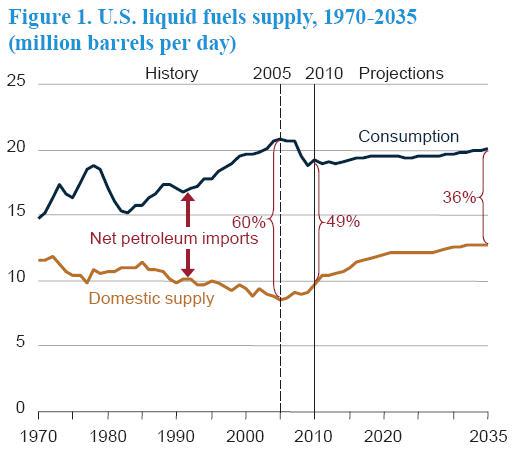
2) EIA states that U.S. oil imports in 2005 = 60% of total consumption, U.S. oil imports in 2010 = 49%, U.S. oil imports In 2035 = 36%.

(Click to expand)

he

3) Bentek states over the next five years the U.S. will see 75 oil pipeline expansions, 25 railroad expansions, and 7 refinery expansions

4) The new kids on the block in terms of shale plays over the next five years taking over from Bakken, Marcellus, and Eagle Ford include Utica in Ohio, Niobrara in Colorado, and Monterey in California.  (Don't forget the father of them all, the Barnett Shale under me here in the Fort Worth Basin.  Peter)

5) EIA slashed the estimate for Marcellus gas shale reserves in its latest 2012 outlook, from 410 Tcf to 141 Tcf.

6) This led to a huge write-down in total U.S. gas shale reserves from 827 Tcf in last year's report to 482 Tcf in the 2012 report

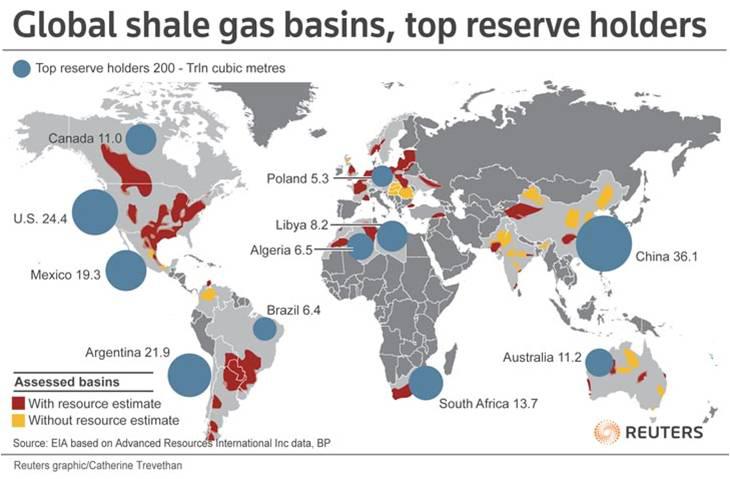
7) According to Reuters / EIA, China is one of the largest holders of gas shale reserves at 1,275 Tcf


8) According to research by IHS CERA, 600k jobs have been created by shale in the U.S., with that set to reach 870k in 2015. This number is set to nearly double to 1.6mln by 2035.  (Someone explain this to the Obama Administration quick.....please.)

9) EIA is calling for shale to make up 49% of natural gas supply by 2035. IHS CERA is calling for this number to be more like 60%

10) EIA expects U.S. oil production to increase by 1.2mbd from 5.5mbpd in 2010 to 6.7mbpd in 2020. Bentek is somewhat more bullish, calling for an additional 2.2mbpd by 2016.

These 10 facts and stats all bode well for the U.S. (...even no.7, as multinational companies pump money into the U.S. / Canada to cut their teeth on joint ventures, before taking what they have learned and applying it globally). As for the downward revisions of estimates of natural gas reserves, they will continue to be revised up and down, but nevertheless new discoveries will be made.

It is impossible to predict whether prices will be dictated by global fundamentals in the future; all that can be said is that the U.S. is becoming increasing less reliant on other countries, and more reliant on itself. That has to be a good thing.

Disclosure: I have no positions in any stocks mentioned, and no plans to initiate any positions within the next 72 hours. 

About the author: Energy Burrito

Energy Burrito picture
Matt Smith spent his twenties working in investment management in London, England, before swapping his bowler hat for a banjo and moving to Louisville, KY, and Summit Energy. Matt is a Commodity Analyst at Summit, and produces a number of pieces of research across a number of global commodities.... More

Friday, February 17, 2012

No Evidence Of Groundwater Contamination From Hydraulic Fracturing

For those interested in the facts and real life applications and experience relating to the practice of hydraulic fracturing, the following study is excellent.
Peter

New Study Shows No Evidence of Groundwater
Contamination from Hydraulic Fracturing


MSC Statement on New University of Texas Report Confirming Fracturing's Safety Record  

Canonsburg, PA – A new report commissioned and funded by the University of Texas at Austin’s Energy Institute provides further, science-based confirmation that hydraulic fracturing “has no direct connection to reports of groundwater contamination.” The group of independent academic experts, along with input from the Environmental Defense Fund, also determined that “Media coverage of hydraulic fracturing is decidedly negative, and few news reports mention scientific research related to the practice,” which is tightly regulated.


Marcellus Shale Coalition (MSC) president Kathryn Z. Klaber issued the following statement regarding the new fact-based study:


“Entirely too often, the debate surrounding the responsible development of shale gas is clouded by rhetoric that is unsupported by the facts, proven data and substantiated science. This new study, however, aims to objectively separate fact from fiction, and does so effectively.

“Not surprisingly, though disappointingly, the study also captures the negative and one-sided nature of the media coverage surrounding shale gas development. Nonetheless, and as laid out in our Guiding Principles, our organization will continue to ‘encourage spirited public dialogue and fact-based education about responsible shale gas development.’”

NOTE
: Click HERE to view the Energy Institute’s press release and HERE for the full study.

Thursday, January 26, 2012

Shale Gas Saves Consumers Billions

Private industry trumps government bailouts, handouts, subsidies and central planning every time.  The abundance of natural gas now being produced through the innovative combination of "horizontal" drilling and hydraulic fracturing is creating a savings of over ONE HUNDRED BILLION DOLLARS to U.S. consumers.  This is money in your pocket to be spent on other  products and services.  It is a direct boost to the economy, and it is not some kind of artificial government stimulus using taxpayer dollars.  It is the real deal, not the usual hot air and empty promises of "green energy" coming from Washington.

To all of you working in the industry of finding, producing and distributing this gas, I salute and congratulate you.  Everyone in this country should know what a fine job you have done.  Certainly other countries all over the world are taking notice.  While I just saw where even former President Clinton is heaping praise on shale gas.  Imagine that.
Peter

Shale Gas $100 Billion Savings to U.S. Exceed Tax Cuts: Energy


January 26, 2012, 9:48 AM EST

By Mark Chediak

Jan. 26 (Bloomberg) -- Natural gas prices that slumped to a 10-year low this month could save U.S. consumers $16.5 billion on home energy bills over the course of a year, according to a senior economist at the U.S. Federal Reserve.


U.S. households might see total savings from lower gas prices of as much as $113 billion a year through 2015, including tack-on effects such as lower product prices and higher wages generated by cheaper fuel, according to energy industry consultants IHS Inc.


The projected savings is “an unbelievable amount of money,” said Greg Ebel, chief executive of Spectra Energy Corp., during a Jan. 17 interview. “That’s better than any tax cut you’ve seen out there, better than any government handout.”

Continue reading here:
 http://www.businessweek.com/news/2012-01-26/shale-gas-100-billion-savings-to-u-s-exceed-tax-cuts-energy.html

Thursday, January 12, 2012

The False Claims Against Fracking: Who And What Is Behind Them

The highly successful process of hydraulic fracturing of subsurface rocks to increase the production of oil and gas has been used for at least 50 years with few problems.  Now it is suddenly being demonized.  One might wonder why.  The following article offers a few clues.

Is this political and not scientific?  Of course.  That is par for the course from the liberal or ironically-named "progressive" side of the political spectrum.  It is sad that more people cannot see through the charade represented by activities like Al Gore's global warming crusade.  It also makes one wonder what our young people are being taught in school that allows them to be so easily fooled and manipulated.
Peter


January 12, 2012

Scientists Discover Gassy Liberal Pseudo-Science

By John Ransom

source:
 http://finance.townhall.com/columnists/johnransom/2012/01/12/scientists_discover_gassy_liberal_pseudoscience
1/12/2012
The science portal New Scientist reported yesterday that the much-publicized risks involved in the natural gas recovery method of “fracking” have been exaggerated according to British geologists.


“Frack away, there's no reason not to,” writes New Scientist. “Two of the main objections to ‘fracking’”- [earthquakes and well-water contamination] - “have been blown out of proportion, according to British geologists… ‘We think the risk is pretty low,’ said Mike Stephenson, head of energy science at the British Geological Survey at a press briefing in London on Tuesday.”


Fracking involves boring into shale deposits with water, chemicals and particulates in order to open seams to allow the escape of natural gas, oil and other fossil gases for recovery as fuel. Huge new reserves of energy have been found in the US over the last decade that can only be recovered by fracking. These reserves have the potential to supply hundreds of years of energy for the US, meaning the country can import less energy from foreign sources, even if domestic sources are only partially developed. The discovery is a threat to liberals because it could upset the bedrock liberal scam that we have to ration everything, including energy.


As conservative George Will noted at the beginning of the year:


Because progressivism exists to justify a few people bossing around most people and because progressives believe that only government’s energy should flow unimpeded, they crave energy scarcities as an excuse for rationing — by them — that produces ever-more-minute government supervision of Americans’ behavior.


Accordingly, liberals have been pushing for a ban on fracking, also called hydraulic fracturing, because of supposed health and environmental risks the method poses. Those risks have been widely hyped via the liberals’ new scientific peer-reviewed media of the docu-drama.


Following the stunning success of Al Gore’s fictional docu-drama, An Inconvenient Truth, a movie about- gasp!- GLOBAL WARMING, a film that relied more on hyperbole than on hypothesis- one science site counted 35 scientific errors in the film before they got through the opening credits- liberals have made a cottage industry of creating pseudo-science through the media magic of the docu-drama.


Peer-review for such efforts have widely consisted of 1) Approval by the Nobel Committee, which is controlled by the Labour and Socialist parties of Norway (really) and; 2) Glowing reviews by the New York Times, which publication is probably way too conservative for the Labour and Socialist parties of Norway.


One such film is Gasland, an expose that uses pyrotechnic effects to “prove” that fracking is turning water into fire around the country. The film, created by Josh Fox, an actor who the New York Times called "one of the most adventurous impresarios of the New York avant-garde," is an avant-garde and adventurous look at the science behind hydraulic fracturing- that is, if you translate avant-garde as “completely fictionalized.”


Liberals don’t think it’s necessary to have scientists investigate the claims made in Gasland, especially when they can "prove" the claims by movie magic created by a celebrated actor, playing a pseudo-scientist-slash-activist who is supported in part by “five grants from the National Endowment for the Arts” and enjoys support from the nephew of George Soros. Really.


Speaking scientifically, that's really impressive. Who needs scientists when you have "brilliantly resourceful mastery of stagecraft" that Josh Fox brings and the popcorn is paid for by taxpayers? Science no longer represents the quest for truth, but only what you con someone into believing. Then all you have to do is manipulate data until you get the result you want.


Well apparently, at least New Scientist still has room for, um, old-fashioned science that relies on objective data.


The idea that fracked methane leaks into drinking water was popularised by the documentary film Gasland, in which a resident of Pennsylvania sets his tap water alight. On Tuesday, Stephenson said he could not comment on this specific case, but that such contamination is unlikely.


Peer-reviewed research on methane contamination is scarce but what little there is suggests fracking is not to blame.


The publication also points out that earthquakes that have been blamed on fracking have been exaggerated.


While earthquakes have happened as a result of fracking, they have been no different than similar temblors caused by- gasp!- COAL MINING. Remember: COAL MINING has been linked to GLOBAL WARMING by ALGORE in a peer-reviewed movie.


Still, the settled science on fracking has not stopped states from banning fracking or investigating the banning of fracking. Governor Chris Christie in New Jersey recently pushed through a ban on fracking in the state of New Jersey. Ohio and New York banned fracking as well. Municipalities in Colorado have asked the state to allow them to ban fracking locally since the state is likely to allow fracking to continue. The docu-drama that currently masquerades as the country of France has also banned fracking.


Instead they prefer to import oil from Libya.


The 30,000 killed, 20,000 wounded in Libya, I guess, is a better price to pay than acknowledging the flaws in the scientific non-science from the left presented on TV, at the theater and in the news.


It may not be true, but it sure is brilliantly resourceful stagecraft.


For liberals who have oh'ed and aw'ed at the Styrofoam columns that have held up Obama's presidency, truth isn't wanted, only stagecraft.


John Ransom

John Ransom is the Finance Editor for Townhall Finance. You can follow him on twitter @bamransom and on Facebook: bamransom.

Saturday, October 1, 2011

The Blind Leading The Blind: Obama Administration's Energy (and economic) Policy

Why is the truth about energy so difficult to obtain?  It is fairly simple, as the following article makes abundantly clear.  "Green Energy" such as solar, wind, geothermal, and biofuel is not working.  It can not and will not work, even when subsidized with BILLIONS of taxpayer dollars, given above or below the table.  (Fallout from Solyndra Bankruptcy Continues, Stirling Files for ... 
SustainableBusiness.com - 781 related articles)

Yet hydraulic fracturing, (fracking) is proven to greatly increase the productivity of oil and gas-bearing rocks and has been quietly and safely used for decades.  Tens of thousands of jobs are being created and Billions of dollars of revenue is being collected by local, state, and Federal governments.  Natural gas for heating, cooling, transportation, and manufacturing is cheap and abundant.   America is becoming less dependent on "foreign oil".  These are all obvious positive truths. 

So why is fracking suddenly and viciously being attacked by the Obama Administration and their obedient propaganda tools known as the "mainstream media" (NBC, MSNBC, ABC, CBS, CNN, etc.)?  Why is the Obama Administration not telling, promoting, and following these simple truths about energy?  Surely they are not simply THAT naive, inexperienced, and ignorant.  Does Obama owe that much to his fanatical "environmental" supporters that he is willing to watch the American economy collapse?  Will the truth be told that Obama's policies are hurting people and having exactly the opposite effect of what he promised would happen if elected?

So what is going on here?  What is really going on and why?  That's anther story and question.  Any ideas?
Peter


What the Frack is Going on Here?


By Paul Driessen

10/1/2011 http://townhall.com/columnists/pauldriessen/2011/10/01/what_the_frack_is_going_on_here/page/full/

Hydraulic fracturing sends “huge volumes of toxic fluids” deep underground at high pressure, to fracture shale rock and release natural gas, Food & Water Watch claims. “Billions of gallons of toxic fluids” will “contaminate” groundwater and drinking water “for generations.” We need to “Ban Fracking Now.”

Environmentalists used to support “clean natural gas.” Whence the intolerant new attitude?

Oil companies have been using hydraulic fracturing for 60 years to get the most petroleum possible from grudging rock formations deep beneath the Earth. A few years ago, Mitchell Energy and others combined HF with horizontal drilling to tap into hydrocarbon-rich shale deposits that previously refused to surrender their energy riches. Countless fracking operations later, the results have been spectacular.

Tapping the Marcellus, Bakken, Barnett, Haynesville and other formations has created jobs, generated revenues and rejuvenated moribund industries in many states that have shale deposits or manufacture the fluids, pipes and other equipment used in these operations. US natural gas production and estimated reserves have soared, and wellhead prices have dropped from $11 per thousand cubic feet in 2008 to $4 today. Canada is actively drilling, while Poland and Britain are evaluating early exploration results.

The Fort Worth (Texas) Chamber says fracking supports 110,000 direct and secondary jobs in the region and added billions in property and sales tax revenues. Loren C. Scott & Associates calculates that shale drilling has added $11 billion to Louisiana’s economy. Pennsylvania’s Labor and Industry Department reports that HF has already generated 72,000 jobs and $1.4 billion in state tax revenues, and could bring another $20 billion by 2020. West Virginia and North Dakota report similar success.


Soaring supplies and plummeting prices have persuaded Dow, Shell, Sasol, Ormet and other companies to open, reopen or expand plants to produce ethylene, petrochemicals, aluminum – and more jobs.

That’s excellent energy and economic news, at a time when we sure could use a little good news.

Certainly, with all this activity going on – much of it in states that haven’t seen much drilling in decades, if ever – there is a clear need for regulations and oversight. We need to ensure that drilling and fracking are done properly, and chemicals are handled, disposed of and recycled correctly, to prevent harm to human health, wildlife habitats and environmental quality. While most shale gas deposits are thousands of feet below groundwater aquifers and drinking water supplies, we need to ensure that well casings are properly installed and cemented, so that there is no danger of contamination.

But to ban hydraulic fracturing – and abandon these revenues and jobs? What the frack is going on here?

Think about it. This is free enterprise in action. It pays its own way. It doesn’t need subsidies, mandates, tariffs, or bureaucrats and politicians deciding which companies and industries win or lose. HF generates real, sustainable jobs, plus significant tax and royalty revenue, right here in America. It provides energy that works 24/7/365 … and is far cheaper than land-hungry wind turbine and solar panel installations. In fact, the shale gas revolution is making it even harder to justify these “renewable energy alternatives.”

Natural gas, specifically shale gas, is essential for powering backup generators for unreliable wind and solar installations. However, low gas prices make wind and solar even less competitive. The better solution is just to go with gas, coal and nuclear for electricity generation, and forget about expensive, eco-unfriendly, subsidy-dependent, crony capitalist wind and solar.

HF also demolishes the “peak oil and gas” mantra that we are rapidly running out of hydrocarbon energy, which further demonstrates that geologist Wallace Pratt was right when he said “Oil is first found in the minds of men.” Once companies devised new ways to extract shale gas bounties, vast new reserves became available.

Today, in reality, the only reason we might run out of energy is that government won’t let us drill.

People want and need reliable, affordable power. Many environmentalists support Paul Ehrlich’s opposite sentiment, that “giving society cheap energy is like giving an idiot child a machine gun.”

No wonder unrepentant fossil fuel haters are going ballistic over fracking.

The rest of us just want honest answers, carefully conducted drilling, fracking and production operations – and the benefits that come with them. Thankfully, the facts are relatively easy to find.

The Wall Street Journal laid many out clearly and forcefully in a June 2011 editorial, “The facts about fracking: The real risks of the shale gas revolution and how to manage them.” Whether it’s cancer, drinking water contamination, toxic or radioactive chemicals, earthquakes or regulations – the truth is miles from the misrepresentations, hysteria and fear-mongering propagated by Food & Water Watch and similar groups.

People who want to know how hydraulic fracturing is actually done – and what chemicals are actually used, even in specific states – can find a wealth of information at well-designed industry websites provided by Chesapeake Energy, the Ground Water Protection Council and Halliburton.

As the Halliburton site notes, 99.5% of fracking fluids is water and sand (the sand is carried into fractures, to keep them open and release the gas). However, forcing that fluid mix down wellbores and into solid rock formations thousands of feet underground requires advanced engineering and special chemicals to:

* Keep the sand suspended in the liquid, so that it is carried deep into the fractures;

* Fight the growth of bacteria in the fluid and wellbore, so that gas flows and pipes don’t corrode; and

* Reduce the surface tension of water that comes in contact with the reservoir, to improve gas production.

Different subsurface rock formations and conditions require different formulations for the 0.5% of the HF fluids that involves special chemicals. In the past, diesel oil and various industrial chemicals were used. Today, to an ever-increasing degree, the chemicals are borrowed from the food and cosmetics industry. The technical names sound daunting or even scary (inorganic acids, polysaccharide polymers and sulfonated alcohol, for instance), but these CleanStream chemicals (Halliburton’s terminology) are found in cheese and beer, canned fish and dairy desserts, and marshmallows and shampoo, respectively.

Even these three chemical groups (and other food and cosmetic chemicals) are classified as “hazardous” by the EPA and FDA, because in high doses some can cause cancer and other problems in animals. So you could say Food & Water Watch is technically correct when it tries to scare people by saying fracking fluids contain “toxic chemicals.” But the same point would apply to alcoholic beverages, fruit juices, lip liners, food starch, hand soap and countless other everyday products. Should we ban them too, along with coffee, broccoli and other foods that naturally contain even more potent carcinogens?

In other advanced techniques, instead of chemical biocides to kill bacteria, some systems now employ ultraviolet light, and mobile units now allow crews to treat and reuse water, reducing the amount of freshwater required in fracking. Other improvements are being made on a regular basis, as explained in simple lay terms on websites like those mentioned above. You can even find psychedelic 3-D maps of hydraulic fracturing operations and explanations of other fascinating technologies.

New York and other states, the Delaware River Basin Commission, Canadian provinces, Britain, Poland, the European Commission, and many Asian and Latin American countries are pondering HF as part of the solution to their energy, unemployment, economic and revenue problems. Getting the facts is essential.

Shale gas is an energy policy game-changer. The last thing we need is more laws, regulations and policies based on misrepresentations and fabrications from outfits like Food & Water Watch.


Paul Driessen

Paul Driessen is senior policy adviser for the Committee For A Constructive Tomorrow (CFACT), which is sponsoring the All Pain No Gain petition against global-warming hype. He also is a senior policy adviser to the Congress of Racial Equality and author of Eco-Imperialism: Green Power - Black Death.