Showing posts with label compressed natural gas. Show all posts

Wednesday, April 11, 2012

Hope For The US Economy Lies In Increasing Oil and Gas Production

The following is a well written, researched and balanced summary of the current state of affairs in the United States regarding our energy situation.  The focus is on oil and gas, but of course all of our sources of energy are intertwined.

One thing I find moderately amusing is that the myth of burning fossil fuels and the release of "fossil" carbon dioxide (CO2) is causing damaging global warming and climate change, will just not die.  The myth is so deeply embedded into people's consciousness by the decades-old propaganda put out by the environmental lobbyists, that even so-called "objective" journalists like the author of the following article, just won't let it go.  Someone said "a lie told often enough becomes accepted as fact".  Maybe that is what has happened.

Anyway, I liked the the article and I consider it a rare example of something accurate and politically neutral coming from the New York Times, which often times I can barely read because of its transparent liberal bias.
Peter

Go here to read more: http://www.nytimes.com/2012/04/11/business/energy-environment/energy-boom-in-us-upends-expectations.html?pagewanted=1&_r=1&nl=todaysheadlines&emc=edit_th_20120411&ref=businessspecial2&adxnnlx=1334160224-BLqeHLoa65Qov22Pwxzh6A


April 10, 2012

Fuel to Burn: Now What?

THE reversal of fortune in America’s energy supplies in recent years holds the promise of abundant and cheaper fuel, and it could have profound effects on what people drive, domestic manufacturing and America’s foreign policy.
       
Cheaper fuel produced domestically could reduce the cost of shipping and manufacturing, trim heating and cooling bills, improve the auto market and provide tens of thousands of new jobs.
It might also pose new environmental challenges, both predictable and unforeseen, by damping enthusiasm for clean forms of energy and derailing efforts to wean the nation from its wasteful energy habits.
       
But for Americans battered by rising gasoline prices, frustrated by the dependence on foreign oil, skeptical of the benefits or practicality of renewable fuels and afraid of nuclear power, the appeal of plentiful domestic oil and gas could far outweigh the costs.
       
Just a few years ago, the dominant theme in discussions about energy was of declining production and the fear of running out of oil. Even today, political tensions in the Middle East, particularly in the Persian Gulf, have fanned fears of supply disruptions that are keeping prices high.
But a new boom in energy production in recent years has upended these expectations in record time. High energy prices led to a wave of successful oil and gas exploration in North America, including in fields that were deemed uneconomical only a few years ago. Using techniques like horizontal drilling and hydraulic fracturing, oil companies are tapping into deeply buried reserves in shale rocks and in the ocean’s depths.
       
The surge in energy prices, along with a recession and new government rules that tightened fuel-economy standards, led to a sharp cutback in gasoline consumption. This decline in demand in the last five years reversed decades of almost uninterrupted growth that made the United States the world’s top energy consumer, accounting for one in every four barrels of oil burned around the globe.
The North American energy revival is primarily the result of so-called unconventional sources of energy — like shale oil and shale gas across the United States, oil sands in Canada and deepwater production in the Gulf of Mexico. In the last five years, the United States and Canada combined have become the fastest-growing sources of new oil supplies around the world, overtaking producers like Russia and Saudi Arabia.
       
“The transformation unfolding in North America represents a potentially decisive shift in the history of energy,” Rex W. Tillerson, the chairman and chief executive of Exxon Mobil, who is not usually given to hyperbole, said in a speech in Houston last month.
       
Ed Morse, head of global commodity research at Citigroup and a longtime energy analyst, says North America has the potential to become a “new Middle East.”
       
“The reduced vulnerability of North America — and the world market — to oil price spikes also has deep consequences geopolitically, including the reduced strategic importance to the U.S. of changes in oil- and natural gas-producing countries worldwide,” Mr. Morse said in a recent 92-page report called Energy 2020. ”Pressures towards isolationism in the U.S. will likely grow, with consequences for global stability that can only just begin to become understood.”
       
“The only thing that could stop this is politics — environmentalists getting the upper hand over supply in the U.S., for instance,” the report said.
       
The new supplies ensure that the United States will remain well entrenched in oil, but the continuing reliance on fossil fuels also carries significant environmental concerns — whether from the risk of offshore drilling, or the hazards, many still unknown, of hydraulic fracturing. It also means that greenhouse gas emissions will most likely increase, at least until carbon emissions are capped or new technology to store carbon dioxide underground is developed.
       
The glut of natural gas supplies cuts two ways on emissions. It has effectively put an end in the United States to any new investment in coal plants, which produce much more emissions. But it also makes the economics of alternative, noncarbon energy sources like wind power or solar power difficult to justify without public support and subsidies.


And with gasoline prices above $4 a gallon, the nation’s energy resources remain a polarizing topic, pitting Republicans against Democrats, environmentalists against oil companies, and conservationists against advocates of unfettered drilling.
       
“It is remarkable how quickly perceptions have changed,” says Guy Caruso, the administrator of the United States Energy Information Administration from 2002 to 2008, who is now at the Center for Strategic and International Studies. “We may be in the early stage of this transformation, and clearly things could still go wrong.”
       
Energy production is an inherently risky business, but recent history suggests that when resources are available they end up being developed.
       
After the explosion of BP’s deepwater well two years ago in the Gulf of Mexico, leading to the biggest oil spill in American history, the Obama administration imposed a moratorium on offshore drilling. But it took only about a year for exploration and production to resume offshore.
       
Cheaper energy costs — particularly for natural gas — would benefit a variety of domestic industries, like chemicals, pharmaceuticals and fertilizers. The rise in natural gas production has already led many utility companies to shift their electrical production away from coal; it also calls into question talk of a nuclear revival in the United States.
       
Economists say that ample gas supplies might also provide the basis for a resurgence of American manufacturing, which has been battered by high energy costs for much of the last decade.
Natural gas prices have fluctuated wildly in recent years, rising to $14 for a thousand cubic feet from $2 within a few years. The current glut, however, has driven prices back down again, to near $2 for a thousand cubic feet.

With America becoming one of the top natural gas producers, some domestic companies might rethink moving parts of their business to countries with cheaper energy costs. (At current consumption rates, American gas reserves would last at least 75 years, an estimate some experts say is conservative.)
Lower natural gas costs would also have cascading benefits to other commercial sectors, like retailing. Shipping costs may be lower, particularly if transportation companies shift their fleets to natural gas-powered or electric vehicles. FedEx, for instance, has already been adding clean energy trucks to its fleet, including hybrid and all-electric delivery trucks in cities like Chicago.

Citigroup estimates that as many as 3.6 million new jobs might be created by 2020 thanks to the energy boom. The current trade deficit might fall by 60 percent by the end of the decade from today’s level, according to the bank’s estimates, and the dollar could appreciate by as much as 5.4 percent as imports shrink.

“In a world of high energy prices, the potential economic activity generated by this wave of new hydrocarbon production is extraordinary and should strongly boost national output, increase incomes, create wealth, stimulate consumption and create jobs,” according to Citigroup.
Given how swiftly expectations have shifted to describe America’s energy prospects, however, some caution may be warranted.
       
Opposition from environmental groups and concerns about climate change — which is caused by increased carbon emissions from fossil fuels — could lead to tighter regulation of petroleum products or derail infrastructure projects like pipelines.
       
That is what has happened to the extension of the Keystone XL Pipeline, which its supporters say is needed to increase the import of oil from Canada’s oil sands into the United States. That project has faced stiff opposition from environmental groups because oil sands are more energy-intensive and emit more carbon dioxide into the atmosphere than traditional oil sources.
       
The increased reliance on these unconventional oil sources, including oil sands and shale oil, has led some energy experts to talk about a “re-carbonization” of energy supplies if that reliance distracts from the need to develop renewable fuels.
       
“As we run out of conventional fossil fuels, we face some fundamental choices,” said Dan Lashof, the climate program director at the Natural Resources Defense Council. “Are we going to switch to cleaner energy sources, or are we going to switch to dirtier energy sources? That’s why the Keystone pipeline was so hard fought. It’s because we face a real fork in the road. And depending which way we go, solving our environmental problems might become impossible.”
Environmental groups are also concerned about the effects on underground aquifers of hydraulic fracturing — in which water under high pressure is used to break apart shale rocks to release natural gas.
While natural gas emits less carbon dioxide than coal when burned for electrical production, which has led producers to try to brand it as a “clean” energy source, it remains a fossil fuel that emits carbon into the atmosphere when burned. Because it is suddenly plentiful, and relatively cheap, doubts have been raised about future investments in renewable power sources that had been favored to replace coal.      
“Cheap natural gas has delivered significant near-term environmental benefits, but it clouds the outlook for renewable energy,” said Trevor Houser, a partner at the Rhodium Group, an economic research firm. “Without an extension of current tax credits or adoption of new pro-renewables policy, wind power and other renewable energy sources will have a tough time competing with natural gas in the years ahead.”

Geologists have long known that shale basins across the country, like the Bakken field in North Dakota, Eagle Ford and Barnett in Texas, and the Marcellus in the Northeast, held tremendous oil and gas reserves. But energy companies had no economic way to collect them until new technology recently changed that.
       
The results have been impressive. Production from the Bakken region alone has gone from negligible quantities to 500,000 barrels of oil a day in just a few years. Production at Eagle Ford produced just 787 barrels in 2004. Last year, its production reached 30.5 million barrels, according to state regulators, and it is still growing. Natural gas production there went from nothing to 243 billion cubic feet in just three years.   (Not bad Ken)

The National Petroleum Council, an industry-led group that provides advice to the secretary of energy, recently outlined its view of how the nation’s larger-than-expected resource might be developed.
In a major study released last year, the group forecast that North American oil production might exceed 20 million barrels a day by 2035 under a “high potential” situation of unfettered access.
However, under a “limited” situation where production was constrained for a variety of environmental or political reasons, domestic supplies might fall to less than 10 million barrels a day.
       
Some experts are more bullish. Mr. Morse of Citigroup forecast that North American oil production could reach an astounding 27 million barrels a day by 2020, almost twice the rate of production of 15 million barrels a day at the end of 2011. Production from the United States could grow to 15.6 million barrels a day by 2020, up from nine million barrels a day in 2011.

If that trend continues, the growth in oil and natural gas supplies in the next decades could turn the United States into a top energy exporter, rivaling some members of the Organization of the Petroleum Exporting Countries. Natural gas could be sold to Mexico and Canada (because exploiting oil sands is so energy-intensive, Canada might have to import natural gas to produce its oil). Refined petroleum products, and even crude oil, could find customers in Europe and Latin America. Coal could be exported to China.
       
With less gasoline demand, the nation’s surplus refining capacity means the United States is already exporting petroleum products — like gasoline and diesel. The United States is now the top exporter of refined products, just ahead of Russia.
       
The United States has been a net oil importer since the middle of the last century. America’s dependence on imports grew as the country’s consumption rose and domestic production dropped, and reached a peak in 2005. That year, domestic consumption of oil was about 21 million barrels of oil a day — a quarter of global oil demand. More than two-thirds of that was imported.
But this was most likely the high-water mark for oil imports, at least in the foreseeable future. The nation’s oil consumption has since fallen by about three million barrels a day as consumers cut back on their gasoline use.

Analysts say this trend is actually deep-seated, and is likely to continue. Americans are buying fewer cars, and they are driving shorter distances. The average distance traveled peaked at 12,500 miles a year in 2003, according to Citigroup, and could fall to 11,600 miles a year by 2020.
At the same time, federal fuel-efficiency standards are being tightened. The Obama administration and automakers last year agreed to new fuel-efficiency targets, aiming to raise the Corporate Average Fuel Efficiency, or CAFE, standard to 54.5 miles per gallon by 2025, with the goal of saving 12 billion barrels of oil over the life of the program.

Political attitudes, once hard and fast, are undergoing a transformation.
“For 20 years, Democrats opposed opening public lands to oil production and Republicans opposed increases in fuel economy standards, but the run-up in oil prices shattered all that,” said Paul W. Bledsoe, a senior adviser at the Bipartisan Policy Center, a research group in Washington. “The shift in politics was amazingly swift. As was the change in psychology, where the United States was viewed as an energy-depleted nation, to the view now of an energy-rich superpower.”
       
The rise in fuel efficiency in conventional vehicles, along with the growing popularity of hybrids, could also mean all-electric cars will struggle to gain much market share, according to a report released last year by the Boston Consulting Group. In fact, the report found that by 2020, electric cars in the United States would account for a lower share of the market than in either China or the European Union, where they are likely to benefit from government support.

Assessing falling American dependence on foreign oil, analysts with the financial firm Raymond James said imports fell from 65 percent of demand, or 13.5 million barrels a day, their peak in 2005, to 9.8 million barrels a day in 2011, or 52 percent of demand. They predicted that imports would keep falling, reaching 4.5 million barrels a day — or just a quarter of domestic oil demand — by 2015. By 2020, they forecast, the United States would not need to import foreign oil anymore.
       
“The resulting savings from the standpoint of the trade deficit are highly meaningful,” the analysts said, “especially when the benefits of cheaper energy for domestic manufacturing are taken into account. Maybe the real question is, When will Washington apply to join OPEC?”
While the question is provocative, the change in outlook for domestic supplies, along with the changed role of the United States in global energy markets, carries important economic and geopolitical lessons.
       
Nationalism over natural resources in countries like Venezuela, Russia and much of the Middle East has increasingly forced Western oil companies to look for oil and gas closer to home. And exports are already shrinking for many OPEC producers as their own domestic demand soars — a result of energy subsidies that keep prices artificially low.
       
It is still too early to get a clear sense of the political implications of this reduced reliance on oil from places like the Middle East. Four of the top five sources of foreign oil to the United States are already outside the Middle East — Canada, Nigeria, Venezuela and Mexico. The fifth is Saudi Arabia.
James Brick, an energy analyst with Wood Mackenzie, a research firm, said in a recent report that by 2030 the United States could end up exporting 500 million tons of coal a year, 3.2 billion cubic feet a day of natural gas and 2.5 million barrels a day of oil products.
       
“The United States will be playing a very different role on the energy markets, a much more international role and a much more complicated and sophisticated one,” said Mr. Brick. “As with any forecast there are uncertainties but no matter how you cut it, the United States has the resources in the ground.”


Wednesday, March 7, 2012

GM Is Catching On....Dual Fuel Pickups, Compressed Natural Gas Or Gasoline

I want one......to heck with those itty-bitty death trap electric toy cars......
Peter

Posted Monday, Mar. 05, 2012
General Motors plans to begin taking orders in April for pickups that run on both gasoline and compressed natural gas, potentially reducing costs for users.

The Chevrolet Silverado and GMC Sierra 2500 HD extended-cab pickups will be offered with a 6.0-liter, V-8 engine that can "seamlessly" transition between natural gas and gasoline, the Detroit-based automaker said today.

A vehicle such as the ones GM will offer can save a driver $6,000 to $10,000 in fuel costs over a three-year period because CNG is cheaper than gasoline, said Joyce Mattman, director of GM commercial product and specialty vehicles.
more here

Tuesday, February 28, 2012

Natural Gas, A Real "Alternative" Fuel For Vehicles

Natural gas, because of its clean burning characteristics, has long been used to power vehicles such as fork lift trucks inside warehouses.  Consider how clean burning natural gas is, many of us cook our food over natural gas stoves in our enclosed kitchens.  Now that we have an abundance of gas, thanks to the combined technologies of horizontal drilling and hydraulic fracturing, why not use this gas to power our cars and trucks, in addition to generating electricity and heating our homes as is already being done.  It makes sense to me and many others.

Now this gas is being used to power vehicles in Louisiana, by EnCana, ironically, a Canadian company.  They produce a lot of gas in Louisiana from horizontal wells drilled in the Haynesville Shale.  (Some of which I proudly helped steer while drilling.)  The following article comes from "The Shreveport Times" and shows and describes what EnCana has going.  This was not done because of Federal government subsidies, or even encouragement for that matter, just intelligent free market enterprise.  Do you hear that Mr. Obama?  This is economic activity, job creation, and wealth building you can count on.  Fire all your current advisers, they don't have any idea what they are doing.
Peter


source: http://www.shreveporttimes.com/article/20120225/NEWS01/202250325/DeSoto-LNG-station-first-Louisiana

DeSoto LNG station first in Louisiana

NEAR FRIERSON — A liquefied natural gas fueling station formally opened Friday by EnCana Natural Gas Inc. at the Relay Station holds the distinction of many "firsts." It's the first:
  • LNG station open in Louisiana.
  • Public LNG station in the U.S.
  • Location for Heckmann Water Resources to use LNG trucks.
And when the Relay Station in a couple of months opens its compressed natural gas pumps, the facility will be the first in the state to offer four fueling options: LNG, compressed natural gas, or CNG, gasoline and diesel.

(continued)

Thursday, February 23, 2012

Peak Oil? What Peak Oil? When?

Basically I think the following ten points about oil and gas production are correct.  The relatively new process of combining horizontal drilling to provide much greater access to oil and gas reservoirs, combined with multi-stage hydraulic fracturing to enhance flow rates is, as they say, a dramatic "game changer" in America's quest for energy independence.

It is not just the technology that makes this so exciting.  From this geologists perspective, what is really significant is this production is coming from organic-rich shales, arguably the most abundant sedimentary rock type on Earth.  Throw out all the old rules of exploration requiring source rock, maturation, migration, reservoir, structural trapping mechanism, and sealing rocks.  It is much simpler now.  What "Peak Oil"?  It's a brand new ball game.  Re-set the scoreboard, go long the drillers and oil field service companies.  Gentlemen (and women), start your engines.
Peter


10 Points To Consider When Examining The U.S. Quest For Energy Independence

http://seekingalpha.com/article/384031-10-points-to-consider-when-examining-the-u-s-quest-for-energy-independence?source=email_macro_view&ifp=0

We are currently at a time when domestic gasoline and diesel prices follow global fundamentals rather than domestic supply / demand dynamics. We are also at a juncture where natural gas is set to either remain a domestic fuel or become a global piece of the puzzle through LNG exports. At this time of uncertainty, it is good to take a step back and review the facts and forecasts to consider whether the U.S. can become energy dependent, and even if it does, will prices still be dictated on a global scale?

1) Oil production in North Dakota, has surpassed that of Opec member Ecuador, and is set to become the second largest oil producing state in the U.S. this year, surpassing Alaska and California.

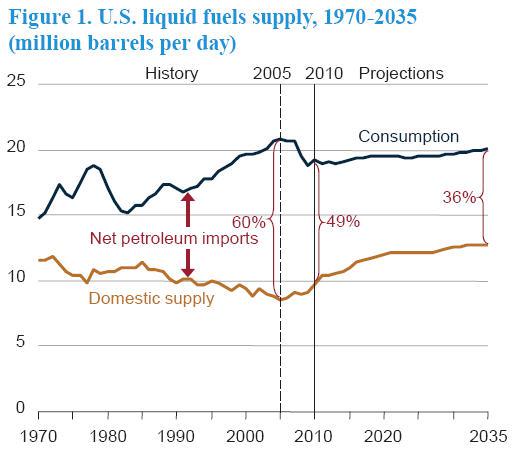
2) EIA states that U.S. oil imports in 2005 = 60% of total consumption, U.S. oil imports in 2010 = 49%, U.S. oil imports In 2035 = 36%.

(Click to expand)

he

3) Bentek states over the next five years the U.S. will see 75 oil pipeline expansions, 25 railroad expansions, and 7 refinery expansions

4) The new kids on the block in terms of shale plays over the next five years taking over from Bakken, Marcellus, and Eagle Ford include Utica in Ohio, Niobrara in Colorado, and Monterey in California.  (Don't forget the father of them all, the Barnett Shale under me here in the Fort Worth Basin.  Peter)

5) EIA slashed the estimate for Marcellus gas shale reserves in its latest 2012 outlook, from 410 Tcf to 141 Tcf.

6) This led to a huge write-down in total U.S. gas shale reserves from 827 Tcf in last year's report to 482 Tcf in the 2012 report

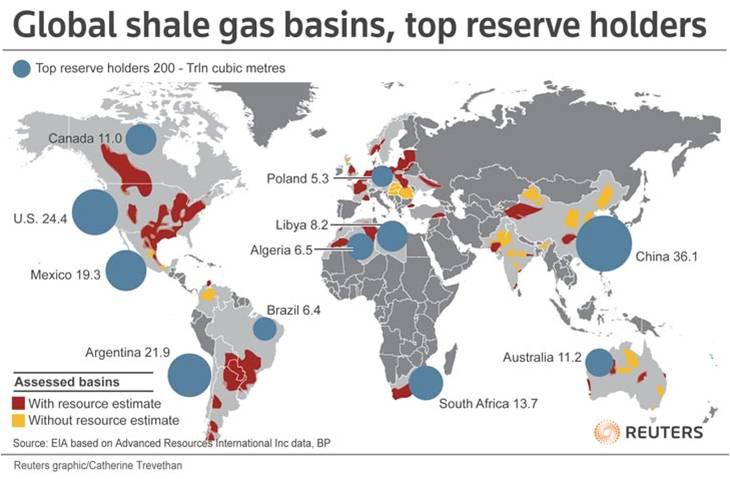
7) According to Reuters / EIA, China is one of the largest holders of gas shale reserves at 1,275 Tcf


8) According to research by IHS CERA, 600k jobs have been created by shale in the U.S., with that set to reach 870k in 2015. This number is set to nearly double to 1.6mln by 2035.  (Someone explain this to the Obama Administration quick.....please.)

9) EIA is calling for shale to make up 49% of natural gas supply by 2035. IHS CERA is calling for this number to be more like 60%

10) EIA expects U.S. oil production to increase by 1.2mbd from 5.5mbpd in 2010 to 6.7mbpd in 2020. Bentek is somewhat more bullish, calling for an additional 2.2mbpd by 2016.

These 10 facts and stats all bode well for the U.S. (...even no.7, as multinational companies pump money into the U.S. / Canada to cut their teeth on joint ventures, before taking what they have learned and applying it globally). As for the downward revisions of estimates of natural gas reserves, they will continue to be revised up and down, but nevertheless new discoveries will be made.

It is impossible to predict whether prices will be dictated by global fundamentals in the future; all that can be said is that the U.S. is becoming increasing less reliant on other countries, and more reliant on itself. That has to be a good thing.

Disclosure: I have no positions in any stocks mentioned, and no plans to initiate any positions within the next 72 hours. 

About the author: Energy Burrito

Energy Burrito picture
Matt Smith spent his twenties working in investment management in London, England, before swapping his bowler hat for a banjo and moving to Louisville, KY, and Summit Energy. Matt is a Commodity Analyst at Summit, and produces a number of pieces of research across a number of global commodities.... More

Thursday, April 21, 2011

Save New York....and America: Allow "Fracking" and Oil an Gas Production

Are Americans going to allow a few ideological environmentalists with dubious motives further damage our economy, put us deeper in debt, cause more job losses, and prolong the recession?  Isn't America's real problem with our spend and (over) regulate politicians in Washington, DC?

It is the height of folly to forgo developing our own oil and gas resources while sending our money and jobs to foreign producers.  What can the average person do about rising energy and commodity prices?  First vote the current naive, anti-growth politicians out of office, in your hometown, your state and in Washington.  Replace them with optimistic people with can-do attitudes.  America can fight its way out of this economic morass we are in, or we can lie down and die.  I choose to fight.  I owe at least that much to my forefather(s).

The follow editorial summarizes the issue quite well.  Support Rep. Thomas Reed New York.
Peter

Published on Washington Examiner (http://washingtonexaminer.com)
--------------------------------------------------------------------------------

By The Examiner and by
Rep. Thomas Reed, a Republican who represents New York's 29th Congressional District.


Created Apr 14 2011 - 8:05pm

New York - and America - can profit from 'fracking' Marcellus Shale

It's no secret that we live in challenging times. Many sectors of our economy continue to struggle and our dependence on foreign energy sources continues to grow. However, there is some good news. Responsible development of the Marcellus Shale natural gas field has tremendous potential to help meet both of these challenges, and many, many more.

In 2009, the production of Marcellus Shale in Pennsylvania had an economic output of more than $3.8 billion, and generated more than $400 million in state and local tax revenues, while creating 48,000 new jobs. There is no reason to believe that we wouldn't see a similar positive effect in New York.


We need this economic development. The 2010 census numbers released recently were, unfortunately, no surprise. Western New York and the southern tier of New York experienced concentrated levels of population decline.


I don't believe this is because people don't want to live here, but because they cannot find substantial employment to support their families. It's quite simple: People go where the jobs are.


Penn State recently determined that counties in Pennsylvania where Marcellus development has taken place saw, on average, an 11 percent growth in sales tax revenue. Our local governments could derive much needed revenue from Marcellus Shale production.


Some fear hydraulic fracturing. The Finger Lakes region is my home. We all agree that we need to keep our natural resources safe and free from pollutants. The reality is that hydraulic fracturing has been used for more than 60 years on more than one million wells nationwide.


New York has a long association with gas production. For decades, producers developed natural gas resources from rock strata residing thousands of feet below the Marcellus, tapping formations such as the Trenton Black River and the Medina.


Nevertheless, concerns regarding groundwater contamination exist. Geologists tell us that our groundwater aquifer is thousands of feet above the shale containing natural gas and is separated by thousands of feet of impermeable rock.


This virtually eliminates any potential risk of groundwater contamination from the process of hydraulic fracturing. Further, the New York State Department of Environmental Conservation is no shrinking violet.


The DEC has a long, effective record of monitoring the energy industry. It will ensure that exploration and extraction is done safely.


The Pennsylvania Department of Environmental Protection just completed a study that found no radiation problem with drinking water in any of the seven rivers tested.  Any risk from industry wastewater is further mitigated by the fact that more fracturing fluid is being recycled and never goes to water treatment plants. Pennsylvania natural gas producers are recycling as much as 90 percent of their wastewater, an amount predicted to increase.


The same holds true in New York. Tens of thousands of natural gas wells have been produced in our state and the regulators charged with managing and overseeing their activities have proven that development can be done safely while protecting our environment.


In fact, the DEC recently noted there was "no record of any documented instance of groundwater contamination caused by hydraulic fracturing for gas well development in New York, despite the use of this technology in thousands of wells across the state during the past 50 or more years."


Other studies, including a 2004 U.S. Environmental Protection Agency study, have concluded that hydraulic fracturing poses no significant environmental risk to drinking water supplies. There is no reason to expect anything different in developing the Marcellus Shale in New York.


The time has come to take appropriate precautions and move forward. Development of domestic energy resources today will lower our dependence on foreign energy tomorrow. We need to realize the potential that Marcellus Shale holds for improving our struggling economy and reducing our reliance on foreign energy.


Rep. Thomas Reed is a Republican who represents New York's 29th Congressional District.

--------------------------------------------------------------------------------

Source URL: http://washingtonexaminer.com/opinion/op-eds/2011/04/new-york-and-america-can-profit-fracking-marcellus-shale

.

Saturday, February 6, 2010

Horizontal Drilling And Geosteering Enable Shale Gas Production

In all the excitement (in some circles) about the production of gas utilizing the combination of "horizontal" or directional drilling and hydraulic fracturing of these wells, it is rarely, almost never, (outside of technical journals) described or discussed HOW these wells are drilled. How are they guided, how are they "steered" into and through the desired layers of rock, in this case shale? Many technologies are brought to bear in finding and producing this gas. Much of that work is held tight by energy companies and much of it goes unheralded. But that will change.
Peter

The Quiet Energy Revolution


FROM-American

By Max Schulz

How ironic that during the ‘drill, baby, drill’ demonstrations as gasoline prices spiked in 2007 and 2008, a silent revolution with natural gas was already underway that will make those concerns largely irrelevant

The 20th century was the century of oil. Wars were fought over it, and the outcomes of the century’s biggest conflicts hinged on the stuff. In World War I, for instance, Churchill’s conversion of the British Navy to oil gave the crown’s ships supremacy over German vessels. In World War II, when the Nazis and Japanese each failed to secure supplies of oil, they were doomed. Later, President Ronald Reagan, CIA Director William Casey, and America’s Middle Eastern partners manipulated global oil production to bankrupt the Soviet Union and win the Cold War. In the first half of the century, oil policy served as the catalyst for military victory. In the second half, oil helped propel the greatest economic expansion in the history of the world, and liberated mankind from the tyranny of immobility.

All hail oil! But not too much, because the 21st century won’t be defined by oil. It is more likely to be defined by a different fossil fuel: natural gas.

Two monumental shifts in the world of energy are underway right now: one technological, the other financial. They will change the way we power our lives (especially our cars), provide a real measure of energy security, and help curb greenhouse gas emissions. Neither shift has anything to do with the turn to a green renewable energy economy promised by President Obama.
Physics ensures that will never happen, no matter how much wishful thinking (and government subsidy) is applied. Sorry, greens, carbon-based energy will continue to dominate our energy future, not windmills or solar panels.

The first profound shift was made possible by a little-noticed technological breakthrough in the last three years that has changed the way we extract natural gas. Engineers now make use of two important innovations.
One is horizontal, or directional, drilling, which permits wells to move laterally beneath the surface instead of going straight down. This technology minimizes the number of holes that have to be drilled, leaving a smaller surface footprint and accessing a larger area.
The other technology is hydraulic fracturing, used to extract gas trapped in porous shale rock. In this process, also known as fracking, water and chemicals are pumped at tremendous pressure into shale rock formations to push gas into pockets for easier recovery.

By marrying and perfecting the two processes into a technology called horizontal fracking, engineering has virtually created, from nothing, new natural gas resources, previously regarded as inaccessibly locked in useless shale deposits. Suddenly, the mammoth shale formations in Texas, Pennsylvania, Ohio, New York, North Dakota, and elsewhere have the potential to produce abundant amounts of gas for decades to come.

How significant are these developments? Exxon Mobil announced in December that it will pay $41 billion—that’s right, billion—to acquire XTO Energy and its expertise at extracting unconventional natural gas resources. The French energy company Total SA, meanwhile, is paying $2.2 billion to acquire a 25 percent stake in Chesapeake Energy’s Barnett Shale operations in Texas.

Human ingenuity has turned theoretical gas reserves—too costly ever to be exploited—into practical resources. And just in time. Less than a decade ago, experts were noting that conventional natural gas production had begun to plateau, despite annual increases in the number of wells drilled. The National Petroleum Council warned in 2003 that “North America is moving to a period in its history in which it will no longer be self-reliant in meeting its growing natural gas needs.” In the spring of 2004, Federal Reserve Chairman Alan Greenspan warned that, driven by these looming shortages, wellhead natural gas prices might top $6 per thousand cubic feet by summer, roughly double 2002 prices; and indeed, until the recession brought down demand, natural gas did sell in the $5–$9 per thousand cubic feet range.

Horizontal fracking has helped eliminate many of those grave worries. As Pulitzer-prize winning author and energy analyst Daniel Yergin and his colleague Robert Ineson wrote recently in the Wall Street Journal, production in the lower 48 states “surged an astonishing 15 percent from the beginning of 2007 to mid-2008.” And this is just the tip of the iceberg, as production ramps up in the nation’s shale formations, such as in Marcellus, Bakken, and Haynesville. What was once a shortage has given way to a glut, or, as Yergin and Ineson put it, a “shale gale.”

Proven reserves of natural gas in the United States have been revised upward by 50 percent in the last decade, and those numbers are sure to climb higher as more shale gas is discovered. Perhaps not surprisingly, other nations are sending geologists to the United States to study techniques for extracting gas from unconventional sources. China, India, and Australia all have enormous shale fields. In the coming decades, the shale gale won’t be just an American phenomenon; it will blow all over the globe.

A technological advance created the first shift, driven by free markets not by government edict. The second shift complements the first, and has taken place again because of the way free markets work. That is the formation of a global market for natural gas, much the same as the global petroleum market.

We are accustomed to think of crude oil as a global commodity, its price the same roughly all over the world. Partly that is because oil is so easily transported. Turn on the taps, and a tanker ship can be filled with liquid crude before heading for any seaport on the planet. On land, oil can travel by pipeline, by truck, or even by the barrel or the one-gallon container. The portability of oil helped an international market begin to blossom more than a century ago.

Natural gas and natural gas markets, however, are different. Ethereal and highly flammable, natural gas poses significant transportation problems. A tanker ship can’t simply fill up and shove off. For this reason, there has been no single global market for gas, but a number of balkanized, regional markets all over the planet. The price of natural gas in one region has little connection to the price in another, and for many years regions facing shortages could not be relieved by gas from regions with excess capacity.

That is changing, not as rapidly as the shale gale has transformed America’s gas picture, but still rapidly compared with other business transformations. The reason is liquefied natural gas (LNG). Innovations in liquefaction and re-gasification technologies allow gas to be condensed to 1/600th its size, which then can be shipped by sea. Major infrastructure investments by energy companies and governments, along with the development of specially designed double-hulled tankers to transport LNG, are creating a robust, integrated market for natural gas.

The implications are profound and largely positive. The new mobility of LNG will bring a sorely needed measure of market stability after the past five years of unpredictability in price and supply.

On the other hand, some observers fear that creating a global marketplace will spur the establishment of a nefarious natural gas cartel similar to oil’s OPEC. Such worries, however, overstate a potential cartel’s capacity to manipulate a diversified, global market, particularly one in which nations like Australia, Canada, and the United States will be heavyweights. Indeed, one truly positive benefit is that the emergence of a market for LNG will severely limit Russia’s ability to use its significant gas resources as a political and economic weapon, as Moscow has done in recent years with its European neighbors.

LNG, along with the shale gale, should help keep natural gas prices low for a long time. The average wellhead price for natural gas in the United States had crept to $8 per thousand cubic feet in 2008. There is little doubt that high energy prices were among the contributing factors to the economic downturn that began in the latter half of 2008. An ocean of cheap gas augurs well for America’s and the global economy’s future.

Natural gas may also change how we drive, and enable ordinary consumers to break oil’s monopoly on transportation. As my colleague, Peter Huber, notes in a recent Manhattan Institute report, “Gas-handling technologies [have] improved quite enough to make natural gas a practical alternative” to oil. After all, gas is cheaper than gasoline and diesel per unit of energy. That’s why large stationary power plants that used to run on oil switched to natural gas long ago.

The chief obstacle to developing a natural gas infrastructure capable of supplying service stations and highway rest stops is regulatory. If that is removed—and here we do need government action—we could expect to see trucks, buses, and cars running on natural gas in a relatively short period of time. The reduction in greenhouse gas emissions would be considerable.

We may also see continued inroads of gas into the electricity-generating sector (which can also affect transportation as we move to hybrid and electric vehicles). Gas emits about half as much carbon per unit of energy as coal. With worries about long-term gas supplies allayed, expect regulators and utilities to favor construction of new gas-fired power plants over controversial coal plants, which are more expensive to build anyway. This same thing happened during the 1990s, and gas shot to a 20 percent share of America’s electricity economy as a result.

The Energy Information Administration estimates that U.S. demand for electricity will rise 26 percent by 2030. Gas-fired power is slightly more expensive than coal-fired electricity today and much more expensive when the wellhead price of gas soars. But stable, lower long-term gas prices brought on by the shale gale and the emerging LNG market will ensure that coal’s pricing advantage is not so pronounced. Gas is well positioned to help meet that increase.

The age of oil took off with a boom when the Spindletop gusher blew in 1901. A century later, as the price of oil hit new records, our politics were inflamed by an acrimonious debate over offshore oil drilling and breaching the Arctic National Wildlife Reserve. How ironic that during the “drill, baby, drill” demonstrations as gasoline prices spiked in 2007 and 2008, a silent revolution with natural gas was already underway that could make those concerns largely irrelevant.

Max Schulz is a senior fellow at the Manhattan Institute

More...


Wednesday, October 7, 2009

Shale Gas Exploration And Development Goes International

It is no surprise to this geologist that the technology used to produce gas from the Fort Worth Basin and its Barnett Shale is finding its way to other parts of the world.

Shale, that often organic-rich, dark gray or black, very fine grained sedimentary rock, is found in every sedimentary basin, both present and ancient, on Earth. It is sometimes called "mud-rock" as is appropriate to its origin.

The organic matter in these shales can be converted into oil and natural gas as it is heated and buried by thousands of feet of additional sediments. The fact that these rocks contain a flammable gas (natural gas) has been known since antiquity. However, from an economic standpoint, shale has mostly just been considered a "source" rock for oil and gas found elsewhere. Times have changed.

Now shale can be considered a source, seal, trap, and reservoir of gas, (and sometimes oil) --- an all in one package. With the proper combination of horizontal drilling and rock fracturing technology these shales can produce very economic quantities of gas. This has been proven in the Barnett Shale in north Texas, and to a lesser, but growing extent elsewhere. Since shales of this nature are so prevalent around the world, it makes sense that the combination of horizontal drilling, the logging and steering of these wells while drilling, and the fracture treatment of the rocks is finding its way to countries outside of the United States.

Natural gas has many uses, from generating electricity, to heating our homes, cooking our food and powering our vehicles. It burns very cleanly and its only by-product is harmless water vapor and carbon dioxide. If it were not so clean, how could we use it in our homes to cook our food? Are you listening EPA?

If President Obama was really interested in stimulating the economy he would be promoting the production and more widespread use of natural gas. Maybe his advisers are just ignorant of the facts. It certainly makes far more sense to use inexpensive and ubiquitous natural gas than it does to spend Billions on solar panels and wind turbines, which can never do more than supply a fraction of our energy needs.

If anyone doubts the jobs, equipment and technology required to drill and produce gas from these shales, they should visit an active drill site, or witness a frac job. They should also consider that for every person working in the field, there are probably tens or hundreds of people working behind the scenes. It is a big and growing business. Browse this blog and you will find many, more relevant articles and information on this subject. Pass it around. Send it to your Congressman. Send it to Mr. Obama.

The following article from the "Fort Worth Star-Telegram" tells more of the story.
Peter


Star-Telegram.com

Barnett Shale seen as model for drillers worldwide


Posted Tuesday, Sep. 29, 2009 (source)


The search for unconventional natural gas deposits in areas like the Barnett Shale of North Texas not only is dominating gas drilling in the United States, but it will also become pervasive worldwide.

That was the message given Tuesday by two experts at the opening of a three-day energy conference in the Fort Worth Convention Center.

"I think unconventional gas is the future, both in the U.S. and overseas," said Vello Kuuskraa, president of Advanced Resources International, known for his work in energy economics and petroleum recovery technologies.

Unconventional gas includes shale gas, tight gas and coal-bed methane, deposits that require measures such as horizontal drilling and hydraulic fracturing to enhance their recovery and make them economically feasible.

Unconventional gas accounts for more than half of U.S. production, Kuuskraa said, even though what he called two new "rock stars" among shale fields — the Haynesville Shale in northwest Louisiana and East Texas, and the Marcellus Shale in the Appalachian region of the eastern United States — are just beginning to be significantly developed.

Meanwhile, Kuuskraa said he expects his end-of-the-year calculations to show that the Barnett Shale has become the biggest gas-producing area in the U.S., outstripping the San Juan Basin in New Mexico and Colorado.

The U.S. is leading the way in the search for unconventional gas, and developing the technology that will "be used around the world," said Stephen Holditch, head of the petroleum engineering department at Texas A&M University and former president of the Society of Petroleum Engineers-International.

Oil and gas exploration and production companies either based in North Texas or with substantial operations in the region are in the thick of the search for unconventional gas.

That includes three Fort Worth-based companies, XTO Energy, Range Resources and Quicksilver Resources; two Oklahoma City-based companies, Devon Energy and Chesapeake Energy, the top two Barnett Shale producers; and Irving-based Exxon Mobil Corp., which is drilling for unconventional gas everywhere from Colorado to Hungary.

Kuuskraa said Exxon Mobil is said to have gotten encouraging results from initial drilling in the Mako Trough in Hungary.

There are reportedly "massive concentrations" of gas — estimated at 700 billion cubic feet per square mile — in a small area of the Eastern European nation, he said.

Future unconventional gas recovery worldwide could significantly expand supplies, which would help make gas increasingly attractive as a fuel for transportation and electric power generation, Kuuskraa forecast at the Unconventional Gas International Conference & Exhibition, which resumes today.


JACK Z. SMITH, 817-390-7724


Tuesday, September 22, 2009

National Public Radio Wakes Up To The Benefits Of Natural Gas

It is good to see the traditionally liberal, left-leaning National Public Radio (NPR) doing a story about energy and the environment without beating the "dead horse" of man-caused global warming or climate change.

The following story about the role natural gas can play in helping to solve America's (and the world's) energy problems is one that dearly needs being heard far and wide.
Peter


Rediscovering Natural Gas By Hitting Rock Bottom

September 22, 2009

September 22, 2009

In recent years, natural gas producers in the United States have struggled, mostly in vain, to be taken more seriously in the energy world. Big oil companies like Exxon had concluded that natural gas reserves in the United States were not sufficiently abundant to warrant big investments in exploration and drilling. When small independent gas producers argued otherwise, they were often ridiculed.

"I once had to tell the Exxon people in front of a congressional committee that I respectfully disagreed with every single thing they had presented," recalls Robert Hefner, 74, a veteran gas producer from Oklahoma.

But the natural gas folks now have numbers on their side due to new successes in getting gas out of shale rock. Geologists have always known that shale rock, often found in combination with coal and oil deposits, holds substantial amounts of natural gas. If a piece of shale rock is broken and lit with a match, it will actually burn for a few moments with a small flame.

The shale gas was previously considered unreachable, but advances in drilling techniques have changed that assessment. The result is a dramatic increase in estimated natural gas reserves. The Potential Gas Committee, loosely affiliated with the Colorado School of Mines, reported in June that natural gas reserves in the United States are actually 35 percent higher than believed just two years ago, and some geologists say even that estimate is too conservative.

Drowning In Natural Gas

Vertical: A deep drilling rigt in Pennsylvania.
Enlarge Tom Gjelten/NPR

A deep drilling rig at the site of a shale rock formation in southwestern Pennsylvania. The rig, which was set up by Range Resources, a leading shale gas player, serves as a brace to support the drill.

Vertical: A deep drilling rigt in Pennsylvania.
Tom Gjelten/NPR

A deep drilling rig at the site of a shale rock formation in southwestern Pennsylvania. The rig, which was set up by Range Resources, a leading shale gas player, serves as a brace to support the drill.

"I used to say the nation is awash in natural gas," Hefner says. "Now I say we're drowning in it."

One area getting new attention is the Marcellus basin, a 400-million-year-old shale formation stretching from New York to West Virginia. That basin alone is believed to hold as much as 500 trillion cubic feet of natural gas, the equivalent of about 80 billion barrels of oil. (There are also large shale gas basins in Texas, Wyoming, Arkansas and Michigan.) It is not clear how much of the shale gas is recoverable, but the new production techniques have boosted all previous estimates.

Shale formations are deep underground — 6,000 feet or more — and the rock is relatively impermeable. Deep drilling is expensive, and in the past the amount of gas that could be reached was not considered sufficient to justify the cost.

Horizontal Drilling

In recent years, however, gas producers expanded the use of "horizontal" drilling. After boring more than a mile below the Earth's surface to reach the shale layer, a drill operator will slowly "steer" the drill bit to one side, until it is heading sideways across the shale layer, thus achieving access to more of the shale than a traditional vertical well could provide.

Vertical Image of a drilling platform on a shale gas rig.
Enlarge Tom Gjelten/NPR

The drilling platform on a shale gas drilling rig. The shaft in the center is turning a drill bit deep underground. The drilling operation continues 24/7.

Vertical Image of a drilling platform on a shale gas rig.
Tom Gjelten/NPR

The drilling platform on a shale gas drilling rig. The shaft in the center is turning a drill bit deep underground. The drilling operation continues 24/7.

Even so, the tightness of the shale rock would mean that relatively little of the trapped gas would seep into the pipeline. Gas producers therefore fracture the rock by forcing a water and sand mixture into the formation at very high pressure. This "water fracturing" technique opens millions of tiny cracks in the rock, enabling more of the gas to seep out.

Horizontal drilling and water fracturing are not new techniques in the oil and gas business, but only in recent years have producers used the procedures in combination to produce shale gas, and the results have been dramatic.

"It's the biggest thing I've ever even heard of," says Ray Walker, vice president of Range Resources, a gas exploration and production company. "It's huge. The ability to produce these shale reservoirs is going to revolutionize this industry all over the world."

Walker moved to Pennsylvania from Texas two years ago to direct his Fort Worth-based company's exploration of the Marcellus basin. Since then, Range Resources has dug more than 40 horizontal wells in Pennsylvania, and several dozen more are in preparation. In Texas, Wyoming and other areas, it's the same story.

Horizontal Drilling And Water Fracturing: The Keys To Shale Gas Production

Gas embedded in shale rock formations deep below the Earth's surface has long been considered inaccessible, due to high drilling costs. New horizontal drilling methods, combined with techniques to fracture the rock, have for the first time made shale gas production practical.

Credit: Tom Gjelten, Alyson Hurt and Avie Schneider/NPR

Spreading The Word

"[Shale gas] is the most important energy development since the discovery of oil," says Fred Julander, founder and chief executive of his own Denver-based gas company, Julander Energy.

But the word has not yet spread as far as gas advocates would like. Ian Cronshaw, the top gas analyst at the Paris-based International Energy Agency, highlighted the jump in estimated gas in his most recent energy outlook report, but noted that the news had gotten little notice. "If that had happened in the oil industry, it would be a headline item," Cronshaw said at a recent meeting in Washington. "But because it happened in gas, nobody seems to be paying any attention."

As an energy source, natural gas is cheaper than oil, and when burned it produces only about half the carbon dioxide that comes from burning coal. As long as natural gas reserves in the United States were believed to be nearing depletion, the fuel did not get much attention, but with the upward revision of estimated reserves, that has changed.

"Natural gas is the fuel that can change everything for our nation," says Robert Hefner, who lays out his case in a new book, The Grand Energy Transition. Hefner argues that a big boost in the use of natural gas would dramatically lower greenhouse gas emissions and reduce the U.S. dependence on foreign oil. Much of the nation's electrical power now generated by burning coal could instead come from natural gas, and a switch to natural gas-powered automobiles would produce dramatic results.

"If we were to convert half of our existing vehicle fleet [to natural gas], we would eliminate a little over half our oil imports," Hefner contends. He and other natural gas advocates have been supported in recent months by environmental organizations.

"There's a huge capacity of natural gas that is lying idle," says Timothy Wirth, a former Democratic senator from Colorado who now heads the United Nations Foundation. "That makes absolutely no sense at all when what we're trying to do is clean up the atmosphere."

A 'Transition' Fuel

Natural gas is still a fossil fuel, and when burned it does produce greenhouse gases. Environmentalists working for the use of renewable energy sources nonetheless see natural gas as a transition fuel. One idea is to build mini-power generating stations, each connected to the natural gas pipeline infrastructure. A station attached to a hospital or a shopping mall could produce heat as well as electrical power, cutting energy costs dramatically.

"You can combine that with improvements in end-use efficiency and the development of renewable energy sources, and really see these as a partnership," says Christopher Flavin, president of Worldwatch Institute, an environmental research organization.

"Even the International Energy Agency is saying the path for oil is downward, and suddenly we've got this very different picture for natural gas," says Flavin. "I think it's unfortunately not fully percolated into the understanding of what's possible among policymakers. But I think as that takes hold in the next few years, it's really going to change the game."

Thursday, August 27, 2009

Colorado School Of Mines Leads The Way In Natural Gas

It's about time America wakes up to the opportunities to create jobs, increase government revenue and provide abundant clean energy from non-foreign sources.
Peter


Mines institute to lead nation in natural gas research

GOLDEN, Colo., Aug. 24, 2009 – Colorado School of Mines has announced the establishment of the Unconventional Natural Gas Institute (UNGI) for the upstream research and development of natural gas, which is clean-burning, helps minimize greenhouse gas emissions, and is in great supply in the United States.

“This lower carbon alternative will contribute to the diversification of our domestic energy supplies. It’s a critical piece in the nation’s energy puzzle,” said Mines President M.W. Scoggins. “Mines is the ideal hub to lead innovative developments in this vital energy arena.”
The UNGI draws from Mines’ unique, specialized expertise in all areas of upstream natural gas research – including petroleum engineering, geology, geophysics, petrophysics, chemical engineering and engineering. And it builds on the school’s already significant research in the area of unconventional natural gas resources, as well as its strong partnerships with industry and government. The institute’s interdisciplinary efforts are directed by Jennifer Miskimins of the Mines Petroleum Engineering Department.
Natural gas is an abundant domestic resource. Based on work directed out of Mines, the Potential Gas Committee recently reported estimates of gas resources increasing from 1,300 trillion cubic feet in 2006 to 1,800 trillion cubic feet in 2008 – with the majority of the increase from unconventional resources such as shale gas.
Contact:
Karen Gilbert, Public Relations Specialist / 303-273-3541 / Karen.Gilbert@is.mines.edu
Marsha Williams, Director of Integrated Marketing Communications / 303-273-3326 / marswill@mines.edu

Friday, July 17, 2009

Haynesville Shale Gas Play Continues With Positive Results

Operators in the Haynesville Shale Gas Play have reduced their drilling activity "until drilling and completion costs are reduced to acceptable levels". What is acceptable? I seems to me these costs are fairly inflexible. These wells are expensive and cutting costs can be dangerous and counter-productive. What really is needed is higher natural gas prices. My guess is the price will increase when demand increases.
Peter

Haynesville well results encourage operators


By OGJ editors (source)
HOUSTON, July 15
-- Forest Oil Corp., Denver, and Goodrich Petroleum Corp., Houston, reported results from recent Jurassic Haynesville horizontal well completions in Louisiana and East Texas.

Forest, meanwhile, said it operated only four rigs in this year’s second quarter and continues to defer significant investments until drilling and completion costs are reduced to acceptable levels to support a larger drilling program at current natural gas prices.

In Red River Parish, La., the Driver 13-1H well produced into a sales line at 20.3 MMcfd of gas equivalent with 6,500 psi flowing casing pressure in early July. It had 10 frac stages in a 3,500-ft horizontal leg and cost $9 million.

Forest has identified 110 potential horizontal locations on the 11,050 Haynesville prospective net acres it holds in Louisiana. It will maintain a one-rig program in the parish for the rest of 2009 and one rig in other prospective areas of the play in Texas and Louisiana.

Goodrich Petroleum said the Taylor Sealey-3H in Panola County, Tex., produced at 9.3 MMcfd with 5,200 psi on a 24/64-in. choke. It is in Minden field 6 miles south of the Lutheran Church-5H well that had an initial rate of 9 MMcfd. The company has 100% working interest.

The company reached total depth at two other Haynesville shale horizontal wells, T. Swiley-4H in Minden field and Beard Taylor-1H in Beckville field.

Goodrich Petroleum also held interests in three wells completed by Chesapeake Energy Corp. in Bethany-Longstreet field, Caddo and DeSoto Parishes, La.

Initial rates were 12.5 MMcfd with 7,800 psi on an 18/64-in. choke at Johnson 32H-1, Goodrich 31%; 15.4 MMcfd with 6,100 psi on a 22/64-in. choke at Wallace 36H-1, Goodrich 22%; and 14 MMcfd with 4,000 psi on a 22/64-in. choke at the Bryan 25H-1, Goodrich 13%.

Thursday, June 18, 2009

America Has Abundant (And Increasing) Amounts Of Natural Gas

This ought to be good news for everyone. The technology and infrastructure to drill and produce more natural gas is proven and much of it is already in place. We use this gas to heat our homes, cook our food, and generate substantial amounts of the electricity we need. The technology to use this gas to power automobiles, trucks and buses exists and involves only a simple and inexpensive conversion.

Increased drilling and production would create jobs, provide increased royalties and tax revenue to Local, State, and the Federal Government, and it would reduce our dependence on "foreign oil". So why aren't we going after this bonanza of energy? Why are drilling rigs sitting idle?
Peter

June 18, 2009

Estimate Places Natural Gas Reserves 35% Higher

Thanks to new drilling technologies that are unlocking substantial amounts of natural gas from shale rocks, the nation’s estimated gas reserves have surged by 35 percent, according to a study due for release on Thursday.

The report by the Potential Gas Committee, the authority on gas supplies, shows the United States holds far larger reserves than previously thought. The jump is the largest increase in the 44-year history of reports from the committee.

The finding raises the possibility that natural gas could emerge as a critical transition fuel that could help to battle global warming. For a given amount of heat energy, burning gas produces about half as much carbon dioxide, the main cause of global warming, as burning coal.

Estimated natural gas reserves rose to 2,074 trillion cubic feet in 2008, from 1,532 trillion cubic feet in 2006, when the last report was issued. This includes the proven reserves compiled by the Energy Department of 237 trillion cubic feet, as well as the sum of the nation’s probable, possible and speculative reserves.

What Is a Tcf?

Natural gas is generally priced and sold in units of a thousand cubic feet (Mcf, using the Roman numeral for

one thousand). Units of a trillion cubic feet (tcf) are often used to measure large quantities, as in

resources or reserves in the ground, or annual national energy consumption. A tcf is one billion Mcf

and is enough natural gas to: Heat 15 million homes for one year; Generate 100 billion kilowatt-hours of electricity;

Fuel 12 million natural gasfired vehicles for one year.

The new estimates show “an exceptionally strong and optimistic gas supply picture for the nation,” according to a summary of the report, which is issued every two years by a group of academics and industry experts that is supported by the Colorado School of Mines.

Much of that jump comes from estimated gas in shale rocks, which drilling companies have only recently learned how to tap. They have developed a technique called hydraulic fracturing, in which water is injected at high pressure into wells to shatter rocks deep underground, helping to release trapped gas.

The method, perfected in recent years in places like Texas and Pennsylvania, has set off a boom in new drilling, but is coming under increasing regulatory and environmental scrutiny. Shale gas accounts for 616 trillion cubic feet of reserves, or a third of the total, according to the report.

“New and advanced exploration, well drilling and completion technologies are allowing us increasingly better access to domestic gas resources — especially ‘unconventional’ gas — which, not that long ago, were considered impractical or uneconomical to pursue,” said John B. Curtis, a geology professor at the Colorado School of Mines and the report’s principal author.

The huge increase in estimated gas supplies comes just as concerns about energy security and climate change are prompting the most profound shift in energy policy since the oil shocks of the 1970s.

The Obama administration has sought more stringent fuel standards for new cars, and Congress is debating regulations that would progressively limit carbon dioxide emissions throughout the economy. The administration has taken a cautious approach to conventional energy resources, freezing leases to develop oil shale reserves and carefully reviewing future offshore leases for oil and gas.

Instead, the administration seeks to increase the share of renewable energy, especially wind and solar power. But experts say that meeting these goals will prove challenging given the scale of the nation’s energy use and the costs involved in switching from fossil fuels.

Shale gas currently provides a small fraction of the nation’s total gas production. But many experts believe the rising supply of natural gas means it can substitute for other fossil fuels. With the output of conventional gas forecast to decline, the Energy Department expects that shale production will rise substantially to meet higher demand, as will imports.

Natural gas accounts for about a quarter of the nation’s total energy use, and 22 percent of electrical production. Coal accounts for about half of the nation’s power generation, while oil dominates transportation fuels. While gas generates less carbon dioxide than oil or coal, it still accounted for about 20 percent of domestic energy-related emissions in 2006.

The Energy Department estimates that demand for natural gas will rise by 13 percent by 2030. In the power sector, utilities have been switching to natural gas from coal, but further increases in the use of gas will most likely depend on whether Congress puts a price on carbon dioxide emissions, as it is considering. That would favor cleaner fuels like gas.

“It’s nice to have aspirations about renewable energy and efficiency, but we need to recognize these are long-term goals and that we need something to get us there in the meantime,” said Guy F. Caruso, a former administrator of the Energy Information Administration. “Natural gas has a role to play as a bridge because of the long lead time and scalability issues of renewable fuels.”

That the nation’s gas reserves were bigger than expected does not mean they will necessarily be developed, Mr. Caruso warned. “There are some things to be cautious about,” he said, “and obviously one of them is cost, and the other is regulatory risk.”

In recent years, industry executives and analysts have been surprised by the discovery and successful development of new supplies of shale gas, like the Barnett Shale in the area around Fort Worth.

But higher drilling costs and the extensive use of water to fracture shale rocks have raised concerns about the long-run commercial potential of these supplies. Some environmental groups fear that hydraulic fracturing will pollute drinking water, and Congress is considering tighter regulation of the practice.

Mr. Caruso said that gas prices needed to be around $4 to $6 per thousand cubic feet to justify developing shale beds. They have fallen below that level at times in recent months, though gas settled Wednesday at $4.25.

For advocates of the gas industry, the report vindicates the potential of natural gas in the economy.

“Natural gas is part of the solution for a low-carbon future, and not an impediment,” said Chris McGill, the managing director for policy analysis at the American Gas Association, a trade group. “It has been difficult to get policy makers over that hump. Many have a vision of gas as a resource we’re running out of, and that’s just not true.”

Wednesday, April 8, 2009

Compressed Natural Gas: Fuel Of The Future For Autos?

The following article gives a brief summary of what could be done with natural gas. The cost of these home fueling stations called "The Phill" is high today, but as with most things, if they were made in quantity the price would come down.

As I see it, one of the beauties of this system is that many, if not most people already have natural gas being piped into their homes for heating and cooking. It is usually very safe, and all the infrastructure to supply this gas is in place. Can anyone think of a better way of lessening our dependence on foreign oil?

As I've shown before on this blog, natural gas is the cleanest of hydrocarbon-based fuels, and as we're seeing with these Shale Gas plays around the United States, the gas is there, in the ground, ready to be produced. Someone with some deep pockets ought to buy the company making "The Phill". Boone Pickens has apparently tried, and maybe he will still succeed.
Peter


Maker of Natural Gas Fueling Systems Tanks
By Clifford Krauss (source)


FuelMaker.com The Phill, a residential compressed natural gas fueling system, never really caught on.

Natural gas is cheap and plentiful, and last summer the future for vehicles fueled by compressed natural gas — or CNG — looked bright. But then crude oil and gasoline prices tanked. Now, the future of CNG cars looks a lot less certain.

It hardly got any attention, but late last week FuelMaker, the Honda-owned maker of natural gas fueling systems — including a residential model called the “Phill” — filed for bankruptcy.
Clean Energy Fuels, a natural gas distributor owned by T. Boone Pickens, had been trying to buy the company from Honda for $17 million, but the two sides could never make a deal. The Phill, which has been on the market about six years, never caught on. Perhaps that is because it takes four hours to fill an empty tank with the device, and it costs up to $6,000.

An even bigger problem for FuelMaker might have been the fact that very few drivers own CNG vehicles. Most are fleet cars, buses and trucks owned by companies and public transportation agencies. And, of course, few gasoline filling stations offer compressed natural gas.

At the moment, the Honda Civic GX is the only CNG car on the market, and it is available at only a select number of dealerships in a few states including California and New York.