Showing posts with label jobs. Show all posts

Wednesday, August 1, 2012

Marcellus Shale Gas Development Update

Everyone should follow the Marcellus Shale Coalition which regularly puts out a newsletter containing information and news such as the following.  Here is their contact information:

Marcellus Shale Coalition | 24 Summit Park Drive | Pittsburgh, PA 15275 | www.marcelluscoalition.org


America needs to become productinve again.  We can not just be consumers.  Eventually that credit card gets "maxed out" and the shopping game is over.  It's time to get back to work.  Developing our shale gas (and oil) is a very good beginning.
Peter

What They’re Saying: American Natural Gas Drives “Economic Growth and Prosperity”

Pittsburgh, Pa. – It’s difficult to go an entire day – or hour – without a reminder of the economic difficulties facing America, especially for the millions looking for work. This week, the Associated Press reports that “As U.S. hiring as declined, so has consumer and business confidence.” The Associated Press also recently reports that “High unemployment isn't going away” in the United States. These are historically challenging times. For its part, though, America’s natural gas producers – along with a robust supply chain – continue to make critical investments leading to expanded economic growth, private sector job creation and strengthened energy security all while protecting the environment. Here’s what they’re saying.

BUILDING A STRONG, LOCAL WORKFORCE, BETTERING COMMUNITIES

· Help Wanted: Trucking Jobs Widely Available in the Marcellus: [PGT Trucking Inc. CEO Pat] Gallagher said recent developments with Marcellus shale drilling in the area have created more opportunities for drivers to seize local driving jobs that will have them home every night. “Most people in Beaver County who want a trucking job will have one,” Gallagher said. (Beaver Co. Times, 7/29/12)
· “Lt. Gov. Cawley says Marcellus Shale Creating Jobs in Blair Co.”: Marcellus Shale natural gas is helping to create family-sustaining jobs in Blair County and across Pennsylvania, Lt. Governor Jim Cawley said today during a tour of New Pig Corporation in Tipton. "Whether it is at one of the drill sites in the southern end of the county or right here at New Pig, Marcellus Shale is creating good, family-sustaining jobs. Governor Tom Corbett and I want to see more of this happen across the state," said Cawley. Cawley cited recent Department of Labor and Industry statistics showing that 29,000 people are working in the drilling industry in the state with average annual earnings of $81,000. There are about 238,000 people working in related industries. He also noted that natural gas drilling has produced $1.6 billion in state tax revenues since 2006 and helped to reduce energy costs across Pennsylvania. (Release, 7/26/12)
· “Gas Co. Donation Ensures Safety”: Thanks to one of the companies constructing a pipeline in Dallas Township, Back Mountain emergency personnel have a new tool at their disposal to help respond to calls related to the natural gas industry. PVR Partners, formerly Chief Gathering LLC, recently donated a Polaris Ranger 800EF all-terrain vehicle to Dallas Fire & Ambulance Inc. … Mark Van Etten, president of Dallas Fire & Ambulance Inc., said the organization has been looking for ways to better equip personnel to respond to natural gas emergencies as the industry continues to move into the area. … PVR Partners Vice President Mark Casaday, a Dallas High School graduate, said it is the company’s policy to aid the communities in which it does business. … “It’s our policy to help out.” (Dallas Post, 7/29/12)
· Job-Creating Shale Gas Creating “Optimism”: Local business leaders have been enthusiastic in their embrace of fracking. "That's a long time coming, and that creates optimism," said Thomas Humphries, president of the Youngstown/Warren Regional Chamber. The industry has already created more than a thousand jobs in the region thanks in part to a European company called Vallourec SA, whose V&M Star unit will soon begin operating a new $650 million mill to manufacture the steel tubes used in extracting the natural gas. Regional homeowners, meanwhile, are cashing in by selling their mineral rights. (CBS News, 7/24/12)
· “Marcellus Summer Camp Held at Mansfield University”: The first ever Marcellus Summer Camp was held at Mansfield University July 8 to 10. Twenty-one students in grades 10 to 12 from Tioga, Bradford, Clarion and Indiana counties in Pennsylvania were joined by students from New York State for an introduction to the natural gas industry and possible career paths. Throughout the event, campers were introduced to many of the 150 occupations within the industry and the educational opportunities available in our area. They gained real world knowledge of a well site and had the opportunity to interact with faculty members from various educational institutions as well as industry professionals. … "We were excited to offer high school students the opportunity to explore different career options within the natural gas industry," Lindsey Sikorski said. (Sun-Gazette, 7/30/12)
· Shale Gas Helping to Drive “Economic Growth and Prosperity”: Cheap energy is vital to the manufacturing sector, lowering the overall cost of goods which increases consumption. That drives economic growth and prosperity, but it does so without government involvement, direction and stimulus. (Washington Times editorial, 7/27/12)
· Local University Training Next Generation of Natural Gas Leaders: The Tioga Co. Development Corp. celebrated 21 years of accomplishments with its 19th annual meeting at the university on Monday. … Featured was the [Mansfield] University's new Marcellus Institute, which was established in February to develop new academic programs focused on expanding the shale gas industry. Since then, the university has developed two degree programs in just a few months. (Sun-Gazette, 7/31/12)
SHALE GAS GENERATING MUCH-NEEDED CONSUMER SAVINGS
· “Columbia Expects Abundant Supplies” of U.S. Natural Gas, Lower Consumer Prices: In announcing its average budget payment plan amount for 2012-13, the natural gas utility said it foresees abundant supplies of gas that should keep consumers' costs in check. The utility calculated the average monthly payment at $66 -- down $9 a month from last winter and among the lowest amounts of the last decade. … Columbia Gas said plentiful gas supplies have helped drive prices down by more than half in recent years. For example, the August, 2008, projected budget plan amount was $133 a month. (Toledo Blade, 7/31/12)
· “Columbia to Lower Price for Natural Gas”: Natural gas is plentiful and its price is low, which yesterday brought good news for Columbia Gas of Ohio customers. Columbia yesterday announced rates for its budget-billing customers. For the year starting in August, the average customer will pay $66 per month per household, down $9 from last year. It’s the lowest in more than five years. “We think it’s a really good thing for consumers,” said spokesman Ken Stammen. “Any time you can lower costs, it’s a good thing and a welcome thing.” … Gas prices are low because of the growing supply of energy from U.S.-based shale deposits, among other factors. (Columbus Dispatch, 7/31/12)
· “More Pa. Drivers Converting to Compressed Natural Gas”: O-Ring CNG Fuel Systems in Punxsutawney has been operating its compressed natural gas station for a year. Compressed natural gas is currently $2 a gallon at that station. Bob Beatty, the founder of the company, believes that using compressed natural gas will continue to become more popular. He predicts that in five years compressed natural gas will not exceed $2.25 a gallon. Beatty said that there is currently an abundance of natural gas, and he believes there is enough in Pennsylvania to last the next 150 years. For Beatty, he said business has been successful. Over the last year he has opened stations in Punxsutawney, Coolspring and Rimbersburg. His Punxsutawney station has about 85 customers. Another station is slated to open near Interstate 80 in Clarion County. (WJAC-TV, 7/31/12)
· “Columbia: Gas Bills Going Down for” Consumers: Columbia Gas of Ohio says its average budget payment plan for this year has gone down, and is among the lowest rates offered in the last decade. … The company states that abundant new supplies of natural gas have helped drive prices down by more than half in recent years. (WYTV, 7/30/12)
· More American Natural Gas = More Consumer Savings: Expanded shale gas production is “making it far less expensive for consumers to heat their homes during the winter and power their appliances throughout the year.” (Washington Times editorial, 7/27/12)
JUST THE FACTS ON SAFE SHALE GAS PRODUCTION
· “Shale ‘Revolution’ Is More Than Hyperbole for Capitol Hill”: Energy policy is being transfigured alongside the energy economy by technology advances that have allowed access to enormous reserves of natural gas. … It is hard to argue with the reality: The American Gas Association says reserves estimates have risen to 2,100 trillion cubic feet of natural gas as of the end of 2011, a century’s worth of supply. … Greater use of natural gas is a stated aim of the Blue Dog Coalition of self-declared fiscally conservative Democrats, and Democratic governors in Colorado and North Carolina have enthusiastically endorsed more natural gas development. (Roll Call op-ed, 7/31/12)
· Facts Must Prevail Over Scare Tactics: Opposition to fracking increasingly seems to be relying on scare tactics, with activists blithely repeating factoids they like with little effort to check the raw data or even the mainstream press. … They also have the same responsibility to check their facts. As with any industrial activity, hydraulic fracturing of shale should be done in an environmentally responsible fashion, and regulators should monitor emissions. But by making false claims, activists not only damage their own credibility, they distract from actual environmental issues that require amelioration. (U.S. News & World Report op-ed, 7/30/12)
· NY Daily News Columnist Highlights “Hypocrisy of The First Order”: A group of anti-fracking foodies threw an interesting fund-raiser at the Brooklyn Winery last week. … They call themselves Chefs for the Marcellus. Guests were treated to eggplant-stuffed okra, smoked lamb belly with fermented tofu and whipped ricotta jewel on toast — along with wines from the Finger Lakes and beers from Cooperstown’s Ommegang brewery. The only thing more delicious than the menu was the irony, because many if not most of those dishes were cooked over the bright blue flame of natural gas. That’s right, the Chefs for the Marcellus saw nothing wrong with using the very same fuel they portray as a dire threat to the upstate countryside. Plus, there’s all the electricity they needed to refrigerate the okra and air-condition the patrons who had paid $125 a pop. Most of those kilowatts, in New York City, were produced by gas-fired power plants. … But too many anti-frackers are trying to have it both ways — to completely ban the practice in their own backyard, while continuing to take enjoy the food-cooking, house-warming, juice-generating benefits of gas drilled elsewhere. (NY Daily News op-ed, 7/31/12)
· EPA - Once Again - Confirms Dimock’s Water Quality: EPA announced June 25 that extensive testing of Dimock wells revealed that “there are not levels of contaminants present that would require additional action by the Agency.” This confirms earlier EPA and Pennsylvania environmental officials’ tests, whose results were denied and decried by natural gas opponents. The silence from these activists on EPA’s latest announcement so far has been deafening. (Forbes.com op-ed, 7/31/12)
# # #

NOTE: Please follow us on Twitter (@MarcellusGas) and Facebook for updates on clean-burning American natural gas.

Thursday, July 26, 2012

Oil And Gas Industry Jobs: A Huge Positive

I don't mean to beat a dead horse, but the oil and gas industry is creating jobs, creating wealth, and making America more energy independent.......all without much government support......in fact, in spite of what the government does.  Compare that to the Billions of taxpayers dollars wasted on failed "green energy" projects (Solar energy boondoggles, wind turbine folly, ethanol production from food sources like corn, and on, and on).  It does make one wonder about our leadership in Washington, D.C.
Peter

Need A Job? Energy Sector Producing More Than Oil, Gas

By Velda Addison, Associate Editor

The oil and gas industry supports more than 1.92 million jobs in the US, and it has the potential to create 1.4 million new jobs in the next 15 years.

Jamie Vazquez, president of W&T Offshore, presented the figures during the July 20 Decision Strategies’ Oilfield Breakfast Forum. Her talk was peppered with an array of statistics. There was even more informative data, left for those who attended the event, in the National Ocean Industries Association’s (NOIA) booklet that touted what the American offshore industry can do. Keeping the economy growing, putting Americans to work, and securing a reliable energy future were on the list.

Article continued here: http://blogs.epmag.com/rebecca/2012/07/24/need-a-job-energy-sector-producing-more-than-oil-gas/?spMailingID=4545580&spUserID=MTUxNzUzNDk0ODgS1&spJobID=49152564&spReportId=NDkxNTI1NjQS1

Friday, July 6, 2012

Oil and Gas Industry Creates Jobs: America Should Be Proud And Thankful

Let's look at the bright side of things in America: the oil and gas industry.  During these unusually hot summer days I wonder how many people understand how the electricity is generated that powers their air conditioners enabling them to live so comfortably.  The same applies to heating in the winter, and the abundance of food made available to us year-round.  The source of these wonders is mostly oil and gas and coal.  And of course the production of these commodities creates jobs, which creates taxes, which pays (at least partly) the government's bills.  Let's take some time to be thankful for the oil and gas industry and all the people making this possible.
Peter


Oil and Gas: America’s Brightest Job Spot

“For many American families, struggling to make ends meet in the jobless recovery, energy development is an answer to a prayer. The fact that the oil and gas boom has been done without taxpayer subsidies—and despite reactionary public policies at the federal level and in some states (such as New York)—means that more economic opportunity is on tap.”
In this so-called “jobless” recovery, aka the Great Recession, an estimated 20 million American workers are unemployed or underemployed. One out of every two college students cannot find work in their chosen fields. Competition for well-paying jobs is likely to become even tougher when thousands of men and women in uniform return home from Afghanistan and look for ways to support their families.

Although many U.S. industries have been reluctant to hire new workers due to political and economic uncertainty, the oil and natural gas industry is booming worldwide. Jobs are available on offshore rigs, at service companies that support energy production activities, and onshore where technologies are unlocking energy supplies from impermeable rock deep underground.

Hydraulic fracturing, directional drilling, and 3- and 4-D computer modeling, among other high technologies, are helping to produce oil and natural gas from shale formations that once were believed to be too difficult or too expensive to tap. In the process, they are creating jobs at large and small companies in dozens of states. In the bigger scheme of things, this renaissance means that the hydrocarbon energy era has an open-ended future.

In North Dakota, where drillers are producing crude oil from the Bakken Shale, workers are finding jobs offering wages that are significantly higher than the national average. Truck drivers are being paid $80,000 a year to start. Some workers on oil rigs are being paid six figures. And yet many jobs are going begging. According to the mayor of Williston, “A lot of jobs get filled every day, but it’s like for every job you fill, another job and a half opens up.” In April, North Dakota had a jobless rate of 3.0 percent, the lowest in the country.

In Pennsylvania’s Marcellus Shale region, tens of thousands of jobs have been created, opening opportunities for unskilled laborers to obtain training and earn excellent wages. According to the state’s Department of Labor and Industry (Center for Workforce Information and Analysis), jobs for drill operators are expected to grow by nearly 85 percent this year, while the job growth rate otherwise in Pennsylvania is projected to be less than three percent.

The expansion of the oil and natural gas industry is also occurring at Texas’s Eagle Ford, Louisiana’s Haynesville Shale, Arkansas’ Fayetteville Shale and other energy-rich rock formations. Taken together, they are increasing domestic energy supplies, making energy more affordable, and spawning subsidiary investments in the private sector creating additional jobs.

A steel plant in Ohio is adding 200 jobs to produce more drill pipe. A new ethane plant in Texas, which will use natural gas to produce plastics, is expected to generate 400 jobs. Frito-Lay is purchasing natural gas-powered trucks to deliver consumer products around the country. New cleaner-burning gas-fired power plants are being built to replace old coal-fueled electricity generating facilities. (But expect coal-fired power to improve its technology too to remain competitive in many respects.)

These jobs are being created by companies, not the federal government. And they are based on “made in the USA” technologies that have the potential to greatly increase nation’s energy security and alter the world’s balance of power. As U.S. oil and natural gas supplies increase, some experts believe American energy independence is on the horizon.

Philip Verleger, an economist at the Peterson Institute for International Economics, believes the United States could be energy self-sufficient in the next 10-plus years and could become a net energy exporter.

Yet, some environmental groups are reluctant to embrace this good news scenario. They see domestic energy’s success as a threat to their green agenda. In their continuing push to reduce carbon dioxide emissions, they are working to stop hydraulic fracturing, shut in oil and natural gas wells, and in the process, slow or stop progress.

Their strategy is to promote fear of hydraulic fracturing worldwide. Concerns over groundwater contamination have prompted France and Bulgaria to ban fracturing and other countries are considering moratoria. Yet, despite efforts to find a link between fracking and drinking water pollution, U.S. Environmental Protection Agency (EPA) investigations have found no credible evidence to support the claim
.
Energy experts believe the reluctance of other countries to develop their shale resources is giving the United States a market advantage, prompting interest in exporting liquid natural gas (LNG) from the Gulf Coast. Italy, Lithuania, and Poland are building terminals to accept LNG imports, and LNG imports to the European Union are expected to grow by nearly 75 percent by 2035. Energy expert Daniel Yergin calls Europe “an obvious market” for U.S. LNG.

The home-grown energy renaissance could become a major reversal of fortune, wiping out 40 years of worry over U.S. reliance on foreign energy sources. According to an analysis by Wood Mackenzie, it also could create an additional one million jobs by 2018 if the government opened more onshore and offshore areas to exploration and development.

For many American families, struggling to make ends meet in the jobless recovery, energy development is an answer to a prayer. The fact that the oil and gas boom has been done without taxpayer subsidies—and despite reactionary public policies at the federal level and in some states (such as New York)—means that more economic opportunity is on tap.
—————-
Note: An earlier version of this op-ed appeared in The Hill (Washington, DC

Sunday, June 3, 2012

Oil And Gas Industry To The Rescue

Pssssst......spread the word.....the oil and gas industry is creating jobs, hiring people, paying taxes instead of spending taxpayers money, and producing inexpensive (natural gas) energy.  In addition to that good news, the myth of man-caused global warming is finally being put to rest(see here) and things are looking up, a lot more than they have been the last few years anyway.   Let's keep this kind of activity going.
Peter


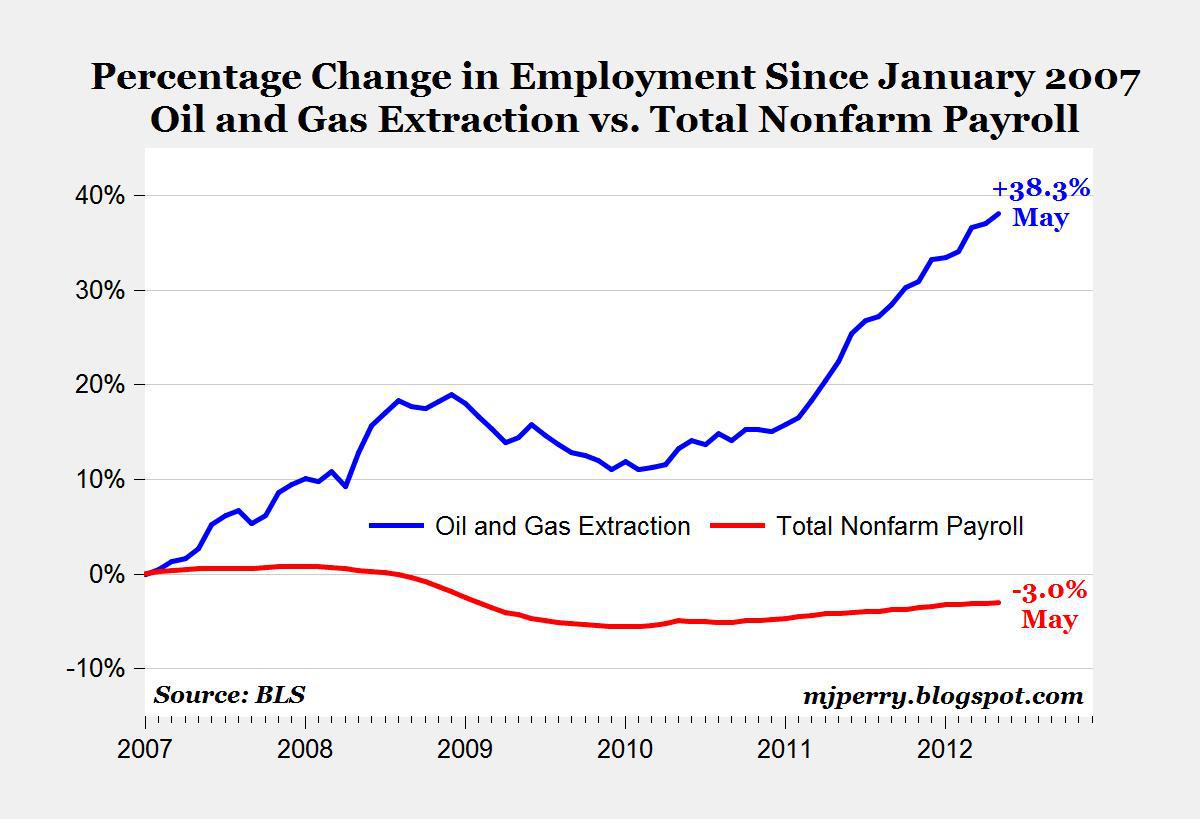
While yesterday's disappointing employment report reflects an economy struggling to create jobs during an extended, sub-par "jobless recovery," it's been a much rosier employment picture in one of America's most successful "shovel-ready" job-creating industries: Oil and Gas Extraction.
The chart above displays the monthly percentage changes in employment levels since January 2007 for oil and gas extraction jobs compared to total nonfarm payroll jobs. As of last month, total nonfarm payroll employment is 3.0%, and 4.1 million jobs, below the January 2007 level. In contrast, the explosion of new oil and gas jobs has increased employment in that industry by more than 38% since January 2007. Over the last 12 months, oil and gas companies have added 21,800 new workers, at a rate of almost 100 new hires every business day. And this just accounts for the new jobs created that involve the actual drilling, extraction and production of oil and gas.
A recent study found that for every one new job added in oil and gas extraction activities, there were three new additional jobs created elsewhere in the economy. The report also found that "the jobs-multiplier effect of U.S. oil and natural gas activity is higher than many other U.S. industries, including the financial, telecommunications, software and non-residential construction sectors. This is the result of the energy industry’s long supply chains and relatively high levels of spending by employees and suppliers." As a result of the multiplier effect, the U.S. economy has potentially been adding almost 400 new jobs per day over the last year due to increased oil and gas production.
Imagine what the jobless rate might be today, and imagine all of the additional shovel-ready, energy-related jobs (direct and indirect jobs) that could have been created over the last several years in the oil and gas industry (and its supporting industries), if the Obama administration: a) hadn't been so unfriendly to the low-cost, job-creating, dependable fossil fuel industry (think Keystone XL pipeline for example) that doesn't require picking the pockets of the taxpayers; and b) instead been so over-friendly to the subsidy-dependent, high-cost, unreliable but politically-favored "green" energies. On the other hand, imagine what the jobless rate might be today if we hadn't had the tremendous "energy-stimulus" to the U.S. economy that has resulted over the last few years from increased oil and gas drilling due to technological advances of hydraulic fracturing and horizontal drilling, and taking place mostly on private land?

Thursday, May 3, 2012

Marcellus Shale Development Practices

Let there be clear and open study and discussion of how the Marcellus Shale is being developed.  This includes the current emotional debate over "fracking".  Get it all out in the open to challenge and appease the often irrational critics.  Let there be public debate.  The benefits of development far outweigh the cost.  Don't let the fear-mongers dominate the issue.  The following represents a good move in that direction.
Peter


May 3, 2012 | PERMALINK | @MarcellusGas
What They’re Saying About the MSC’s Recommended Practices
Canonsburg, PA – Last week, the Marcellus Shale Coalition (MSC) released the first in a series of forthcoming recommended practices (RP). This ongoing and collaborative work is aimed at enhancing the region’s economy and responsibly developing American natural gas with industry-leading environmental safeguards and technologies, an affirmation of our Guiding Principles. In several major Pennsylvania newspapers this week, the MSC reinforced the importance of this initiative. Here’s what they’re saying about the first RP on site planning, development and restoration:
·         “Marcellus Group 'Raises Bar' With Conservation Guidelines”: The Marcellus Shale Coalition's "recommended practices" are guidelines rather than requirements, and address site planning, development and restoration. Still-planned guidelines will focus on areas such as air quality and water management. A 34-page document, released on April 26, recommends 11 steps for operators, from identifying sites for gas installations, to monitoring, maintenance and repair. The coalition said it sought guidance from member companies and other stakeholders to come up with standards that make sense operationally and environmentally. "These content-rich guidance documents represent a level of detail and transparency derived from many sources which will be updated and refined as development continues," said MSC chairman Dave Spigelmyer, in a statement. (AOL Energy, 4/28/12)

·         “Marcellus Trade Group Issues Recommended Practices For Site Work”: The Marcellus Shale Coalition released the first document April 26 in a series of "recommended practices" documents aimed at providing guidance on a range of subjects. "These content-rich guidance documents represent a level of detail and transparency derived from many sources which will be updated and refined as development continues," said Dave Spigelmyer of Chesapeake Energy, chairman of the Canonsburg, Pa.-based trade group. The first document, "Recommended Practices: Site Planning, Development and Restoration," is based on operational best practices already recognized by MSC members as well as on recommendations developed through consultation with leading sportsmen and conservation groups, according to an overview. (West Virginia State Journal, 4/27/12)
MSC President Kathryn Klaber Discusses the Recommended Practices on PCN-TV

 PCN

Click HERE to view this segment online.

·         “Industry Coalition Offers First Take on Best Practices”: The Marcellus Shale Coalition, a natural gas industry group, last week released the first of a series of reports outlining the best voluntary industry practices for hydraulic fracturing and horizontal drilling in the Appalachian basin. The reports, drawn up by teams of coalition members in consultation with leading sportsmen and conservation groups, outline recommended practices for developing natural gas resources while addressing environmental concerns and working with local landowners, according to MSC Chairman Dave Spigelmyer of Chesapeake Energy Corp. (E&E News, 4/30/12)
·         “Industry Group Releases Suggestions For Natural Gas Development In Marcellus Shale”: The Marcellus Shale Coalition, a trade group of oil and gas companies, released Thursday operational suggestions it hopes will standardize how the oil and natural gas industry approaches future drilling operations. … The coalition's recommended practices touch on how companies could develop a lease and how they should go about restoring the landscape once a well is shut and decommissioned. … "From site identification, to safety, communications, landowner engagement and eventual reclamation, this guidance document is the first of many that the coalition will release in the coming months - all of which are designed to increase awareness and share ideas and practices that work while continuing to raise the bar on responsible natural gas development across the region," said coalition president Kathryn Klaber. (International Business Times, 4/26/12)

# # #