http://www.stategeologists.org/temp/AASG%20Hydraulic%20Fracturing%20statement.pdf
August 12, 2012 | Association of American State Geologists“After decades of hydraulic fracturing-related activity there is little evidence if any that hydraulic fracturing itself has contaminated fresh groundwater. No occurrences are known where hydraulic fracturing fluids have moved upward from the zone of fracturing of a horizontal well into the fresh drinking water.” Quoted from the Association of American State Geologists statement. |
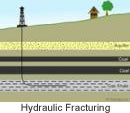
Hydraulic fracturing as applied in the oil and gas industry (commonly referred to as "fracking," "fracing," or "hydrofracking") is
the process of pumping a mixture of water, sand or similar material, and chemical additives, under high pressure, to create small
interconnecting fractures to increase permeability in targeted subsurface rock formations. Oil and gas companies perform
hydraulic fracturing after a well is drilled, cased and cemented, to increase the well’s productivity. Sand is used to prop open the
fractures, and chemical additives reduce friction, control bacteria, decrease corrosion, and serve other purposes. More than 50
percent of the natural gas, and a growing percentage of the oil, produced in the U.S. comes from hydraulically fractured
reservoirs. The following statement describes hydraulic fracturing in the oil and gas industry, discusses environmental concerns
about the practice and associated activity, and expresses the position of the Association of American State Geologists (AASG).
For an oil or gas well to be productive, hydrocarbons must flow through the rocks in which they are contained (the reservoir) into
the well and to the surface. Much of the oil and gas resource in the U.S. resides in "tight" rock formations, rocks so impermeable
that they do not allow oil and gas to flow easily through the rock to the wellbore. Reservoir rocks are fractured to enhance their
permeability and enable oil and natural gas to flow. Hydraulic fracturing is employed on both traditional vertical wells and on
horizontal wells, which are increasingly common. Most of these wells would not flow at rates that would make the drilling of the
well worthwhile without hydraulic fracturing. The combination of horizontal wells and hydraulic fracturing has led to increasing both
oil and natural gas production and the addition of large new reserves in the United States after years of decline.
Hydraulic fracturing was first used in the oil and gas industry in the U.S. in 1947. Since then, more than one million oil and gas
wells have been hydraulically fractured in the U.S., and hydraulic fracturing has become a common well-stimulation technique.
The application of hydraulic fracturing to horizontally drilled wells uses higher volumes of fluids than more traditional applications.
Today’s accumulated geological and engineering knowledge and improved technology are used to protect public health and the
environment while producing larger volumes of oil and gas. Modern wellbore casing and cementing are designed to isolate
freshwater aquifers from hydraulically fractured oil and gas reservoirs, which are generally thousands of feet below the aquifers.
Casing and cementing are required and regulated by state regulatory agencies and have performed as intended in the oil and
natural gas wells already drilled and currently operating in the U.S.
Environmental impacts are a concern for any activity on or below the land’s surface, including drilling and hydraulically fracturing
an oil or gas well. Constant vigilance is imperative to insure the quality of air, land, and water. Environmental issues raised in
association with hydraulic fracturing and other drilling and production operations include the potential for contamination of fresh
groundwater, water consumption, earthquakes triggered by injecting fluids, venting or flaring methane, and the disposal of fluids.
When they occur, most of these problems are not related to hydraulic fracturing, but to the drilling, casing and cementing of the
well, or disposal of fluids.
After decades of hydraulic fracturing-related activity there is little evidence if any that hydraulic fracturing itself has contaminated
fresh groundwater. No occurrences are known where hydraulic fracturing fluids have moved upward from the zone of fracturing of
a horizontal well into the fresh drinking water. In a single case currently under investigation, contamination may have occurred
when a vertical well was hydraulically fractured in a zone just a few hundred feet below the base of the freshwater. In most cases,
however, freshwater aquifers are near the surface, and are thousands of feet above deeply buried oil- or gas-bearing formations.
Under these geologic conditions, it is highly unlikely that a connection would develop between a hydraulically fractured oil or gas
reservoir and a freshwater aquifer. To further minimize the chance of such a connection, it is important to locate and plug any
abandoned wells that could provide a conduit between reservoir rocks and shallower freshwater aquifers, although no cases are
known where this has led to groundwater contamination from hydraulic fracturing fluids. Contamination has occurred, however,
from spills or mishandling of hydraulic fracturing fluids on the surface. Sound professional and regulatory practices therefore
should be diligently followed when handling fluids on the surface to minimize or eliminate this source of contamination.
Known instances of methane migration associated with well drilling are unrelated to hydraulic fracturing and could occur while
drilling any kind of well. All wells should be carefully cemented and tested properly to avoid methane migration. In some areas,
methane occurs in water wells because there is a natural source of methane within or just beneath the aquifer and in these cases
methane was present in water wells long before drilling or the use of hydraulic fracturing. It is important for oil and gas regulatory
agencies to determine if methane in freshwater wells has increased following drilling activities. This can only be done if baseline
water quality testing is carried out before oil and gas drilling. Also, enhanced practices and regulations may be required to
minimize release of methane, a greenhouse gas, to the atmosphere.
Introduction
The Association of American State Geologists (AASG) represents the State Geologists of the
50 United States and Puerto Rico. Founded in 1908, AASG seeks to advance the science
and practical application of geology and related earth sciences in the United States and its
territories, commonwealths, and possessions.
www.stategeologists.org
AASG statement
State geological surveys are important sources of information and expertise related to subsurface geology, water resources, and
energy. AASG members regularly monitor and discuss issues related to hydraulic fracturing. Several state surveys have been
engaged in investigations of potential freshwater contamination that may have been caused by recent hydraulic fracturing-related
activities; others are undertaking research on, and providing information about, hydraulic fracturing. The following points constitute
AASG’s position on hydraulic fracturing:
• AASG advocates that comprehensive public information based on sound science and open processes be utilized when
formulating energy and environmental policy. We encourage a balanced, independent, fact-based analysis of controversies
regarding natural resource development.
• AASG supports and encourages the disclosure of hydraulic fracturing fluids and chemical additives on FracFocus, the
hydraulic fracturing chemical registry website, developed by the Interstate Oil and Gas Compact Commission (IOGCC) and the
Groundwater Protection Council (GWPC).
• AASG advocates for better understanding and scientific documentation of our subsurface geology and aquifers, which will
result in improved geologic models to help all parties avoid problems that might occur during drilling and hydraulic fracturing
activities of oil or gas reservoirs, especially in new fields. This will allow safer and enhanced production of oil and gas.
• AASG is committed to protecting the nation’s public safety and the natural environment, including groundwater and
surface-water resources. AASG supports the wise and prudent production of oil and gas resources to help fulfill the nation’s
energy needs.
• AASG recognizes the economic and social importance, and the abundance, of oil and gas resources that only can be
recovered if reservoir rocks are hydraulically fractured.
• AASG maintains that state oil and gas regulatory agencies are best equipped, through statutory authority, expertise, and
experience, to ensure that hydraulic fracturing and all other operations associated with oil and natural gas development
proceed in a manner that protects the natural environment, including public safety as well as groundwater and surface-water
resources.
• AASG recognizes that the environmental record of hydraulic fracturing activities over the past 60 years has been
overwhelmingly positive. AASG also maintains that operators who do not follow regulatory requirements should be
appropriately sanctioned and, where appropriate, barred from conducting further oil and gas operations.
• AASG notes that geologic data generally show a significant vertical separation between most oil and natural gas reservoirs
targeted for hydraulic fracturing and the shallower freshwater aquifers. In areas where targets of hydraulic fracturing are
comparatively close to freshwater aquifers, thorough geologic characterization of the area is warranted and even greater
caution should be exercised by operators and regulatory agencies.
• AASG recognizes the fast pace of recent drilling for oil and natural gas and the associated hydraulic fracturing activities. AASG
suggests that caution and careful attention to community relations be exercised by operators, contractors, and regulators in the
design, review, approval, documentation, implementation, and verification of plans for the drilling, completion, stimulation and
production of oil and gas wells.
• AASG encourages continuing work to acquire and maintain local pre-drilling water quality assessment and ongoing information
on groundwater quality, and recommends that casing and cementing operations in hydraulically fractured wells be carefully
documented by operators, contractors, and regulators.
Water used for hydraulic fracturing is generally obtained from nearby water wells, lakes, streams and rivers. Although a
substantial amount of water is used in hydraulic fracturing, this represents a one-time use, and the amount is considerably less
than the volumes required in other common ongoing uses, such as agriculture, municipal supplies, and industrial processes. Oil
and gas operators must follow state laws in the acquisition and use of water and make sure that they do not negatively impact
local (individual, city, or county) water supplies. The industry is working to reduce their freshwater needs, including recycling the
water they use in hydraulic fracturing operations.
Much of the water used in hydraulic fracturing flows from the well along with gas, oil, and saline water during normal production
operations. That "wastewater," or “flow-back water," must be recycled or disposed of properly. Disposal is generally through deep
wells drilled specifically for that purpose. In some locations, injecting returned water into deep wells has triggered small earthquakes
(generally less than Magnitude 3.0), a phenomenon called triggered seismicity or induced seismicity. Proper well siting
away from faults and using managed injection rates and pressures can minimize or eliminate triggered seismicity.
With new technologies, exploration has expanded into areas and communities that have seen little oil and gas drilling, or have
not seen it recently. That has created a variety of new issues--some positive, some negative. Caution, good judgment, and sound
regulatory practices must be exercised in areas where less information is available about the subsurface geology.
Co-Chairs, Energy Committee Co-Chairs, Environmental Policy Committee
Scott W. Tinker Nick Tew Karl Muessig David K. Norman
scott.tinker@beg.utexas.edu ntew@gsa.state.al.us karl.muessig@dep.state.nj.us dave.norman@dnr.wa.gov
Texas State Geologist Alabama State Geologist New Jersey Geological Survey WA Div. of Geology and Earth Resources


