Showing posts with label production. Show all posts

Monday, July 15, 2013

Fracking Can And Is Being Done Safely, Cleanly, And Efficiently

Let's think this through.

Recycling is a good thing, right?  This word has been around for quite a while now.  People understand it and consider it a good thing.  We are familiar with the "recycling" of aluminum cans, glass and plastic bottles, newspapers and plastic bags.  In fact many of us have been dutifully separating these items from our trash and putting them out for waste pickup on a regular basis for years.  Most of us make nothing from doing this, and even though it requires a bit of effort and forethought, we have learned to do it "for the good of the environment".  It makes sense.  These materials can be re-used and turned into other useful products and by doing so reduce the burden on our landfill waste disposal sites.  It is a "win-win" situation for those modern motivators and business planners.

So why not recycle the water used in the "fracking" or hydraulic fracturing of rocks containing oil and gas?  (See the many other articles in this blog explaining the hydraulic fracturing process.)  Often when a well is drilled and used to produce oil and gas it also produces a lot of "formation water".  This is water that has been trapped in these underground rocks for thousands, millions, tens and even hundreds of millions of years.  Why not re-use this water to fracture rocks and produce more oil and gas?  After all, the concern over water usage and "pollution" is used as the primary motivator by the so-called "environmentalists" so actively opposed to fracking.  Recycling makes sense, so why is it not more widely embraced and practiced?

The reason why opponents of fracking won't admit it can be done safely and without destroying our  precious  freshwater sources, is because the opponents of fracking don't really care that much about water.  They have other motives.  Dig into an article.  Read farther than the headlines, which are always emotionally charged, and usually written from a politically liberal viewpoint.  In this case here is a quote from the following article:

"The practice scales down the amount of freshwater used for fracking, but environmentalists say it does nothing to assuage concerns about groundwater contamination, and only facilitates the extraction of fossil fuels that produce climate-warming gases."

So there it is, the real underlying motivation of "banning fracking" is to stop or limit the production of fossil fuels and the alleged link to "climate warming gases".  So the concern about safe drinking water is an emotional ploy.  Clean water is something everyone needs and desires.  It is a clever trick, and in my opinion, evil, because it deprives people all around the world of something else everyone needs and wants: inexpensive energy.  We cannot all ride bicycles and walk wherever we want to go.  Nobody likes being deceived, and I see it going on all around.  The only solution to this intentional misinformation is education.  So here we are.

Another poorly understood benefit for using formation water, or re-used water in the fracking process is the water is usually in "equilibrium" with the rocks that are being fracked.  After all, the water has been sitting there in the pore spaces of the rocks to be fracked for a long time.  It has time to come to chemical equilibrium.  Pumping it back underground during the fracking process does nothing to harm that balance.

There are more benefits to recycling.  It saves money, tens and sometimes hundreds of thousands of dollars on the cost of drilling and completing a well.  It reduces the cost and damage caused by the need of trucks hauling water.  It reduces the cost of disposing of waste water.  The water used comes from the deep oil and gas producing rock formations, thus it is by definition and usage, "polluted".  So why  not use it, and put it back where it came from and leave our much shallower drinking and irrigating water alone.  This is truly a win-win situation, something everyone can be happy with.

Oil and gas companies and their service companies, like Baker Hughs and Halliburton, and Schlumberger, have been drilling and completing wells in similar ways for decades.  They are very, very competitive with one another.  Read the remainder of the article below.  Why is this recycling not publicized and done more?  Think government regulation.  Think government politically motivated interference.  Think environmental groups lobbying (bribing) politicians.  Think big businesses promoting "alternative" energy like solar and wind, (which are fine in certain circumstances).  Think corruption, like Solyndra.  Think of ignorance.  Think of those making and seeking to make Billions of dollars on "carbon taxes" and "carbon credits".  Think Al Gore, and others acting as parasites on the public.  Who suffers?  You and I, us, the public, in the form of higher energy prices, which increase the cost of everything.

What do you say we fight back against the darkness and danger or ignorance.  Spread the word.
Peter


Analysis: Fracking water's dirty little secret - recycling
A worker drinks coffee as he watches a drilling process at a shale gas fracking facility run by Poland's PKN Orlen company on the outskirts of the village of Uscimow, south-eastern Poland, June 5, 2013. REUTERS/Peter Andrews


By Nichola Groom
LOS ANGELES (Reuters) - The oil and gas industry is finding that less is more in the push to recycle water used in hydraulic fracturing. Slightly dirty water, it seems, does just as good a job as crystal clear when it comes to making an oil or gas well work.

Exploration and production companies are under pressure to reduce the amount of freshwater used in dry areas like Texas and to cut the high costs of hauling millions of barrels of water to oil and gas wells and later to underground disposal wells.

To attack those problems, oilfield service companies like Halliburton, Baker Hughes and FTS International, are treating water from "fracked" wells just enough so that it can be used again. Smaller companies like Ecosphere Technologies Inc have also deployed similar methods.

"It is a paradigm shift," Halliburton's strategic business manager of water solutions, Walter Dale, said.

Until recently, many companies considered recycling too expensive or worried that using anything other than freshwater would reduce well output.

But oil and gas companies are increasingly treating and reusing flowback water from wells, which unlike freshwater is very high in salt, with good results.

The practice scales down the amount of freshwater used for fracking, but environmentalists say it does nothing to assuage concerns about groundwater contamination, and only facilitates the extraction of fossil fuels that produce climate-warming gases.


"It doesn't lessen the potential for groundwater contamination, and it can increase the amount of contaminants that you are exposing the groundwater to," said Myron Arnowitt, Pennsylvania director for Clean Water Action.

Read the remainder or the article here:
 http://finance.yahoo.com/news/analysis-fracking-waters-dirty-little-165146500.html


Friday, September 14, 2012

Drilling On A Large Scale....The Future Is Here

Innovation, efficiency, economy, safety, progress....the American way.  Hats off to all the hard-working people in this industry who make such things possible.
Peter


Three-dimensional representation of oil or natural gas development of a large underground area, from four drilling pads on the surface, as described in the article text
Source: U.S. Energy Information Administration, reproduced with permission from Statoil.
Note: Three-dimensional representation of oil or natural gas development of a large underground area, from four drilling pads on the surface (depicted within the red ovals).
 

Developments in drilling methods and technology are leading to efficiency gains for oil and natural gas producers. For example, "pad" drilling techniques allow rig operators to drill groups of wells more efficiently, because improved rig mobility reduces the time it takes to move from one well location to the next, while reducing the overall surface footprint. A drilling pad is a location which houses the wellheads for a number of horizontally drilled wells. The benefit of a drilling pad is that operators can drill multiple wells in a shorter time than they might with just one well per site.
Moving a drilling rig between two well sites previously involved disassembling the rig and reassembling it at the new location ("rigging down" and "rigging up") even if the new location was only a few yards away. Today, a drilling pad may have five to ten wells, which are horizontally drilled in different directions, spaced fairly close together at the surface. Once one well is drilled, the fully constructed rig can be lifted and moved a few yards over to the next well location using hydraulic walking or skidding systems, as demonstrated by Range Resources.

In the picture above, each of the four drilling pads hosts six horizontal wells. Pad drilling allows producers to target a significant area of underground resources while minimizing impact on the surface. Concentrating the wellheads also helps the producer reduce costs associated with managing the resources above-ground and moving the production to market.

Bentek Energy, LLC analysis shows that drilling operators are achieving efficiency gains in the well-drilling process. In June 2012, operators in the Eagle Ford shale formation averaged about 19 days to drill a horizontal well, down from an average of 23 days in 2011. Reducing the time it takes to drill wells can save oil and gas producers a significant amount of money. In the North Dakota section of the Bakken formation, the increase in drilling rigs in the area has begun to slow, but production levels continue to reach record highs each month.

Recent studies by the University of Pittsburgh and Rigzone, as well as analysis of financial reports from E&P companies Abraxas, EQT, and El Paso, show that drilling costs alone are only a portion of the total drilling and completion expenses that producers face. EIA analysis of average Bakken, Eagle Ford, and Marcellus well-related expenses finds that total costs per horizontal well can vary between approximately $6.5 million and $9 million. The cost of completing and hydraulic fracturing typically exceeds the cost of drilling the well.

One of the industry's more recent innovations, pad-to-pad moves, underscores the efficiency gains from rig mobility and pad drilling. During the drilling operation pictured below, rig operator Nabors Industries transported a fully-assembled drilling rig about one mile between drill sites. The cost of rigging down and rigging back up can be high enough that producers may find it more efficient to build a road between two pads, transport the rig intact, and have it arrive ready to drill the next well.
image of a fully constructed rig being moved between two drilling pads, as described in the article text
Source: Reproduced with permission from Nabors Industries Ltd.


Thursday, July 12, 2012

The Permian Basin, Born Again

In the Permian Basin, drilling and production is rising while the price of oil is falling.  That is good for some, not so good for others.  All told, it looks to me that by combining "horizontal" drilling with careful and selective hydraulic fracturing, the future looks bright for increasing activity and production, which is good for everyone.
Peter


source: http://www.eia.gov/todayinenergy/detail.cfm?id=7030

July 10, 2012

Rising production in the Permian basin

graph of Monthly Permian Basin rig count and oil production, as described in the article text
Sources: U.S Energy Information Administration, based on Baker Hughes and HPDI, LLC.
Notes: Graph includes rig counts through June 2012 and oil production through December 2011. Active rigs include rigs drilling for both crude oil and natural gas.


The source for the crude oil production data series published on July 10 was websites of the Railroad Commission of Texas and the New Mexico Energy, Minerals and Natural Resources Department. On July 11 the source was changed to HPDI, LLC, because HPDI, LLC collects both that data and production data that has not yet been processed by the Railroad Commission of Texas.

The Permian Basin—a long-time oil and natural gas producing region in west Texas and eastern New Mexico—is showing signs of new life. The active rig count has grown from 100 rigs in mid-2009 to over 500 rigs in May 2012. According to data from HPDI, oil production from the Permian has increased fairly steadily over the past few years, reaching the 1 million barrels per day (bbl/d) threshold in 2011—the first time since 1998.
graph of Spot prices of WTI and Midland crude oil, as described in the article text
Sources: U.S. Energy Information Administration, based on Bloomberg.


Growing oil production in the Permian Basin and other Texas plays, most notably the Eagle Ford shale, may be starting to strain existing takeaway capacity and is creating a need for Texas oil to serve more distant refineries. While new pipeline projects are scheduled to come online, current transportation constraints have caused Permian crude oil, which is priced in Midland, Texas, to sell at a significant discount to WTI beginning in January 2012.

Sunday, June 3, 2012

Oil And Gas Industry To The Rescue

Pssssst......spread the word.....the oil and gas industry is creating jobs, hiring people, paying taxes instead of spending taxpayers money, and producing inexpensive (natural gas) energy.  In addition to that good news, the myth of man-caused global warming is finally being put to rest, (see here) and things are looking up, a lot more than they have been the last few years anyway.   Let's keep this kind of activity going.
Peter


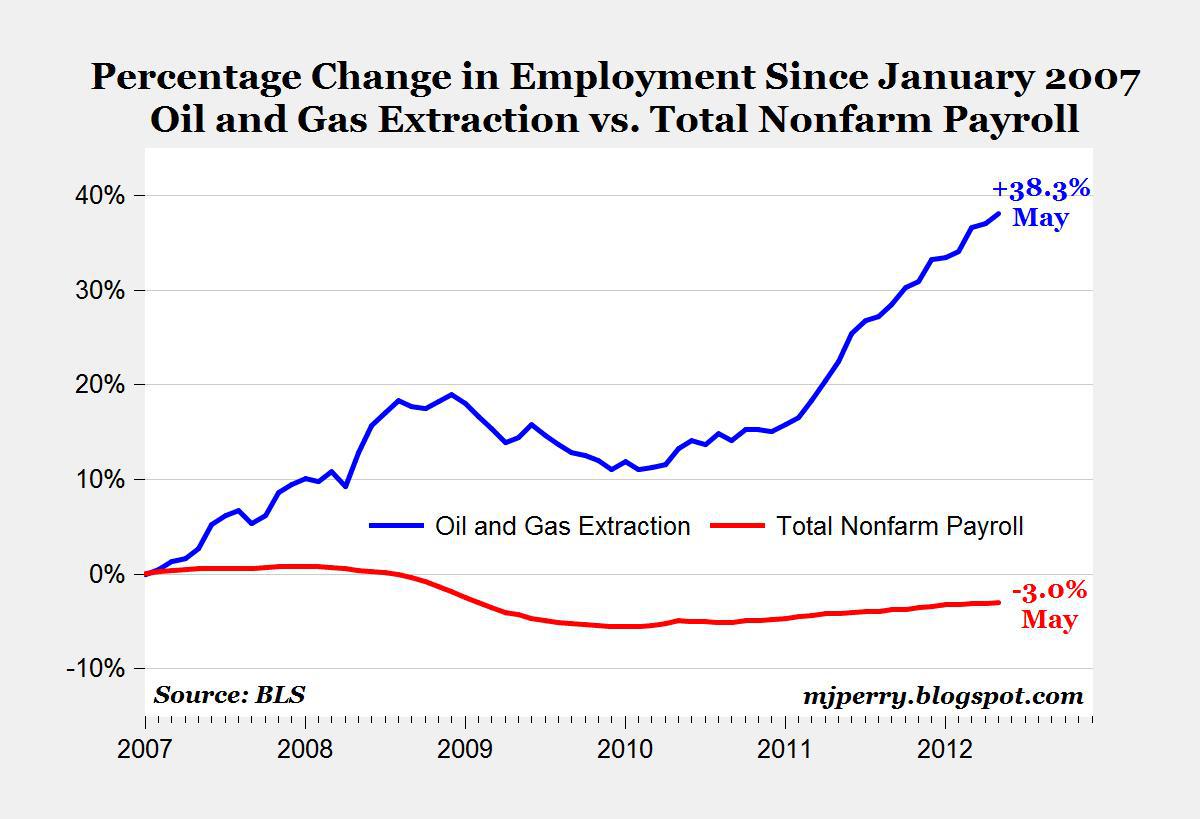
While yesterday's disappointing employment report reflects an economy struggling to create jobs during an extended, sub-par "jobless recovery," it's been a much rosier employment picture in one of America's most successful "shovel-ready" job-creating industries: Oil and Gas Extraction.
The chart above displays the monthly percentage changes in employment levels since January 2007 for oil and gas extraction jobs compared to total nonfarm payroll jobs. As of last month, total nonfarm payroll employment is 3.0%, and 4.1 million jobs, below the January 2007 level. In contrast, the explosion of new oil and gas jobs has increased employment in that industry by more than 38% since January 2007. Over the last 12 months, oil and gas companies have added 21,800 new workers, at a rate of almost 100 new hires every business day. And this just accounts for the new jobs created that involve the actual drilling, extraction and production of oil and gas.
A recent study found that for every one new job added in oil and gas extraction activities, there were three new additional jobs created elsewhere in the economy. The report also found that "the jobs-multiplier effect of U.S. oil and natural gas activity is higher than many other U.S. industries, including the financial, telecommunications, software and non-residential construction sectors. This is the result of the energy industry’s long supply chains and relatively high levels of spending by employees and suppliers." As a result of the multiplier effect, the U.S. economy has potentially been adding almost 400 new jobs per day over the last year due to increased oil and gas production.
Imagine what the jobless rate might be today, and imagine all of the additional shovel-ready, energy-related jobs (direct and indirect jobs) that could have been created over the last several years in the oil and gas industry (and its supporting industries), if the Obama administration: a) hadn't been so unfriendly to the low-cost, job-creating, dependable fossil fuel industry (think Keystone XL pipeline for example) that doesn't require picking the pockets of the taxpayers; and b) instead been so over-friendly to the subsidy-dependent, high-cost, unreliable but politically-favored "green" energies. On the other hand, imagine what the jobless rate might be today if we hadn't had the tremendous "energy-stimulus" to the U.S. economy that has resulted over the last few years from increased oil and gas drilling due to technological advances of hydraulic fracturing and horizontal drilling, and taking place mostly on private land?

Friday, June 1, 2012

A Quiet Revolution In The Oil And Gas Industry

There has been somewhat of a quiet revolution taking place in today's oil and gas industry.  Or perhaps a better description is that a slow, decades-long series of technological innovations is   enabling the production of oil and gas never before dreamed of.  For the most part, politicians, economists, planners, "social engineers"  (I hate that term) and the general public, have not caught on.  The importance of this revolution or evolution in where and how our energy comes from is enormous. 

The world's economy is at a crossroads.  Solar energy, wind energy, geothermal energy, bio-fuels, and all other current alternatives are clearly not the solution to our near term energy needs.  We must accept this, perhaps swallow a little pride, and accept the idea that we really need all the oil and gas we can find and produce.

Meanwhile, fortunately, the idea that the burning of fossil fuels and the consequent release of "fossil" carbon dioxide as the cause of global warming and/or climate change is being proven to be false (if not an outright fraud and hoax).  See here for more on global warming/climate change.

The following article is an excellent summary of the timeline of how this transformation of the oil and gas business has come about.  All geologists, geophysicists, engineers, and others, should take note.

The bottom line is, we have and can produce A LOT of oil and natural gas.  "Peak Oil" has been pushed ahead.  This is good for our economy; it is good for us; it might help us get on the road back to growth and prosperity.  It buys us time to develop the inevitable alternatives.  Parents, "teach your children well".
Peter

Here is a pertinent excerpt from the following article:


"Is horizontal drilling helping bring about any other changes? Perhaps it is even changing the way corporations work. “Companies that fail to adequately research the geology are putting themselves at considerable risk if they assume all resource plays are alike and that more and larger fracks are the solution to economic production,” according to Russum. Even so, engineers are increasingly replacing geologists in the executive suite.
Traditional geologists who spent entire careers looking for conventional reservoirs are now more interested in minor variations in rock properties, in stress regimes and in proximity to source rock. In terms of traditional petro-geology this is a difficult concept to grasp, but to a large extent it is a response to the revolution spawned by horizontal drilling."

Where it All Began
Published : May 30th, 2012
1996 words - Reading time : 4 - 7 minutes


The world of oil and gas was quite a different place a quarter century ago. Production mostly came straight up out of vertical holes. Though the Texans had drilled the first horizontal well in 1929, in Canada horizontal drilling was still mostly an esoteric, unproved and untested technology.
In 1987, all that began to change – so much so that, during the last 25 years, it simultaneously emerged as a standard production technique and revolutionized production. One result is that many petroleum resources have become technology-driven plays. Another is that reserves are way, way up.
In a sense, the most important uses of horizontal drilling technologies are reverse images of each other. “What makes horizontal drilling for nonconventional resources (like shale gas and tight oil) so attractive to the financial community is the very high initial rate of return. In the beginning, production rates are extremely high, although they quickly taper off. You have to remember that these applications enable you to get highly desirable hydrocarbons out of really poor reservoirs,” according to Dave Russum, who is director of geosciences at AJM Deloitte, a consultancy.
The oilsands represent the mirror image of this situation. “You are drilling into tremendous reservoir rocks – highly porous and very permeable, so there’s plenty of oil in there. But until you process the stuff it isn’t a particularly attractive commodity.”
The Bitumen Story
It’s true that in April 1978 Imperial Oil drilled Canada’s first horizontal well into the Clearwater formation at Cold Lake – a storied well overseen by Dr. Roger Butler in an early test of a system of oilsands production now known as steam-assisted gravity drainage (SAGD). After that test and a less interesting effort by Texaco a couple of years later, in Canada the technique mostly languished until 1987.
Then the advent of improved down-hole drilling motors and the invention of other necessary supporting equipment, materials, and technologies – particularly down-hole telemetry equipment, which enabled rigs to drill straight on target – led to an explosion of new applications for this technology. Producers and the drilling and service firms that support them found endless new uses for directional drilling – especially as it is used for horizontal wells.
Appropriately, in Canada the first horizontal wells drilled after Imperial’s early test were part of the Underground Test Facility (UTF), which celebrated its official opening on June 29th, 1987. Developed by the Alberta Oil Sands Technology and Research Authority (AOSTRA), the UTF involved a pair of tunnels driven into limestone 15 metres below the reservoir.
Within those tunnels, AOSTRA constructed large well chambers. “Pairs of injection and production wells were drilled upwards from the well chambers at a 170 slant,” according to the mining engineer behind the project, Gerry Stephenson, “and deflected horizontally into the base of the reservoir. The mobilized bitumen drained by gravity from the steam chamber in the reservoir to the well head in the tunnel and all of the production was pumped from a central location.” Those tests proved Butler’s theories about SAGD beyond any possible doubt.
Over its 15-year life, the UTF also evaluated other recovery strategies, but nothing compared to its SAGD results. “AOSTRA’s staff had estimated that the recovery might be somewhere between 30 percent and 45 percent of the bitumen in place” during the Phase A tests, according to Stephenson. “We actually got 65 percent recovery. The steam chambers formed by mobilization of the bitumen spread way beyond the area we’d expected….Over the 10-year life of the well pairs, Phase B got a steam/oil ratio, the most critical figure of all, of 2.3 to one.”
The tests at the UTF forever transformed Canada’s oilsands industry. Today, SAGD is responsible for more than half of Canada’s bitumen production.
Ironically, Sceptre Resources drilled the first horizontal well in Saskatchewan to test a SAGD-like system at Tangleflags, just as the UTF began its definitive tests. Drilled into the shallow (450-metre) Lloydminster sandstone, this primitive application of a form of SAGD illustrated the kinds of problems horizontal drilling could overcome. With an active aquifer below and a gas cap above, the reservoir’s pay thickness was about 27 metres. The oil was heavy: about 13o API. Primary production from the field had been meagre (0.6% of the oil in place), and the use of cyclic steam stimulation, which uses vertical production wells, had flopped when they tapped the aquifer and started producing 99% water.
That was when the company decided to try SAGD – not the technique we use today, but the primitive version Imperial had tried out nine years earlier. Sceptre injected steam through four vertical wells near the gas-oil contact, draining the mobilized oil through a horizontal well. At the industry’s leading edge, the company found itself with a technical and economic success.
Fast Production from Tight Reservoirs
More than any other series of innovations, the technology-intensive processes that now surround directional drilling have enabled the industry to get production out of otherwise unproductive rock. In August of that same transformational year, Alberta Energy drilled the first horizontal well into the Glauconitic formation at Suffield. This was the first time a Canadian operator drilled horizontally into a conventional oilfield.
Things then quickly sped up. In February 1998 alone, three significant projects based on horizontal drilling took off. Amoco began a 10-well horizontal drilling program at Athabasca, into the Wabiskaw formation. Canadian Hunter drilled gas wells at Ansell (Alberta) into the Cardium formation and at Helmet (British Columbia) into the Jean Marie. A few months later, Shell Canada drilled for Mississippian oil in Saskatchewan, at Weyburn. This early application of the technology was meant to connect isolated small reservoirs or improving contact within heterogeneous rocks to enhance the sweep efficiency.
“In the 1990s the big push was to explore conventional carbonate rocks, especially from the Mississippian in Saskatchewan,” according to AJM Deloitte’s Russum. “The idea was to develop known reservoirs where the rock quality was variable, using horizontal wells to extract more oil from those formations…. Many different companies hopped on to the horizontal drilling band wagon in Saskatchewan with more than 500 wells drilled into the Mississippian in 1997 alone. In that year more than 1300 horizontal oil wells were drilled across the basin – a tally that was not beaten until 2007.”
Horizontal drilling also began to tap the heavier oils in Saskatchewan and southeastern Alberta in the 1990s, and there was a lot of experimentation in other reservoirs. Also, of course, in that decade SAGD began to be developed in its modern form.
As horizontal drilling became more commonplace, the petroleum industry began combining it with innovations in both drilling and well completion technologies and ideas. The result has been like a snowball rolling downhill. Horizontal drilling has been enhanced by geo-steering, measurement-while-drilling, coil tubing, down-hole motors and new bit design, for example. Also, producers can now drill multilateral horizontal wells from a single drilling pad.
Perhaps the important recent development on the drilling side is the monobore. Monobore drilling involves running a casing string, then forcing a steel cone down the well to expand it in the hole. This process is repeated with identical casing strings. Thus, monobore completions have the revolutionary characteristic of installing a string with the same interior diameter from top to bottom. “These are making a huge difference,” said Russum. “In the past you had to drill a vertical well, then run the casing to the bottom and wait for the casing to set before you could begin to drill the horizontal leg. Monobores help reduce those time-consuming steps.”
Although technologies like microseismic are also making a difference, the most important developments on the completion side have involved the increasing power and sophistication of hydraulic fracturing. Better fracking has developed because of new packers, better pumping equipment and better treatment fluids and proppants. “It’s now easier to isolate horizontal wells and to put fractures into certain points of the formation,” according to Russum. “In the early days, each stage of multistage fracking would take a whole day. Each frack would have to be tested separately before you proceeded to the next one. Today it’s a continuous process.”
These clusters of technological breakthroughs first created the shale gas revolution. Pioneered by an American, George Mitchell, in the Barnett shale in Texas, tight gas reservoirs began yielding highly economic volumes of natural gas – and, not incidentally, drove down the price of gas. Some observers now describe natural gas as a low-value by-product encountered in shale reservoirs in the quest for natural gas liquids.

From a production perspective, the other great outcome from this cluster of technologies has been the development of tight oil from shale – what Russum prefers to call “conventional oil from more shaley, low-permeability reservoirs.” One outcome is that both western Canada and the US are experiencing growing light oil production for the first time in decades – much of it coming from the Bakken play in North Dakota and Montana. After decades of decline in Alberta, for example, light oil production has recently risen to ten year highs.
An Explosion of Uses
These new technologies are changing almost everything about Canada’s petroleum industry. For example, horizontal wells are now a huge part of gas storage. “You can store gas very quickly into those wells,” said Russum, “and you can extract it quickly, too. Then there is the whole area of trying to reduce surface impact. I think we’re going to see more and more of that. Surface owners are more and more reluctant to have pumpjacks and other surface equipment on their land, and horizontal wells are less likely to disturb natural habitat. There is also extended reach, so you can reach under lakes and towns and cities. You can use it to reduce water production in a thin reservoir located over an aquifer.”
The economics of the horizontal well are also greatly improved, especially when you are planning production from a narrow reservoir – ten metres thick, for example. Horizontal wells provide much greater contact with the reservoir per dollar of drilling than do their vertical kin. And when they are drilled in search of unconventional resources like shale gas and tight oil, the producer gets a quick payback because initial production rates are so high.
Still not convinced? Then let the numbers tell the tale. According to an AJM Deloitte study which is complete to late 2011, more than 30,000 horizontal wells have produced conventional oil or gas in Western Canada over the past twenty five years. Of that tally, 4,300 were completed in 2011. This set a record for horizontal oil drilling: nearly 3,500 wells (led by the Cardium, Viking and Bakken), and an additional 800 wells focused on gas – mainly attracted by the high liquids content in the Montney and Middle Mannville. Today, half of Western Canada’s wells are being drilled horizontally.
Is horizontal drilling helping bring about any other changes? Perhaps it is even changing the way corporations work. “Companies that fail to adequately research the geology are putting themselves at considerable risk if they assume all resource plays are alike and that more and larger fracks are the solution to economic production,” according to Russum. Even so, engineers are increasingly replacing geologists in the executive suite.
Traditional geologists who spent entire careers looking for conventional reservoirs are now more interested in minor variations in rock properties, in stress regimes and in proximity to source rock. In terms of traditional petro-geology this is a difficult concept to grasp, but to a large extent it is a response to the revolution spawned by horizontal drilling.


Oilsands companies in particular, but also other companies involved in modern resource plays are basing their business plans on step-by-step, decades-long development of vast and well-defined resources. This means traditional wheeling-and-dealing is at least partly on the decline – to a large extent replaced by courting cash-rich foreign companies with deep pockets and the desire to support these capital-intensive activities.
Peter McKenzie-Brown


Peter McKenzie-Brown

Peter McKenzie Brown is the vice president of a resource company. He has written several volumes of history, and has worked in the corporate and academic worlds. He is British by birth, American by upbringing and Canadian by choice. Disclaimer : Although the writer is a director and officer of Stratabound, the thoughts and views herein are his only and not those of Stratabound. He is not registered in any jurisdiction as a broker or investment adviser, so nothing herein should be construed as advice on whether to buy, sell or hold shares of Stratabound or any other company mentioned herein.
Peter McKenzie-Brown Archive Website Contact author Subscribe to his services

Tuesday, March 6, 2012

Another New Shale Play: Newfoundland, Canada

It looks like a new oil exploration and development play might be taking shape in Canada's northeastern Province of Newfoundland.  The target appears to be the stratigraphic equivalent of the Utica Shale of the Ohio, and New York areas in the United States.  In the area of interest off the west coast of Newfoundland around Port au Port Bay, they call this the "Green Point Shale".

source: http://seekingalpha.com/article/412511-newfound-billions-of-barrels-of-shale-oil-in-newfoundland?source=email_macro_view&ifp=0


Source: Shoal Point Energy website.
Here is a link to a map showing all of the oil and gas activity in eastern Canada.

Oil exploration and production is well established in the offshore basins of eastern Newfoundland with fields such as Hibernia, Terra Nova, and White Rose producing around 300,00 barrels of light crude per day.  (One wonders why exploration and production off Canada's east coast has been allowed where geologically similar areas off the U.S. east coast are off limits.)  Newfoundland is also "friendly" to the oil and gas business, both environmentally and economically.  There is even a refinery in Newfoundland , a good infrastructure network, and a trained workforce in place, presumably eager to expand and grow.  Again this is a refreshing contrast to the U.S.

The Green Point Shale in Newfoundland apparently compares well with the south Texas Eagle Ford Shale that is attracting so much attention.  These factors include total organic content (TOC) of the shales and the thermal maturity of the shales, that is their ability to contain and produce both oil and gas.  One major difference is the Green Point Shale is far thicker in this area than the Eagle Ford Shale is in Texas.

Apparently the Green Point Shale is much thicker than the Eagle Ford Shale, (and many other shales) because it has been through at least one episode of comressional tectonics, or mountain-building.  This has taken the layers of shale, and compressed them, pushing them together like a deck of cards on a table would be pushed together to overlap into a single large deck of cards.  This is a positive aspect to this play.  The negative to this "mountain building" is the layers of rock are much more structurally complex than the shales in for example, the Eagle Ford Shale, Barnett Shale, Haynesville Shale, and the Bakken Formation.  This makes for more difficult drilling and development.  On the other hand, these shales probably compare more favorably with the successfully developing Marcellus Shale in the Pennsylvania area of the eastern U.S.

The exploration of the Green Point Shale is in its preliminary stages but there are some very positive initial results in the area.  However the claims of "Billions" of barrels of oil seem premature and a bit sensational to me, still this area is very much worth watching.

This activity is discussed in more detail here:

Peter