It is not often that you hit a home run in your first at-bat, but it looks like Forest Oil, with corporate headquarters in Denver, Colorado, has done just that. Their first horizontal well in the Haynesville Shale Gas Play produced at a rate of 14 MMcfe/d, which is eye-opening by any standards.
Note that Forest Oil says they completed a 14 well vertical drilling program in 2008 in the Haynesville Shale. Why 14 vertical wells before drilling a single horizontal well? Prudence and foresight. The vertical wells give them geologic information which they can use to correlate, interpret and maximize the drilling, completion, and production of their subsequent horizontal wells. Obviously they're doing it right. Beginners luck you say? I don't think so.
Peter
Forest Oil All Smiles over Completed Haynesville/Bossier Shale Well
Forest Oil Corp. 2/11/2009
URL: http://www.rigzone.com/news/article.asp?a_id=72803
Forest Oil has reported results from its first horizontal Haynesville/Bossier shale well in the East Texas/North Louisiana corridor. The Moseley 14-1H, located in Red River Parish, Louisiana, produced into the sales line at a rate of 14 MMcfe/d with 6,500 psi flowing casing pressure while still cleaning up frac load. Forest has a 100% working interest in this well.
Forest holds approximately 3,800 net acres around the drillsite. Forest has approximately 140,000 gross (106,000 net) acres in the Haynesville/Bossier play and intends to operate a two rig program to drill 10-12 horizontal Haynesville/Bossier shale wells and participate in 2-3 non-operated wells during 2009. The Company currently has two horizontal Haynesville/Bossier shale wells completing and two drilling.
In 2008, Forest completed a 14 well vertical Haynesville/Bossier shale program in East Texas and North Louisiana. The 2008 vertical program allowed the Company to obtain additional data to identify the most prospective geographic areas to drill horizontally for the Haynesville/Bossier shale on its acreage. In 2009, Forest will now focus on executing a horizontal drilling program on its Haynesville/Bossier shale acreage using the Company’s wholly owned drilling subsidiary Lantern Drilling.
H. Craig Clark, President and CEO, stated, "We are particularly pleased with the productivity of our first Haynesville/Bossier horizontal. Our operations team has again performed well, especially in light of the mechanical difficulties being experienced in the industry related to this type of horizontal drilling. We will continue to evaluate different well designs and stimulation treatments as we did in our successful Cotton Valley horizontal program. Our future Haynesville program, like the Cotton Valley, will lead to increased cost efficiencies and enhanced completions."
Friday, February 13, 2009


Haynesville Shale May Become World's Largest Gas Field?
Ok, CEO's have been known to exaggerate their company's prognosis. See the following comments by the CEO of Chesapeake Energy. However, the Haynesville Shale in northwestern Louisiana and far eastern Texas is shaping up to be at least a major new gas play. Call it "unconventional shale gas", but it is for real. This gas play is at the heart of what I'm presenting on this blog.
The Haynesville Shale Play involves horizontal drilling, and the interpretation and steering while drilling of those wells, multi-stage frac jobs, and the opening of thousands of feet of pay zone, and multiple wells being drilled in all directions from one location. The Haynesville Shale and plays like it represent a big part of the future gas industry. Stay tuned.
Peter
Haynesville Shale Primed to Become World's Largest Gas Field by 2020 by Starr SpencerPlatts 2/11/2009
URL: http://www.rigzone.com/news/article.asp?a_id=72839
The Haynesville Shale may eventually become the world's largest producing gas field, Aubrey McClendon, CEO of Chesapeake Energy and a pioneer of the play in east Texas and northwest Louisiana, said Wednesday.
 (Map showing the location of the Haynesville Gas Shale Play)
Chesapeake expects the play, which only became widely known when the company began talking about it last March, will produce at least 500 Tcf over time and then recover around 700 Tcf before potentially growing even larger, McClendon said during a presentation to the annual Cambridge Energy Research Associates conference in Houston.
"We think in time it will become the largest gas field in the world at 1.5 quadrillion cubic feet," he added.
Haynesville will become the largest US gas field by 2020, he added.
Meanwhile, the Barnett Shale play in north Texas, which sparked the shale craze earlier this decade, now produces 4.5 to 5 Bcf/d, and "is largely responsible for the current oversupply of natural gas" in the US, said the CEO. However, Chesapeake does not believe production will peak at more than 7 Bcf/d.
"If the current 100 rigs there -- half what it was six months ago -- holds, this field won't ever produce more than about 6 Bcf/d," he said.
Last week, Chesapeake peer EOG Resources said it expected the Haynesville to peak in the first quarter at 5 Bcf/d.
In addition, McClendon projected that a declining rig count could cause a 7% to 8%, and possibly even as much as 10%, decline in US natural gas production.
"You could see as much as a 10 Bcf/d swing in gas output year over year," McClendon said. US gas production currently hovers about 60 Bcf/d.
However, oilfield service costs should be down this year about 20%, and that, on top of the fall in rig count, should also spur recovery in the rig count, he said.
"The seeds of recovery in gas prices are being sown today and we think 2010 and 2011 should be a much better environment," said the CEO.
He also said he believes the US gas rig count, which peaked at about 1,500 rigs last September, needs to go down about 60% to create the much-sought price rebound. It is currently at 1,104 rigs.
The Haynesville Shale Play involves horizontal drilling, and the interpretation and steering while drilling of those wells, multi-stage frac jobs, and the opening of thousands of feet of pay zone, and multiple wells being drilled in all directions from one location. The Haynesville Shale and plays like it represent a big part of the future gas industry. Stay tuned.
Peter
Haynesville Shale Primed to Become World's Largest Gas Field by 2020 by Starr SpencerPlatts 2/11/2009
URL: http://www.rigzone.com/news/article.asp?a_id=72839
The Haynesville Shale may eventually become the world's largest producing gas field, Aubrey McClendon, CEO of Chesapeake Energy and a pioneer of the play in east Texas and northwest Louisiana, said Wednesday.
(Map showing the location of the Haynesville Gas Shale Play)Chesapeake expects the play, which only became widely known when the company began talking about it last March, will produce at least 500 Tcf over time and then recover around 700 Tcf before potentially growing even larger, McClendon said during a presentation to the annual Cambridge Energy Research Associates conference in Houston.
"We think in time it will become the largest gas field in the world at 1.5 quadrillion cubic feet," he added.
Haynesville will become the largest US gas field by 2020, he added.
Meanwhile, the Barnett Shale play in north Texas, which sparked the shale craze earlier this decade, now produces 4.5 to 5 Bcf/d, and "is largely responsible for the current oversupply of natural gas" in the US, said the CEO. However, Chesapeake does not believe production will peak at more than 7 Bcf/d.
"If the current 100 rigs there -- half what it was six months ago -- holds, this field won't ever produce more than about 6 Bcf/d," he said.
Last week, Chesapeake peer EOG Resources said it expected the Haynesville to peak in the first quarter at 5 Bcf/d.
In addition, McClendon projected that a declining rig count could cause a 7% to 8%, and possibly even as much as 10%, decline in US natural gas production.
"You could see as much as a 10 Bcf/d swing in gas output year over year," McClendon said. US gas production currently hovers about 60 Bcf/d.
However, oilfield service costs should be down this year about 20%, and that, on top of the fall in rig count, should also spur recovery in the rig count, he said.
"The seeds of recovery in gas prices are being sown today and we think 2010 and 2011 should be a much better environment," said the CEO.
He also said he believes the US gas rig count, which peaked at about 1,500 rigs last September, needs to go down about 60% to create the much-sought price rebound. It is currently at 1,104 rigs.
Thursday, February 12, 2009
A Look At All Categories Of "Unconventional Gas" Supplies
How things change, in just one year. The economic downturn has put much of the drilling and production of so called "unconventional gas" on hold. The question is, when and to what degree will the economy recover and increase demand and price? This article, written just one year ago, in February 2008, describes and defines the different categories of unconventional gas. The authors also make projections of future demand and production.
Today, unconventional natural gas already accounts for one-third of the annual domestic production of the slightly more than 18 trillion cubic feet (Tcf) of natural gas from the lower 48 states, according to DOE. Most unconventional gas is differentiated from traditional natural gas sources in that the gas is produced from reservoir rocks with poor permeability — so poor that drillers must routinely enhance permeability in the rocks surrounding each producing well. Unconventional resources occur in low-permeability sandstones (tight gas), within unusual host rocks such as shales (shale gas) or coal seams (coalbed methane), or within gas hydrates in offshore continental margins and onshore Arctic permafrost. Although the U.S. Energy Information Administration (EIA) and National Petroleum Council foresee slight declines in future production of conventional natural gas in the lower 48 states, both onshore and shallow offshore, unconventional natural gas, as well as deepwater and subsalt offshore gas, will continue to provide a greater share of the overall gas supply in the future.
The Need

The continuing growth of unconventional domestic gas supplies will lessen the need for LNG. These gas “plays” have already spurred a dramatic rise in drilling activity, with the U.S. gas-rig count surpassing 1,400 since August 2006, double the levels of 2002, according to Jeremy Platt, chair of the Energy Economics Committee of the Energy Minerals Division (EMD) of the American Association of Petroleum Geologists. This upsurge in drilling activity is attributable to rising natural gas prices. The sources of unconventional gas certainly vary, but many are currently economically viable.
The Sources
Because unconventional gas resources are generally lower-grade compared to conventional gas, more wells — closely spaced over large areas (whole counties or larger) — are required to produce them. Tens of thousands of new wells have been drilled in the United States for unconventional gas in the past decade. Cost-effective exploration and production strategies must take into account the unique set of play elements that exist for each type of unconventional gas reservoir. An in-depth look at the rock properties is vital to understanding the true complexity of these unusual reservoirs.
Tight Gas
Stephen Laubach and his team at the Bureau of Economic Geology (BEG) at the University of Texas at Austin are investigating low-permeability sandstones in the deep subsurface and examining links between mechanical and chemical processes in open fractures that can serve as permeability pathways for gas migration to the well bore. Observations of microfractures in thin sections demonstrate that fracturing and mineral cementation are linked processes. Laubach’s team learned that, ironically, fractures can be both clogged (bad news) or propped open (good news) by quartz cementation. Research efforts are now directed at predicting areas of enhanced fracturing where the cracks remain partially open to fluid flow.
Coalbed Methane
Coalbed methane production in the United States and Canada is centered in the West.
Coalbed methane has a unique set of factors that affect production, including the type of coal, as well as cleat and fracture development, which together control migration of gas to the well bore. Coal-seam thickness and continuity also play a role in coalbed methane resource size by controlling reservoir volumes and extent. For example, the greatest coalbed methane production in the Cretaceous Fruitland Formation in the San Juan Basin in New Mexico and Colorado coincides with thick coal seams that accumulated landward (southwestward) of ancient shorelines of the shallow sea that once covered this region about 73 million years ago.
Shale Gas
Shale gas research is expanding rapidly as a result of successes in the Barnett in Texas and the age-equivalent Fayetteville Shale in northern Arkansas, and the push to repeat those successes elsewhere. This research covers a wide spectrum of issues. Fundamental depositional controls on mudstones are being reexamined by geologists such as Juergen Schieber at Indiana University in Bloomington. Other major areas of study include pore and fracture development, physical rock properties of shales, and burial/thermal history with related hydrocarbon expulsion. All of these areas of research will help determine production strategies during the lifetime of shale gas plays, targeting recovery of a larger fraction of in-place resources.
Still, there are challenges to this production. The need for safe and efficient disposal of waste water produced during production can be a significant cost factor for producing both coalbed methane and shale gas. Many coalbed methane wells (for example, in the Powder River Basin in Wyoming) require the production of substantial volumes of water before methane becomes mobile and migrates to the well bore. Water is commonly used to fracture the rocks to enhance production in shale gas reservoirs such as the Barnett Shale, where an individual horizontal well can require up to 3 million gallons of water for multiple “frac jobs” in the well-completion process. The Railroad Commission of Texas reports that about 2.6 billion gallons of water were used for frac jobs in the Barnett Shale in 2006. Basinwide, this amounts to 2 percent of total water usage, but in some areas in the Fort Worth Basin, frac water is 10 to 20 percent of the local usage from the Trinity aquifer, according to Jean-Philippe Nicot of BEG. Most of this frac water is produced with the gas and must be disposed of by deep injection. One implication for the oil and gas industry, particularly in the Barnett Shale play, is that operators may eventually have to rely on fracturing techniques that use reconditioned, produced water or less water in general.
Gas hydrates —The New Frontier
Although natural gas from hydrates is not yet economically feasible to produce, it has been produced successfully in pilot wells in permafrost regions of Russia and Canada. Lessons learned from these investigations could result in viable commercial production by 2015, according to Art Johnson, chair of the EMD Gas Hydrates Committee. However, several safety and technical issues need to be resolved before gas hydrates can become a viable source of unconventional gas. For example, seafloor stability must be assured, as large-scale slumping of shallow, hydrate-bearing strata during production could potentially damage production facilities and release large amounts of methane into the water column and eventually into the atmosphere. Methane, volume-for-volume, is about 20 times more potent than carbon dioxide as a greenhouse gas, so unintended releases must be guarded against.
Important technical issues for gas hydrates include the need for improved petrophysical characterization — a difficult proposition, however. The three-dimensional distribution of gas hydrates can be complex, occurring either in disseminated or tabular form. Realistic modeling of this distribution has a significant bearing on an accurate determination of gas saturation and, thus, on potential resource size. One step in determining distribution of hydrates in sediments involves the correlation of gas-hydrate rock properties with seismic data.
The Future
Ambrose, Potter and Briceno are all at the Bureau of Economic Geology at the University of Texas at Austin. The authors gratefully acknowledge Joel Lardon, who drafted the second figure, and Lana Dieterich, who helped edit the manuscript.
Peter
An “Unconventional” Future for Natural Gas in the United States
Growing demand for energy in the United States is causing shifts in the mix of fossil fuel supplies and creating new opportunities for geological research. Oil, gas and coal are the country’s primary energy sources. Yet the United States faces declining domestic oil production and increasing reliance on oil imports: According to the U.S. Department of Energy (DOE), the United States already imports 67 percent of the oil it consumes. And though we have plenty of coal, it has a bad reputation for not being clean. Natural gas, on the other hand, is relatively clean, and the United States produces quite a bit of it, only importing about 16 percent each year. Furthermore, domestic production is expected to continue to rise in the near future, thanks primarily to “unconventional” gas resources. Such unconventional sources were thought to be noncommercial only a few years ago. Recent efforts to pursue these lower-quality reservoirs, which host huge amounts of widely disseminated gas resources, have been remarkably successful.
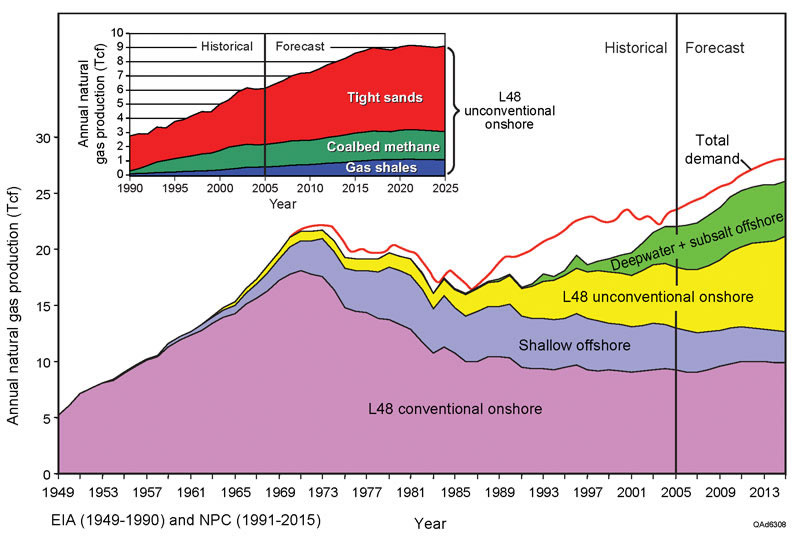
Today, unconventional natural gas already accounts for one-third of the annual domestic production of the slightly more than 18 trillion cubic feet (Tcf) of natural gas from the lower 48 states, according to DOE. Most unconventional gas is differentiated from traditional natural gas sources in that the gas is produced from reservoir rocks with poor permeability — so poor that drillers must routinely enhance permeability in the rocks surrounding each producing well. Unconventional resources occur in low-permeability sandstones (tight gas), within unusual host rocks such as shales (shale gas) or coal seams (coalbed methane), or within gas hydrates in offshore continental margins and onshore Arctic permafrost. Although the U.S. Energy Information Administration (EIA) and National Petroleum Council foresee slight declines in future production of conventional natural gas in the lower 48 states, both onshore and shallow offshore, unconventional natural gas, as well as deepwater and subsalt offshore gas, will continue to provide a greater share of the overall gas supply in the future.
The Need
Natural gas provides about 22 percent of total U.S. energy needs and is used primarily for industrial fuel and raw materials, electrical power generation and home heating, according to EIA. Natural gas is a cleaner-burning alternative to other fossil fuels used in power generation and can be considered, along with nuclear power and “clean coal” technologies, in near-term carbon-reduction strategies. Natural gas is also the best current starting material for hydrogen manufacture for both industrial use and fuel cells.
Ambrose, Potter and Briceno: Sources: EIA and NPC
Ambrose, Potter and Briceno: Sources: EIA and NPC
Annual natural gas production in the U.S. lower 48 states in trillion cubic feet. Production from unconventional gas sources (predominantly tight gas) and deepwater/subsalt offshore will continue to increase. In contrast, production from the lower 48 conventional onshore and shallow offshore sources will decline slightly.
Despite abundant natural gas resources and production capacity in the United States, demand still exceeds supply, with the balance imported mostly via pipeline from Canada. The natural gas supply gap will grow to nearly 9 Tcf per year by 2025, according to Michelle Foss at the Center for Energy Economics in Houston, Texas.
Liquefied natural gas (LNG), transported from traditional high-quality reservoirs outside North America, is expected to make up for this growing shortfall. LNG is a form of natural gas that has been refrigerated to reduce volume. It is typically transported to coastal receiving terminals via large, double-hulled transport ships. When giant fields of natural gas are discovered far from markets or pipelines, transport of the gas in LNG form is a common strategy, and this form of international gas trade is growing rapidly. Significant sources of LNG include the Middle East, North and West Africa, the Caribbean, South America, Indonesia, Malaysia and Australia. The United States is expected to increase imports of LNG from 0.6 billion cubic feet per day in 2006 to 9.6 billion cubic feet per day by 2011, according to EIA.
The continuing growth of unconventional domestic gas supplies will lessen the need for LNG. These gas “plays” have already spurred a dramatic rise in drilling activity, with the U.S. gas-rig count surpassing 1,400 since August 2006, double the levels of 2002, according to Jeremy Platt, chair of the Energy Economics Committee of the Energy Minerals Division (EMD) of the American Association of Petroleum Geologists. This upsurge in drilling activity is attributable to rising natural gas prices. The sources of unconventional gas certainly vary, but many are currently economically viable.
The Sources
Unconventional natural gas differs from conventional natural gas and oil systems in terms of its “play elements,” or key geologic attributes. Major play elements for oil and gas deposits include reservoir quality, trap, source and migration. In conventional oil and natural gas deposits, most hydrocarbons originate from organic-rich source beds and migrate into either structural or stratigraphic traps sealed by low-permeability shales, mudstones or salt.
In contrast, unconventional gas systems, such as shale gas and coalbed methane, are self-sourcing, and gas molecules (principally methane) are trapped in pore networks and in adsorbed state on in-situ organic material. Shale gas and coalbed methane production come from a combination of desorbed gas and free gas flowing through fractures (or cleats in coal in the case of coalbed methane), rather than through the types of intergranular pore networks typically encountered in sandstone beds in conventional oil and gas deposits.
Because unconventional gas resources are generally lower-grade compared to conventional gas, more wells — closely spaced over large areas (whole counties or larger) — are required to produce them. Tens of thousands of new wells have been drilled in the United States for unconventional gas in the past decade. Cost-effective exploration and production strategies must take into account the unique set of play elements that exist for each type of unconventional gas reservoir. An in-depth look at the rock properties is vital to understanding the true complexity of these unusual reservoirs.
Tight Gas
Although tight-gas reservoirs — which account for the majority of unconventional U.S. gas production (about 5 Tcf per year) — produce gas from conventional host-rock lithologies (sandstones and limestones), the quality of the reservoir is a major limiting factor for how accessible the gas is. Tight gas reservoirs are commonly so impermeable that fractures, either natural or those that are intentionally induced in the well-completion process, or both, are necessary to boost producibility. Major tight-gas drilling programs are under way in Rocky Mountain basins as well as in eastern and southern Texas.
Stephen Laubach and his team at the Bureau of Economic Geology (BEG) at the University of Texas at Austin are investigating low-permeability sandstones in the deep subsurface and examining links between mechanical and chemical processes in open fractures that can serve as permeability pathways for gas migration to the well bore. Observations of microfractures in thin sections demonstrate that fracturing and mineral cementation are linked processes. Laubach’s team learned that, ironically, fractures can be both clogged (bad news) or propped open (good news) by quartz cementation. Research efforts are now directed at predicting areas of enhanced fracturing where the cracks remain partially open to fluid flow.
Coalbed Methane
Coalbed methane also provides significant contributions to the U.S. unconventional gas supply, accounting for approximately 10 percent of the nation’s methane resources. With at least 750 Tcf of domestic coalbed methane resources recently discovered, more than 550 Tcf of which is in the western United States, coalbed methane production has climbed from negligible amounts in the mid-1980s to almost 2 Tcf per year, according to DOE. Despite this rapid increase, there are indications that production is beginning to flatten, introducing the challenges of searching for new coalbed methane targets and enhancing production in marginal areas.
Coalbed methane production in the United States and Canada is centered in the West.
Coalbed methane has a unique set of factors that affect production, including the type of coal, as well as cleat and fracture development, which together control migration of gas to the well bore. Coal-seam thickness and continuity also play a role in coalbed methane resource size by controlling reservoir volumes and extent. For example, the greatest coalbed methane production in the Cretaceous Fruitland Formation in the San Juan Basin in New Mexico and Colorado coincides with thick coal seams that accumulated landward (southwestward) of ancient shorelines of the shallow sea that once covered this region about 73 million years ago.
Shale Gas
Shale gas plays have recently made a significant impact on unconventional gas production, especially from the Barnett Shale in the Fort Worth Basin in Texas, where estimated resources are approximately 26 Tcf, according to the U.S. Geological Survey. The Fort Worth Basin is one of about 20 shale gas basins across the United States where total domestic shale gas resources are thought to range from 500 Tcf to 780 Tcf, according to Schlumberger, Inc.
Despite this enormous resource, the percentage of gas recovered by today’s production methods in shale gas reservoirs is low (typically less than 15 percent of estimated gas in place), and controls on shale gas producibility and recovery are still not well-understood. Work continues on modeling fluid flow in nanometer-scale pores in shale gas reservoirs, where classical equations that describe fluid flow through porous media may not be valid, according to Farzam Javadpour at the Alberta Research Council in Canada.
Shale gas research is expanding rapidly as a result of successes in the Barnett in Texas and the age-equivalent Fayetteville Shale in northern Arkansas, and the push to repeat those successes elsewhere. This research covers a wide spectrum of issues. Fundamental depositional controls on mudstones are being reexamined by geologists such as Juergen Schieber at Indiana University in Bloomington. Other major areas of study include pore and fracture development, physical rock properties of shales, and burial/thermal history with related hydrocarbon expulsion. All of these areas of research will help determine production strategies during the lifetime of shale gas plays, targeting recovery of a larger fraction of in-place resources.
Still, there are challenges to this production. The need for safe and efficient disposal of waste water produced during production can be a significant cost factor for producing both coalbed methane and shale gas. Many coalbed methane wells (for example, in the Powder River Basin in Wyoming) require the production of substantial volumes of water before methane becomes mobile and migrates to the well bore. Water is commonly used to fracture the rocks to enhance production in shale gas reservoirs such as the Barnett Shale, where an individual horizontal well can require up to 3 million gallons of water for multiple “frac jobs” in the well-completion process. The Railroad Commission of Texas reports that about 2.6 billion gallons of water were used for frac jobs in the Barnett Shale in 2006. Basinwide, this amounts to 2 percent of total water usage, but in some areas in the Fort Worth Basin, frac water is 10 to 20 percent of the local usage from the Trinity aquifer, according to Jean-Philippe Nicot of BEG. Most of this frac water is produced with the gas and must be disposed of by deep injection. One implication for the oil and gas industry, particularly in the Barnett Shale play, is that operators may eventually have to rely on fracturing techniques that use reconditioned, produced water or less water in general.
Gas hydrates —The New Frontier
Although commercial production has already been established from shale gas and coalbed methane, gas hydrates are truly a frontier resource. Hydrates occur predominantly as methane trapped inside ice-lattice molecular structures in deepwater seafloor sediments. Because of the high-pressure and low-temperature conditions of the seafloor, hydrate methane is a concentrated energy source, with an energy density of 42 percent of that of LNG, according to Bob Hardage of BEG. Although estimates of gas-hydrate resources are uncertain, many experts think that these resources are enormous, and the potential North American resource may be many thousands of trillion cubic feet.
Although natural gas from hydrates is not yet economically feasible to produce, it has been produced successfully in pilot wells in permafrost regions of Russia and Canada. Lessons learned from these investigations could result in viable commercial production by 2015, according to Art Johnson, chair of the EMD Gas Hydrates Committee. However, several safety and technical issues need to be resolved before gas hydrates can become a viable source of unconventional gas. For example, seafloor stability must be assured, as large-scale slumping of shallow, hydrate-bearing strata during production could potentially damage production facilities and release large amounts of methane into the water column and eventually into the atmosphere. Methane, volume-for-volume, is about 20 times more potent than carbon dioxide as a greenhouse gas, so unintended releases must be guarded against.
Important technical issues for gas hydrates include the need for improved petrophysical characterization — a difficult proposition, however. The three-dimensional distribution of gas hydrates can be complex, occurring either in disseminated or tabular form. Realistic modeling of this distribution has a significant bearing on an accurate determination of gas saturation and, thus, on potential resource size. One step in determining distribution of hydrates in sediments involves the correlation of gas-hydrate rock properties with seismic data.
The Future
Obviously, there are several sources of natural gas that are markedly different from conventional gas that may stave off some of the energy issues the United States will face in the coming years. The new unconventional sources are lower-grade, but very widespread in U.S. sedimentary basins. Natural gas consumption in the United States will continue to grow, driven by demand for electric power, home heating, industrial uses and cleaner-burning alternatives to oil and coal for transportation and electricity.
LNG imports, which EIA anticipates will grow from 1 percent of the U.S. natural gas supply to approximately 15 percent by 2025, will help to meet future demands. As these LNG imports come online, additional natural gas production from unconventional gas plays will help to fill supply gaps for the next several decades.
Ambrose, Potter and Briceno are all at the Bureau of Economic Geology at the University of Texas at Austin. The authors gratefully acknowledge Joel Lardon, who drafted the second figure, and Lana Dieterich, who helped edit the manuscript.
Wednesday, February 11, 2009
Is Shale Gas Still "Unconventional"?
The following article comes from the AAPG Explorer, November 2008. Of particular note in the discussion of the factors important to finding and producing this "shale gas", is a lack of a mention of the importance of actually drilling, or steering one of these "horizontal wells". This must be addressed and it is not as simple as it might seem. I hope to discuss this more in the future.
Peter
Understanding gains on ‘new’ reservoir
Shales Closing ‘Conventional’ Gap (source)
At what point do unconventional resources become conventional resources?
If this is possible, gas shales are certainly closing the gap.
Even though operators have produced gas from shales since the first shale-gas well in the organic-rich Dunkirk Shale (Devonian) in New York in 1821, the recent interest in gas shales began in 1981 with the first Barnett Shale well, drilled in the Fort Worth Basin in northern Texas by Mitchell Energy Corporation. Gas shales have advanced to an economic gas play since the year 2000 thanks to a combination of high gas prices, shale reservoir characterization and advances in drilling and completion technology.
The sheer number of articles and conferences describing gas-shale plays in the United States and Canada attests to the high interest level.
As for importance, the Barnett Shale alone supplies about 7 percent of the United States’ annual dry-gas production.
The Marcellus Shale has helped raise the interest in shale plays.
Note the accompanying alphabetical list of many of the United States and Canada gas-shale plays in the news.
Gas shales span reservoir ages of Cambrian to Miocene, and shale formations such as the Barnett, Fayetteville and Woodford have become household names.
Some long-producing shales such as the Antrim, Huron and New Albany are seeing renewed interest – and the Haynesville Shale in Louisiana and Marcellus Shale in the Appalachian states are being compared to the Barnett Shale as the next big plays.
(The Late Devonian-Early Mississippian Bakken Shale in the Williston Basin is not on the list because it is primarily an oil play.)
Early lessons learned and shared concerning how to produce gas from shales have drastically shortened the learning curve when exporting the technology to new shale-gas plays.
One of these lessons was the importance of fractures (natural and induced) for gas production while avoiding fracture propagation into water-bearing formations with the occurrence of shale or carbonate fracture barriers.
Hydraulic slick-water fracturing and re-fracturing were the initial keys to completing the tight-shale reservoir. Today, horizontal wells – first applied to shales in 2003 – are now routinely applied to expose more of the shale to the well bore and use the shale boundaries as fracture barriers.
Recent technological advances applied to horizontal wells in shales include:
3-D seismic in determining lateral length and placement.
Multilaterals (drilling several laterals from a single well pad).
Multiple frac stages within a lateral.
Real-time microseismic monitoring to image hydraulic-fracture treatments.
Simul-fracs (simultaneous hydraulic fracturing of offset parallel horizontal wells about 1,000 feet apart).
Seismic is playing an increasing role in shale gas appraisal and development. In addition to imaging the basic structural geometry and faults, multi-trace attributes such as coherence and volumetric curvature are being used to detect smaller-scale faults, areas of more intense fracturing and collapse features such as sinkholes.
Of course, not all organic-rich shales will be economic gas shales, even with the application of innovative completion technology. What was once thought of as a hydrocarbon source rock or cap rock must now be evaluated as a gas reservoir.
Also, it is not enough to have a thick, organic-carbon rich black shale in the gas window. Other factors such as mineralogy (e.g., clay content and types) and petrographic properties (e.g., silt stringers, laminae, bitumen network) are important to produce gas from shales.
Fortunately, research on petrophysics, geomechanics and geochemistry conducted at universities, service companies and consortia is advancing our understanding of shales as reservoirs.
Much has been learned about how to evaluate shale as a gas source rock and reservoir. Some remaining questions include:
What is the optimum range of thermal maturity?
How low or high of thermal maturity is too low or too high?
What depth is too shallow or too deep to be economic?
How important is reservoir pressure?
Energy Minerals Division members have access to the EMD members-only Web site, which has semiannual gas-shale reports, a calendar of gas-shale conferences, an extensive list of published gas-shale literature, presentations, online reports, Web links and short course notes.
Check it out – and please let me know if you have suggestions on additions to the EMD Gas Shales Committee Web site.
United States and Canada Gas-Shale Plays
Antrim (Late Devonian; Michigan Basin, Michigan)
Baxter (Late Cretaceous; Vermillion Basin, Colorado, Wyoming)
Barnett (Mississippian; Fort Worth and Permian basins, Texas)
Bend (Pennsylvanian; Palo Duro Basin, Texas)
Cane Creek (Pennsylvanian; Paradox Basin, Utah)
Caney (Mississippian; Arkoma Basin, Oklahoma)
Chattanooga (Late Devonian; Alabama, Arkansas, Kentucky, Tennessee)
Chimney Rock (Pennsylvanian; Paradox Basin, Colorado, Utah)
Cleveland (Devonian; east Kentucky)
Clinton (Early Silurian; east Kentucky)
Cody (Cretaceous; Montana)
Colorado (Cretaceous; central Alberta, Saskatchewan)
Conasauga (Middle Cambrian; Black Warrior Basin, Alabama)
Duvernay (Late Devonian; west central Alberta)
Eagleford (Late Cretaceous; Maverick Basin, Texas)
Ellsworth (Late Devonian; Michigan Basin, Michigan)
Excello (Pennsylvanian; Kansas, Oklahoma)
Exshaw (Devonian-Mississippian; Alberta, northeast British Columbia)
Fayetteville (Mississippian; Arkoma Basin, Arkansas)
Fernie (Jurassic; west central Alberta, northeast British Columbia)
Floyd/Neal (Late Mississippian; Black Warrior Basin, Alabama, Mississippi)
Frederick Brook (Mississippian; New Brunswick, Nova Scotia)
Gammon (Late Cretaceous; Williston Basin, Montana)
Gordondale (Early Jurassic; northeast British Columbia)
Gothic (Pennsylvanian; Paradox Basin, Colorado, Utah)
Green River (Eocene; Colorado, Utah)
Haynesville/Bossier (Late Jurassic; Louisiana, east Texas)
Horn River (Middle Devonian; northeast British Columbia)
Horton Bluff (Early Mississippian; Nova Scotia)
Hovenweep (Pennsylvanian; Paradox Basin, Colorado, Utah)
Huron (Devonian; member of Ohio Shale; east Kentucky, Ohio, Virginia, West Virginia)
Klua/Evie (Middle Devonian; northeast British Columbia)
Lewis (Late Cretaceous; Colorado, New Mexico)
Mancos (Cretaceous; San Juan Basin, New Mexico, Uinta Basin, Utah)
Manning Canyon (Mississippian; central Utah)
Marcellus (Devonian; New York, Pennsylvania, West Virginia)
McClure (Miocene; San Joaquin Basin, California)
Monterey (Miocene; Santa Maria Basin, California)
Montney-Doig (Triassic; Alberta, northeast British Columbia)
Moorefield (Mississippian; Arkoma Basin, Arkansas)
Mowry (Cretaceous; Bighorn and Powder River basins, Wyoming)
Muskwa (Late Devonian; northeast British Columbia)
New Albany (Devonian-Mississippian; Illinois Basin, Illinois, Indiana)
Niobrara (Late Cretaceous; Denver Basin, Colorado)
Nordegg/Gordondale (Late Jurassic; Alberta, northeast British Columbia)
Ohio (Devonian; Appalachian Basin, east Kentucky, Ohio, West Virginia)
Pearsall (Cretaceous; Maverick Basin, Texas)
Percha (Devonian-Mississippian; west Texas)
Pierre (Cretaceous; Raton Basin, Colorado)
Poker Chip (Jurassic; west central Alberta, northeast British Columbia)
Queenston (Ordovician; New York)
Rhinestreet (Devonian; Appalachian Basin)
Second White Speckled (Late Cretaceous; southern Alberta)
Sunbury (Mississippian; Appalachian Basin)
Utica (Ordovician; New York, Quebec)
Wilrich/Buckinghorse/ Garbutt/Moosebar (Early Cretaceous; west central Alberta, northeast British Columbia)
Woodford (Late Devonian-Early Mississippian; Oklahoma, Texas)
Peter
Understanding gains on ‘new’ reservoir
Shales Closing ‘Conventional’ Gap (source)
At what point do unconventional resources become conventional resources?
If this is possible, gas shales are certainly closing the gap.
Even though operators have produced gas from shales since the first shale-gas well in the organic-rich Dunkirk Shale (Devonian) in New York in 1821, the recent interest in gas shales began in 1981 with the first Barnett Shale well, drilled in the Fort Worth Basin in northern Texas by Mitchell Energy Corporation. Gas shales have advanced to an economic gas play since the year 2000 thanks to a combination of high gas prices, shale reservoir characterization and advances in drilling and completion technology.
The sheer number of articles and conferences describing gas-shale plays in the United States and Canada attests to the high interest level.
As for importance, the Barnett Shale alone supplies about 7 percent of the United States’ annual dry-gas production.
The Marcellus Shale has helped raise the interest in shale plays.
Note the accompanying alphabetical list of many of the United States and Canada gas-shale plays in the news.
Gas shales span reservoir ages of Cambrian to Miocene, and shale formations such as the Barnett, Fayetteville and Woodford have become household names.
Some long-producing shales such as the Antrim, Huron and New Albany are seeing renewed interest – and the Haynesville Shale in Louisiana and Marcellus Shale in the Appalachian states are being compared to the Barnett Shale as the next big plays.
(The Late Devonian-Early Mississippian Bakken Shale in the Williston Basin is not on the list because it is primarily an oil play.)
Early lessons learned and shared concerning how to produce gas from shales have drastically shortened the learning curve when exporting the technology to new shale-gas plays.
One of these lessons was the importance of fractures (natural and induced) for gas production while avoiding fracture propagation into water-bearing formations with the occurrence of shale or carbonate fracture barriers.
Hydraulic slick-water fracturing and re-fracturing were the initial keys to completing the tight-shale reservoir. Today, horizontal wells – first applied to shales in 2003 – are now routinely applied to expose more of the shale to the well bore and use the shale boundaries as fracture barriers.
Recent technological advances applied to horizontal wells in shales include:
3-D seismic in determining lateral length and placement.
Multilaterals (drilling several laterals from a single well pad).
Multiple frac stages within a lateral.
Real-time microseismic monitoring to image hydraulic-fracture treatments.
Simul-fracs (simultaneous hydraulic fracturing of offset parallel horizontal wells about 1,000 feet apart).
Seismic is playing an increasing role in shale gas appraisal and development. In addition to imaging the basic structural geometry and faults, multi-trace attributes such as coherence and volumetric curvature are being used to detect smaller-scale faults, areas of more intense fracturing and collapse features such as sinkholes.
Of course, not all organic-rich shales will be economic gas shales, even with the application of innovative completion technology. What was once thought of as a hydrocarbon source rock or cap rock must now be evaluated as a gas reservoir.
Also, it is not enough to have a thick, organic-carbon rich black shale in the gas window. Other factors such as mineralogy (e.g., clay content and types) and petrographic properties (e.g., silt stringers, laminae, bitumen network) are important to produce gas from shales.
Fortunately, research on petrophysics, geomechanics and geochemistry conducted at universities, service companies and consortia is advancing our understanding of shales as reservoirs.
Much has been learned about how to evaluate shale as a gas source rock and reservoir. Some remaining questions include:
What is the optimum range of thermal maturity?
How low or high of thermal maturity is too low or too high?
What depth is too shallow or too deep to be economic?
How important is reservoir pressure?
Energy Minerals Division members have access to the EMD members-only Web site, which has semiannual gas-shale reports, a calendar of gas-shale conferences, an extensive list of published gas-shale literature, presentations, online reports, Web links and short course notes.
Check it out – and please let me know if you have suggestions on additions to the EMD Gas Shales Committee Web site.
United States and Canada Gas-Shale Plays
Antrim (Late Devonian; Michigan Basin, Michigan)
Baxter (Late Cretaceous; Vermillion Basin, Colorado, Wyoming)
Barnett (Mississippian; Fort Worth and Permian basins, Texas)
Bend (Pennsylvanian; Palo Duro Basin, Texas)
Cane Creek (Pennsylvanian; Paradox Basin, Utah)
Caney (Mississippian; Arkoma Basin, Oklahoma)
Chattanooga (Late Devonian; Alabama, Arkansas, Kentucky, Tennessee)
Chimney Rock (Pennsylvanian; Paradox Basin, Colorado, Utah)
Cleveland (Devonian; east Kentucky)
Clinton (Early Silurian; east Kentucky)
Cody (Cretaceous; Montana)
Colorado (Cretaceous; central Alberta, Saskatchewan)
Conasauga (Middle Cambrian; Black Warrior Basin, Alabama)
Duvernay (Late Devonian; west central Alberta)
Eagleford (Late Cretaceous; Maverick Basin, Texas)
Ellsworth (Late Devonian; Michigan Basin, Michigan)
Excello (Pennsylvanian; Kansas, Oklahoma)
Exshaw (Devonian-Mississippian; Alberta, northeast British Columbia)
Fayetteville (Mississippian; Arkoma Basin, Arkansas)
Fernie (Jurassic; west central Alberta, northeast British Columbia)
Floyd/Neal (Late Mississippian; Black Warrior Basin, Alabama, Mississippi)
Frederick Brook (Mississippian; New Brunswick, Nova Scotia)
Gammon (Late Cretaceous; Williston Basin, Montana)
Gordondale (Early Jurassic; northeast British Columbia)
Gothic (Pennsylvanian; Paradox Basin, Colorado, Utah)
Green River (Eocene; Colorado, Utah)
Haynesville/Bossier (Late Jurassic; Louisiana, east Texas)
Horn River (Middle Devonian; northeast British Columbia)
Horton Bluff (Early Mississippian; Nova Scotia)
Hovenweep (Pennsylvanian; Paradox Basin, Colorado, Utah)
Huron (Devonian; member of Ohio Shale; east Kentucky, Ohio, Virginia, West Virginia)
Klua/Evie (Middle Devonian; northeast British Columbia)
Lewis (Late Cretaceous; Colorado, New Mexico)
Mancos (Cretaceous; San Juan Basin, New Mexico, Uinta Basin, Utah)
Manning Canyon (Mississippian; central Utah)
Marcellus (Devonian; New York, Pennsylvania, West Virginia)
McClure (Miocene; San Joaquin Basin, California)
Monterey (Miocene; Santa Maria Basin, California)
Montney-Doig (Triassic; Alberta, northeast British Columbia)
Moorefield (Mississippian; Arkoma Basin, Arkansas)
Mowry (Cretaceous; Bighorn and Powder River basins, Wyoming)
Muskwa (Late Devonian; northeast British Columbia)
New Albany (Devonian-Mississippian; Illinois Basin, Illinois, Indiana)
Niobrara (Late Cretaceous; Denver Basin, Colorado)
Nordegg/Gordondale (Late Jurassic; Alberta, northeast British Columbia)
Ohio (Devonian; Appalachian Basin, east Kentucky, Ohio, West Virginia)
Pearsall (Cretaceous; Maverick Basin, Texas)
Percha (Devonian-Mississippian; west Texas)
Pierre (Cretaceous; Raton Basin, Colorado)
Poker Chip (Jurassic; west central Alberta, northeast British Columbia)
Queenston (Ordovician; New York)
Rhinestreet (Devonian; Appalachian Basin)
Second White Speckled (Late Cretaceous; southern Alberta)
Sunbury (Mississippian; Appalachian Basin)
Utica (Ordovician; New York, Quebec)
Wilrich/Buckinghorse/ Garbutt/Moosebar (Early Cretaceous; west central Alberta, northeast British Columbia)
Woodford (Late Devonian-Early Mississippian; Oklahoma, Texas)
Tuesday, February 10, 2009
Shale Gas A Major Contributor To Supplies
Here is more information on the abundance and viability of producing gas from shale. Perhaps the term "unconventional" should be dropped from the phrase "shale gas". It might make financing easier to obtain.
Peter
Laboratory Evaluation of Shale Permeability by InGrain RocksMonday, January 5th, 2009
A Houston company has developed new methods for assessing the production potential of shale based upon an examination of nanofractures in core and cutting specimens. Read more in an article at the Houston Chronicle.
Unconventional Natural Gas is AbundantWednesday, October 1st, 2008
Stephen Holditch of Texas A&M University described a research project at the Oil & Gas Journal’s Unconventional Gas International Conference & Exhibition that estimates volumes of recoverable unconventional natural gas in US sedimentary basis exceeds the amount of recoverable natural gas in conventional deposits by ten fold. More on his study at the Oil and Gas Journal.
Unconventional Natural Gas Production TrendsSaturday, September 6th, 2008
The Energy Information Administration includes the graph of natural gas production shown below in the natural gas section of their 2008 Annual Energy Outlook.

The graph shows onshore unconventional gas production shooting up between 1990 and 2006 but leveling off for the projected data. It seems that there are enough undrilled natural gas leases ticking towards expiration to steepen the production rate rather than allow it to go level.
Peter
Laboratory Evaluation of Shale Permeability by InGrain RocksMonday, January 5th, 2009
A Houston company has developed new methods for assessing the production potential of shale based upon an examination of nanofractures in core and cutting specimens. Read more in an article at the Houston Chronicle.
Unconventional Natural Gas is AbundantWednesday, October 1st, 2008
Stephen Holditch of Texas A&M University described a research project at the Oil & Gas Journal’s Unconventional Gas International Conference & Exhibition that estimates volumes of recoverable unconventional natural gas in US sedimentary basis exceeds the amount of recoverable natural gas in conventional deposits by ten fold. More on his study at the Oil and Gas Journal.
Unconventional Natural Gas Production TrendsSaturday, September 6th, 2008
The Energy Information Administration includes the graph of natural gas production shown below in the natural gas section of their 2008 Annual Energy Outlook.
The graph shows onshore unconventional gas production shooting up between 1990 and 2006 but leveling off for the projected data. It seems that there are enough undrilled natural gas leases ticking towards expiration to steepen the production rate rather than allow it to go level.
Energy And The Role Played By Natural Gas
We are learning what a valuable fuel natural gas is. It burns more cleanly than oil or coal. The infrastructure to find, produce, and transport it to the end users is in place. Perhaps best of all, we're finding more of it than ever and some predictions are there may be enough to power our economy for 100 years or more.
This abundance is largely due to improved technology enabling the production of gas from tight sandstones and most importantly, shale. This technology involves horizontal drilling, new hydraulic fracturing methods, and the ability to interpret these long, "horizontal" well bores, or as they're called, "laterals".
Peter

Natural gas is vital to all aspects of the American economy, and it is not easily replaced.
 Natural gas far less carbon (dioxide) emissions that does burning oil or coal.
 Petroleum products, coal, and natural gas account for 85% all energy used in America. This can not be replaced by so-called "renewables" in the near term.
 Natural gas burns far more cleanly than oil or coal.
 Natural gas is the more efficient that oil, coal, or even nuclear energy.
This abundance is largely due to improved technology enabling the production of gas from tight sandstones and most importantly, shale. This technology involves horizontal drilling, new hydraulic fracturing methods, and the ability to interpret these long, "horizontal" well bores, or as they're called, "laterals".
Peter
Natural gas is vital to all aspects of the American economy, and it is not easily replaced.
 Natural gas far less carbon (dioxide) emissions that does burning oil or coal.
 Petroleum products, coal, and natural gas account for 85% all energy used in America. This can not be replaced by so-called "renewables" in the near term.
 Natural gas burns far more cleanly than oil or coal.
 Natural gas is the more efficient that oil, coal, or even nuclear energy.
Solving The Financial Crisis AND The Energy Crisis
Here is some positive news about the economy and America's need for abundant, inexpensive, clean energy. Somehow the credit markets must be re-established so these independent producers can do what they do best: find, produce, and deliver the abundant natural gas resources known to exist.
This will not be the only way to work out of this economic recession, but it will be a giant step in the right direction. See the following article and consider the added graphs and charts.
Peter
Financial Crisis = Energy Crisis? (source) posted Sept. 30, 2008
Up until a few weeks ago, energy was a front-page topic. Now its place has been taken by our financial crisis. But while all the mainstream media attention regarding the present financial crisis has focused on its threat to America’s financial sector, the fact is that threat very much includes our present and future ability to meet our energy needs.
Most of our domestic natural gas production is not the work of so-called “big oil,” but rather by independent producers who are entrepreneurial businesses that make their revenues only by producing natural gas. They utilize the futures market to reduce risk and to ensure a certain return on what they produce but have no retail or other operations that can offset big swings in price. Current domestic production is threatened because of the massive amounts of capital it requires to drill and produce that natural gas here in the U.S. Producers must have access to that capital.
At the same time, the financial crisis has increased the volatility of the energy markets. Bear Stearns, Lehman Brothers, Goldman Sachs and others all played a major role in the commodities markets, including energy. The buying and selling that has occurred, as the major players have had to liquidate some positions and cover others have roiled the markets, making it extremely difficult for independent producers to do any long-range planning. It also has left some holding the bag.
Tulsa, Oklahoma-based Semgroup LP’s bankruptcy, caused by the firms’ huge exposure to energy options trading, has left thousands of small producers who sold oil to the firm owed millions, and the producers unable to pay royalty owners. We don’t have to go far back in time to see what happens if the independent producers are harmed.
In the late 1990’s, Venezuela flooded the U.S. market with below-cost Venezuelan oil. Oil fell to $8 a barrel, if you can imagine that now—less than 10 years ago. This was done with the goal of driving America’s independent oil producers out of business, about a million barrels of oil a day. Thousands of independent producers who had hung on through the boom and bust 1980’s were put out of business, and our reliance on foreign oil, and the transfer of American wealth overseas, increased accordingly. But it wasn’t only our domestic oil production that was lost.
Many of the independents were also natural gas producers. But we were able to move from a position of natural gas want to natural gas abundance with new, more expensive technology and new ideas that unlocked natural gas from shales and sands. That brings us to a less tangible, but no less real aspect to the present threat, and it is the fact that independents also bring the kind of “outside the box” thinking needed to solve our energy and environmental problems.
In the 1970’s, while the best and brightest of the biggest oil companies were busy telling Congress we were running out of natural gas, such small independents as GHK’s Bob Hefner had the gall to challenge them both in words and deeds, in the end proving that natural gas could be found even where no oil existed, and at depths never before thought possible. Independents were way ahead of the curve in jumping in with both feet when it came to natural gas, to the point where today in America, more than 90 percent of the working rigs are exploring for the natural gas that is so critical to our present and future energy needs.
The shale production techniques that have played such a key role in just the past four years in providing abundant supplies of clean-burning natural gas were developed by an independent producer and it is the American independent producers that are leading the way in developing these clean energy sources for the future right now. This kind of entrepreneurial thinking is also driving the current development of wind, solar, and biomass, which, in conjunction with natural gas, can form an energy portfolio that will secure a green energy future for us. But these sectors are also facing the same threats. Access to capital is essential for these “plays” to develop to their full potential. The need for wise, forward-thinking policy decisions has never been greater. You cannot have a sound economy without American energy to fuel that economy. A strong capital market is essential to any energy policy. And an energy policy that ignores the environment is self-defeating. It’s not just financial institutions that are at stake in this debate, but our energy and environmental future as well.
This will not be the only way to work out of this economic recession, but it will be a giant step in the right direction. See the following article and consider the added graphs and charts.
Peter
Financial Crisis = Energy Crisis? (source) posted Sept. 30, 2008
Up until a few weeks ago, energy was a front-page topic. Now its place has been taken by our financial crisis. But while all the mainstream media attention regarding the present financial crisis has focused on its threat to America’s financial sector, the fact is that threat very much includes our present and future ability to meet our energy needs.
Most of our domestic natural gas production is not the work of so-called “big oil,” but rather by independent producers who are entrepreneurial businesses that make their revenues only by producing natural gas. They utilize the futures market to reduce risk and to ensure a certain return on what they produce but have no retail or other operations that can offset big swings in price. Current domestic production is threatened because of the massive amounts of capital it requires to drill and produce that natural gas here in the U.S. Producers must have access to that capital.
At the same time, the financial crisis has increased the volatility of the energy markets. Bear Stearns, Lehman Brothers, Goldman Sachs and others all played a major role in the commodities markets, including energy. The buying and selling that has occurred, as the major players have had to liquidate some positions and cover others have roiled the markets, making it extremely difficult for independent producers to do any long-range planning. It also has left some holding the bag.
Tulsa, Oklahoma-based Semgroup LP’s bankruptcy, caused by the firms’ huge exposure to energy options trading, has left thousands of small producers who sold oil to the firm owed millions, and the producers unable to pay royalty owners. We don’t have to go far back in time to see what happens if the independent producers are harmed.
In the late 1990’s, Venezuela flooded the U.S. market with below-cost Venezuelan oil. Oil fell to $8 a barrel, if you can imagine that now—less than 10 years ago. This was done with the goal of driving America’s independent oil producers out of business, about a million barrels of oil a day. Thousands of independent producers who had hung on through the boom and bust 1980’s were put out of business, and our reliance on foreign oil, and the transfer of American wealth overseas, increased accordingly. But it wasn’t only our domestic oil production that was lost.
Many of the independents were also natural gas producers. But we were able to move from a position of natural gas want to natural gas abundance with new, more expensive technology and new ideas that unlocked natural gas from shales and sands. That brings us to a less tangible, but no less real aspect to the present threat, and it is the fact that independents also bring the kind of “outside the box” thinking needed to solve our energy and environmental problems.
In the 1970’s, while the best and brightest of the biggest oil companies were busy telling Congress we were running out of natural gas, such small independents as GHK’s Bob Hefner had the gall to challenge them both in words and deeds, in the end proving that natural gas could be found even where no oil existed, and at depths never before thought possible. Independents were way ahead of the curve in jumping in with both feet when it came to natural gas, to the point where today in America, more than 90 percent of the working rigs are exploring for the natural gas that is so critical to our present and future energy needs.
The shale production techniques that have played such a key role in just the past four years in providing abundant supplies of clean-burning natural gas were developed by an independent producer and it is the American independent producers that are leading the way in developing these clean energy sources for the future right now. This kind of entrepreneurial thinking is also driving the current development of wind, solar, and biomass, which, in conjunction with natural gas, can form an energy portfolio that will secure a green energy future for us. But these sectors are also facing the same threats. Access to capital is essential for these “plays” to develop to their full potential. The need for wise, forward-thinking policy decisions has never been greater. You cannot have a sound economy without American energy to fuel that economy. A strong capital market is essential to any energy policy. And an energy policy that ignores the environment is self-defeating. It’s not just financial institutions that are at stake in this debate, but our energy and environmental future as well.
Subscribe to:
Posts (Atom)