Showing posts with label United States. Show all posts

Wednesday, April 11, 2012

Hope For The US Economy Lies In Increasing Oil and Gas Production

The following is a well written, researched and balanced summary of the current state of affairs in the United States regarding our energy situation.  The focus is on oil and gas, but of course all of our sources of energy are intertwined.

One thing I find moderately amusing is that the myth of burning fossil fuels and the release of "fossil" carbon dioxide (CO2) is causing damaging global warming and climate change, will just not die.  The myth is so deeply embedded into people's consciousness by the decades-old propaganda put out by the environmental lobbyists, that even so-called "objective" journalists like the author of the following article, just won't let it go.  Someone said "a lie told often enough becomes accepted as fact".  Maybe that is what has happened.

Anyway, I liked the the article and I consider it a rare example of something accurate and politically neutral coming from the New York Times, which often times I can barely read because of its transparent liberal bias.
Peter

Go here to read more: http://www.nytimes.com/2012/04/11/business/energy-environment/energy-boom-in-us-upends-expectations.html?pagewanted=1&_r=1&nl=todaysheadlines&emc=edit_th_20120411&ref=businessspecial2&adxnnlx=1334160224-BLqeHLoa65Qov22Pwxzh6A


April 10, 2012

Fuel to Burn: Now What?

THE reversal of fortune in America’s energy supplies in recent years holds the promise of abundant and cheaper fuel, and it could have profound effects on what people drive, domestic manufacturing and America’s foreign policy.
       
Cheaper fuel produced domestically could reduce the cost of shipping and manufacturing, trim heating and cooling bills, improve the auto market and provide tens of thousands of new jobs.
It might also pose new environmental challenges, both predictable and unforeseen, by damping enthusiasm for clean forms of energy and derailing efforts to wean the nation from its wasteful energy habits.
       
But for Americans battered by rising gasoline prices, frustrated by the dependence on foreign oil, skeptical of the benefits or practicality of renewable fuels and afraid of nuclear power, the appeal of plentiful domestic oil and gas could far outweigh the costs.
       
Just a few years ago, the dominant theme in discussions about energy was of declining production and the fear of running out of oil. Even today, political tensions in the Middle East, particularly in the Persian Gulf, have fanned fears of supply disruptions that are keeping prices high.
But a new boom in energy production in recent years has upended these expectations in record time. High energy prices led to a wave of successful oil and gas exploration in North America, including in fields that were deemed uneconomical only a few years ago. Using techniques like horizontal drilling and hydraulic fracturing, oil companies are tapping into deeply buried reserves in shale rocks and in the ocean’s depths.
       
The surge in energy prices, along with a recession and new government rules that tightened fuel-economy standards, led to a sharp cutback in gasoline consumption. This decline in demand in the last five years reversed decades of almost uninterrupted growth that made the United States the world’s top energy consumer, accounting for one in every four barrels of oil burned around the globe.
The North American energy revival is primarily the result of so-called unconventional sources of energy — like shale oil and shale gas across the United States, oil sands in Canada and deepwater production in the Gulf of Mexico. In the last five years, the United States and Canada combined have become the fastest-growing sources of new oil supplies around the world, overtaking producers like Russia and Saudi Arabia.
       
“The transformation unfolding in North America represents a potentially decisive shift in the history of energy,” Rex W. Tillerson, the chairman and chief executive of Exxon Mobil, who is not usually given to hyperbole, said in a speech in Houston last month.
       
Ed Morse, head of global commodity research at Citigroup and a longtime energy analyst, says North America has the potential to become a “new Middle East.”
       
“The reduced vulnerability of North America — and the world market — to oil price spikes also has deep consequences geopolitically, including the reduced strategic importance to the U.S. of changes in oil- and natural gas-producing countries worldwide,” Mr. Morse said in a recent 92-page report called Energy 2020. ”Pressures towards isolationism in the U.S. will likely grow, with consequences for global stability that can only just begin to become understood.”
       
“The only thing that could stop this is politics — environmentalists getting the upper hand over supply in the U.S., for instance,” the report said.
       
The new supplies ensure that the United States will remain well entrenched in oil, but the continuing reliance on fossil fuels also carries significant environmental concerns — whether from the risk of offshore drilling, or the hazards, many still unknown, of hydraulic fracturing. It also means that greenhouse gas emissions will most likely increase, at least until carbon emissions are capped or new technology to store carbon dioxide underground is developed.
       
The glut of natural gas supplies cuts two ways on emissions. It has effectively put an end in the United States to any new investment in coal plants, which produce much more emissions. But it also makes the economics of alternative, noncarbon energy sources like wind power or solar power difficult to justify without public support and subsidies.


And with gasoline prices above $4 a gallon, the nation’s energy resources remain a polarizing topic, pitting Republicans against Democrats, environmentalists against oil companies, and conservationists against advocates of unfettered drilling.
       
“It is remarkable how quickly perceptions have changed,” says Guy Caruso, the administrator of the United States Energy Information Administration from 2002 to 2008, who is now at the Center for Strategic and International Studies. “We may be in the early stage of this transformation, and clearly things could still go wrong.”
       
Energy production is an inherently risky business, but recent history suggests that when resources are available they end up being developed.
       
After the explosion of BP’s deepwater well two years ago in the Gulf of Mexico, leading to the biggest oil spill in American history, the Obama administration imposed a moratorium on offshore drilling. But it took only about a year for exploration and production to resume offshore.
       
Cheaper energy costs — particularly for natural gas — would benefit a variety of domestic industries, like chemicals, pharmaceuticals and fertilizers. The rise in natural gas production has already led many utility companies to shift their electrical production away from coal; it also calls into question talk of a nuclear revival in the United States.
       
Economists say that ample gas supplies might also provide the basis for a resurgence of American manufacturing, which has been battered by high energy costs for much of the last decade.
Natural gas prices have fluctuated wildly in recent years, rising to $14 for a thousand cubic feet from $2 within a few years. The current glut, however, has driven prices back down again, to near $2 for a thousand cubic feet.

With America becoming one of the top natural gas producers, some domestic companies might rethink moving parts of their business to countries with cheaper energy costs. (At current consumption rates, American gas reserves would last at least 75 years, an estimate some experts say is conservative.)
Lower natural gas costs would also have cascading benefits to other commercial sectors, like retailing. Shipping costs may be lower, particularly if transportation companies shift their fleets to natural gas-powered or electric vehicles. FedEx, for instance, has already been adding clean energy trucks to its fleet, including hybrid and all-electric delivery trucks in cities like Chicago.

Citigroup estimates that as many as 3.6 million new jobs might be created by 2020 thanks to the energy boom. The current trade deficit might fall by 60 percent by the end of the decade from today’s level, according to the bank’s estimates, and the dollar could appreciate by as much as 5.4 percent as imports shrink.

“In a world of high energy prices, the potential economic activity generated by this wave of new hydrocarbon production is extraordinary and should strongly boost national output, increase incomes, create wealth, stimulate consumption and create jobs,” according to Citigroup.
Given how swiftly expectations have shifted to describe America’s energy prospects, however, some caution may be warranted.
       
Opposition from environmental groups and concerns about climate change — which is caused by increased carbon emissions from fossil fuels — could lead to tighter regulation of petroleum products or derail infrastructure projects like pipelines.
       
That is what has happened to the extension of the Keystone XL Pipeline, which its supporters say is needed to increase the import of oil from Canada’s oil sands into the United States. That project has faced stiff opposition from environmental groups because oil sands are more energy-intensive and emit more carbon dioxide into the atmosphere than traditional oil sources.
       
The increased reliance on these unconventional oil sources, including oil sands and shale oil, has led some energy experts to talk about a “re-carbonization” of energy supplies if that reliance distracts from the need to develop renewable fuels.
       
“As we run out of conventional fossil fuels, we face some fundamental choices,” said Dan Lashof, the climate program director at the Natural Resources Defense Council. “Are we going to switch to cleaner energy sources, or are we going to switch to dirtier energy sources? That’s why the Keystone pipeline was so hard fought. It’s because we face a real fork in the road. And depending which way we go, solving our environmental problems might become impossible.”
Environmental groups are also concerned about the effects on underground aquifers of hydraulic fracturing — in which water under high pressure is used to break apart shale rocks to release natural gas.
While natural gas emits less carbon dioxide than coal when burned for electrical production, which has led producers to try to brand it as a “clean” energy source, it remains a fossil fuel that emits carbon into the atmosphere when burned. Because it is suddenly plentiful, and relatively cheap, doubts have been raised about future investments in renewable power sources that had been favored to replace coal.      
“Cheap natural gas has delivered significant near-term environmental benefits, but it clouds the outlook for renewable energy,” said Trevor Houser, a partner at the Rhodium Group, an economic research firm. “Without an extension of current tax credits or adoption of new pro-renewables policy, wind power and other renewable energy sources will have a tough time competing with natural gas in the years ahead.”

Geologists have long known that shale basins across the country, like the Bakken field in North Dakota, Eagle Ford and Barnett in Texas, and the Marcellus in the Northeast, held tremendous oil and gas reserves. But energy companies had no economic way to collect them until new technology recently changed that.
       
The results have been impressive. Production from the Bakken region alone has gone from negligible quantities to 500,000 barrels of oil a day in just a few years. Production at Eagle Ford produced just 787 barrels in 2004. Last year, its production reached 30.5 million barrels, according to state regulators, and it is still growing. Natural gas production there went from nothing to 243 billion cubic feet in just three years.   (Not bad Ken)

The National Petroleum Council, an industry-led group that provides advice to the secretary of energy, recently outlined its view of how the nation’s larger-than-expected resource might be developed.
In a major study released last year, the group forecast that North American oil production might exceed 20 million barrels a day by 2035 under a “high potential” situation of unfettered access.
However, under a “limited” situation where production was constrained for a variety of environmental or political reasons, domestic supplies might fall to less than 10 million barrels a day.
       
Some experts are more bullish. Mr. Morse of Citigroup forecast that North American oil production could reach an astounding 27 million barrels a day by 2020, almost twice the rate of production of 15 million barrels a day at the end of 2011. Production from the United States could grow to 15.6 million barrels a day by 2020, up from nine million barrels a day in 2011.

If that trend continues, the growth in oil and natural gas supplies in the next decades could turn the United States into a top energy exporter, rivaling some members of the Organization of the Petroleum Exporting Countries. Natural gas could be sold to Mexico and Canada (because exploiting oil sands is so energy-intensive, Canada might have to import natural gas to produce its oil). Refined petroleum products, and even crude oil, could find customers in Europe and Latin America. Coal could be exported to China.
       
With less gasoline demand, the nation’s surplus refining capacity means the United States is already exporting petroleum products — like gasoline and diesel. The United States is now the top exporter of refined products, just ahead of Russia.
       
The United States has been a net oil importer since the middle of the last century. America’s dependence on imports grew as the country’s consumption rose and domestic production dropped, and reached a peak in 2005. That year, domestic consumption of oil was about 21 million barrels of oil a day — a quarter of global oil demand. More than two-thirds of that was imported.
But this was most likely the high-water mark for oil imports, at least in the foreseeable future. The nation’s oil consumption has since fallen by about three million barrels a day as consumers cut back on their gasoline use.

Analysts say this trend is actually deep-seated, and is likely to continue. Americans are buying fewer cars, and they are driving shorter distances. The average distance traveled peaked at 12,500 miles a year in 2003, according to Citigroup, and could fall to 11,600 miles a year by 2020.
At the same time, federal fuel-efficiency standards are being tightened. The Obama administration and automakers last year agreed to new fuel-efficiency targets, aiming to raise the Corporate Average Fuel Efficiency, or CAFE, standard to 54.5 miles per gallon by 2025, with the goal of saving 12 billion barrels of oil over the life of the program.

Political attitudes, once hard and fast, are undergoing a transformation.
“For 20 years, Democrats opposed opening public lands to oil production and Republicans opposed increases in fuel economy standards, but the run-up in oil prices shattered all that,” said Paul W. Bledsoe, a senior adviser at the Bipartisan Policy Center, a research group in Washington. “The shift in politics was amazingly swift. As was the change in psychology, where the United States was viewed as an energy-depleted nation, to the view now of an energy-rich superpower.”
       
The rise in fuel efficiency in conventional vehicles, along with the growing popularity of hybrids, could also mean all-electric cars will struggle to gain much market share, according to a report released last year by the Boston Consulting Group. In fact, the report found that by 2020, electric cars in the United States would account for a lower share of the market than in either China or the European Union, where they are likely to benefit from government support.

Assessing falling American dependence on foreign oil, analysts with the financial firm Raymond James said imports fell from 65 percent of demand, or 13.5 million barrels a day, their peak in 2005, to 9.8 million barrels a day in 2011, or 52 percent of demand. They predicted that imports would keep falling, reaching 4.5 million barrels a day — or just a quarter of domestic oil demand — by 2015. By 2020, they forecast, the United States would not need to import foreign oil anymore.
       
“The resulting savings from the standpoint of the trade deficit are highly meaningful,” the analysts said, “especially when the benefits of cheaper energy for domestic manufacturing are taken into account. Maybe the real question is, When will Washington apply to join OPEC?”
While the question is provocative, the change in outlook for domestic supplies, along with the changed role of the United States in global energy markets, carries important economic and geopolitical lessons.
       
Nationalism over natural resources in countries like Venezuela, Russia and much of the Middle East has increasingly forced Western oil companies to look for oil and gas closer to home. And exports are already shrinking for many OPEC producers as their own domestic demand soars — a result of energy subsidies that keep prices artificially low.
       
It is still too early to get a clear sense of the political implications of this reduced reliance on oil from places like the Middle East. Four of the top five sources of foreign oil to the United States are already outside the Middle East — Canada, Nigeria, Venezuela and Mexico. The fifth is Saudi Arabia.
James Brick, an energy analyst with Wood Mackenzie, a research firm, said in a recent report that by 2030 the United States could end up exporting 500 million tons of coal a year, 3.2 billion cubic feet a day of natural gas and 2.5 million barrels a day of oil products.
       
“The United States will be playing a very different role on the energy markets, a much more international role and a much more complicated and sophisticated one,” said Mr. Brick. “As with any forecast there are uncertainties but no matter how you cut it, the United States has the resources in the ground.”


Tuesday, June 9, 2009

US and Canadian Shale Gas Important Globaly

Study: US-Canadian shale could neutralize Russian energy threat to Europeans

New Baker Institute report looks at Russia and world energy balance (source)

Rising shale gas production in the United States and Canada as well as potential natural gas supplies from Iraq could be pivotal in curbing Russia’s ability to organize an “energy weapon” against European consumers, according to a new study released today by Rice University’s Baker Institute for Public Policy.

The study, "Russia and the Caspian States in the Global Energy Balance," examines Russia’s evolving energy relations with its Caspian neighbors, the Organization of Petroleum Exporting Countries and the West and considers potential scenarios for Russian and Caspian oil and natural gas strategies.

"Maintaining favorable tax conditions to support investment in onshore shale gas resources in the United States can play an important role of containing Russia’s leverage over an increasingly global natural gas market," said Kenneth Medlock, a Baker Institute researcher and lead author of the study. "In addition to North American resources, our scenario analysis shows that there are several supply sources that can serve as viable alternatives to heavy future global reliance on Russian natural gas."

The level of investment made by small U.S. independent oil and gas companies could be negatively affected by proposed new tax changes such as the abolition of IDC (intangible drilling costs) credits and adjustments in the depreciation allowance because in many cases, smaller drilling companies do not have the scale to absorb additional costs.

Medlock said that Russian efforts to organize a "gas troika" among three of the largest natural gas producers – Iran, Russia and Qatar – would result in all members of the troika losing significant market share over time with only minor, short-lived gains from higher prices. The development of alternative supplies from a variety of other sources, including North America, North Africa, Australia and Iraq, would serve as counterweights to attempts by the troika to exercise any market power. "Ironically, Russia could be one of the biggest losers in this scenario," Medlock said. Nonetheless, the Baker Institute recommends that the United States and Europe work together to promote the development of additional natural gas storage capacity (perhaps a strategic stockpile), particularly in Europe, to enhance energy security in the emerging global natural gas market. "Storage is vital to overcoming short-term market disruptions, but it is likely that market reform will be a precursor to substantially enhancing Europe’s storage capability," Medlock said. The study also notes that concerns about the vulnerability of Eastern European countries such as Ukraine and Poland could be best addressed by helping to finance projects to diversify the natural gas supplies of those countries.

The Baker Institute researchers recommend that the Obama administration consider new approaches to counter Russian interference in the energy sector of the Central Asian energy states and transit states in the Caucasus. The Baker Institute said U.S. diplomats should focus more on resolving territorial and ethnic conflicts in the region and on promoting overall energy market transparency and liberalization than on reviving stalled pipeline diplomacy. "For all the United States’ good intentions, U.S. pipeline diplomacy has not managed to significantly reduce the dependence of Central Asian states on Russia to transport their energy supplies," the study’s authors wrote. Although there was little damage to the U.S.-backed Baku-Tbilisi-Ceyhan pipeline and the Baku-Tbilisi-Erzurum pipelines that extended through Georgia during the Russo-Georgia war of 2008, the operation of Georgian ports was seriously disrupted, making apparent the risks that either accidental or deliberate damage could take place at Russian hands.

To access the executive summary of the study, visit here http://www.rice.edu/nationalmedia/multimedia/2009-05-07-RussEnergyExecSum.pdf.

For more information, or to speak to one of the authors, contact Franz Brotzen at franz.brotzen@rice.edu or 713-348-6775.

Wednesday, April 22, 2009

Shale Gas Development In U.S. --- Table of Contents

The following summarizes what is covered in the recent publication by The Department of Energy (DOE). (source)
For our purposes here, we are most interested in the geological, engineering and economic aspects of shale gas development, but comments on any of the following subjects are welcome.

(As an aside, do any of our political lawmakers and decision-makers read and understand the significance of extracting this abundant natural gas? It is used to heat and cool our homes, power our industry, and can even be easily used to power our vehicles when it is compressed. If we really want to reduce our dependence on "foreign oil" we should be aggressively producing this gas! The DOE estimates we have enough to last 100 years! What are we waiting for? Windmills, solar panels and nuclear power plants? That's crazy! We have this natural gas here and now, with established infrastructure and known technology; let's go get it!)
Peter

MODERN SHALE GAS DEVELOPMENT IN THE UNITED STATES: A PRIMER

TABLE OF CONTENTS

Table of Contents ---i
List of Exhibits---iii

INTRODUCTION---1

THE IMPORTANCE OF SHALE GAS --- 3
The Role of Natural Gas in the United States’ Energy Portfolio ---3
The Advantages of Natural Gas --- 5
Natural Gas Basics ---6
Unconventional Gas--- 7
The Role of Shale Gas in Unconventional Gas---8
Looking Forward ---10

SHALE GAS DEVELOPMENT IN THE UNITED STATES ---13
Shale Gas – Geology ---14
Sources of Natural Gas---16
Shale Gas in the United States ---16
The Barnett Shale ---18
The Fayetteville Shale---19
The Haynesville Shale ---20
The Marcellus Shale ---21
The Woodford Shale ---22
The Antrim Shale ---23
The New Albany Shale ---24

REGULATORY FRAMEWORK--- 25
Federal Environmental Laws Governing Shale Gas Development--- 25
State Regulation ---25
Local Regulation ---27
Regulation of Impacts on Water Quality ---29
Clean Water Act---29
Safe Drinking Water Act --- 32
Oil Pollution Act of 1990 – Spill Prevention Control and Countermeasure---33
State Regulations and Regional Cooperation --- 35
Regulation of Impacts on Air Quality---35
Clean Air Act ---35
Air Quality Regulations ---36
Air Permits ---36
Regulation of Impacts to Land ---37
Resource Conservation and Recovery Act (RCRA) ---37
Endangered Species Act---38
State Endangered Species Protections ---39
Oil and Gas Operations on Public Lands ---39
Federal Lands ---39
State Lands ---40
Other Federal Laws and Requirements that Protect the Environment---40
Comprehensive Environmental Response, Compensation, and Liability Act ---40
Emergency Planning and Community Right-to-Know Act---41
Occupational Safety and Health Act ---42
Summary ---42

ENVIRONMENTAL CONSIDERATIONS --- 43
Horizontal Wells ---46
Reducing Surface Disturbance ---47
Reducing Wildlife Impacts --- 48
Reducing Community Impacts --- 49
Protecting Groundwater: Casing and Cementing Programs ---51
Hydraulic Fracturing ---56
Fracture Design ---56
Fracturing Process---58
Fracturing Fluids and Additives ---61
Water Availability ---64
Water Management ---66
Naturally Occurring Radioactive Material (NORM) ---70
Air Quality ---71
Sources of Air Emissions --- 72
Composition of Air Emissions --- 72
Technological Controls and Practices---74
Summary ---76
Acronyms and Abbreviations ---79

DEFINITIONS --- 81

END NOTES---83

Sunday, February 22, 2009

Shale Gas Production Methods To Be Used Overseas

Why not take the technology mastered in the United States in the Barnett Shale, Haynesville Shale, Fayeteville Shale, Marcellus Shale, Bakken Formation, etc. and use it in shale formations containing gas in other parts of the world? It makes perfect sense and it is bound to happen. American companies with this expertise should position themselves to take advantage of this opportunity.
Peter

American drilling techniques may migrate overseas
By MARK WILLIAMS AP Energy Writer (source)
With one eye cast toward home, giant European energy companies are investing billions in U.S. natural gas and oil fields where huge, hard-to-get reserves have been unlocked with new drilling technology.

That technology is the prize in Europe, where gas production has declined and where an international utility dispute recently left people in more than a dozen European countries shivering in unheated homes.

Europe's natural gas supply is routed through Ukraine from Russia. Russia supplies about one-quarter of the EU's natural gas, with 80 percent of it shipped through Ukraine. A rift between the two nations left more than a dozen European countries with little or no gas for two weeks last month.

Declines in European gas production has potentially made the new techniques used in the U.S. even more pivotal.

At least three European oil and gas giants are developing or have bought interests in oil and gas shale projects in the U.S. - Norwegian oil company StatoilHydro, the U.S. unit of British oil company BP Plc and French company Total.

StatoilHydro and BP have agreed in recent months to pay billions of dollars for stakes in shale gas projects from the top U.S. producer of gas, Chesapeake Energy. Total has bought a 50 percent stake in a U.S. company exploring for oil shale in the Rocky Mountains.
"Given the magnitude of oil shale resources we believe that this project has an important long-term potential for global energy markets," Yves-Louis Darricarrere, Total's exploration and production president, said in announcing Total's deal with American Shale Oil.
Shale is a kind of layered, sedimentary rock that exists in formations throughout the world. In the U.S., gas production from shale dates back to the 1800s.

But the gas, tightly locked in rock formations, had been extraordinarily expensive to extract. That began to change about 15 years ago as producers developed new techniques such as horizontal drilling, where the drill is turned in a right angle to bore into a gas reservoir horizontally.

Gas from shale now amounts to about 5 percent of total U.S. production, according to the Gas Technology Institute.

If the same technology works in Europe it could free up an enormous amount of energy, and potentially provide a buffer against cross-border disputes to the east.
StatoilHydro bought into Chesapeake Energy's massive Appalachian Marcellus shale project for $3.37 billion in November. Executive Vice President Rune Bjornson said at an energy conference this month in Houston that StatoilHydro wants to bring new drilling technology to other regions of the world.

If the race to duplicate drilling success in the U.S. is on, few companies are talking about it.
Even Aubrey McClendon, co-founder and chief executive of Chesapeake, the largest natural gas producer in the U.S., said, "I doubt we will trumpet it as I think the combination of their international stature and presence and our knowledge of gas shale would do nothing but attract competition."

But it has become abundantly clear since a chilly two weeks in January that Europe's energy security has been diminished since the break up of the Soviet Union.
Buying into the technology in the U.S. makes sense and could spare European companies years of development, said Don Hertzmark, an international energy expert.
"The Europeans never bothered to develop this stuff," he said.
U.S. companies stand to expand through new markets in Europe if the new techniques work, and many experts believe that they will.

Energy companies are now funding a six-year study to locate gas deposits in Europe and to determine if they can be exploited.
"The companies that are involved here - they're not beginners," said Brian Horsfield of the GFZ German Research Center, which is heading the study. "It could come online within three years if it turns out these gas shales really are as prolific as we're led to believe."
Horsfield, a professor of organic geochemistry, said companies already have acquired land rights throughout Europe.

"The shale gas, if it were to be economic here, is very close to the user," Horsfield said. "That's one of the selling points, certainly, of our project on a nonscientific basis. And the events of the last month or so have helped to stress that."

European Commission President Jose Manuel Barroso said after the dispute between Russia and Ukraine was settled (the second dispute in recent years) that Europe must diversify its energy sources and supply route.
"It was utterly unacceptable that European gas consumers were held hostage to this dispute between Russia and Ukraine," he said.

Associated Press writers Patrick McGroarty in Berlin and Greg Keller in Paris contributed to this story.

Thursday, February 12, 2009

A Look At All Categories Of "Unconventional Gas" Supplies

How things change, in just one year. The economic downturn has put much of the drilling and production of so called "unconventional gas" on hold. The question is, when and to what degree will the economy recover and increase demand and price? This article, written just one year ago, in February 2008, describes and defines the different categories of unconventional gas. The authors also make projections of future demand and production.
Peter


An “Unconventional” Future for Natural Gas in the United States

Growing demand for energy in the United States is causing shifts in the mix of fossil fuel supplies and creating new opportunities for geological research. Oil, gas and coal are the country’s primary energy sources. Yet the United States faces declining domestic oil production and increasing reliance on oil imports: According to the U.S. Department of Energy (DOE), the United States already imports 67 percent of the oil it consumes. And though we have plenty of coal, it has a bad reputation for not being clean. Natural gas, on the other hand, is relatively clean, and the United States produces quite a bit of it, only importing about 16 percent each year. Furthermore, domestic production is expected to continue to rise in the near future, thanks primarily to “unconventional” gas resources. Such unconventional sources were thought to be noncommercial only a few years ago. Recent efforts to pursue these lower-quality reservoirs, which host huge amounts of widely disseminated gas resources, have been remarkably successful.

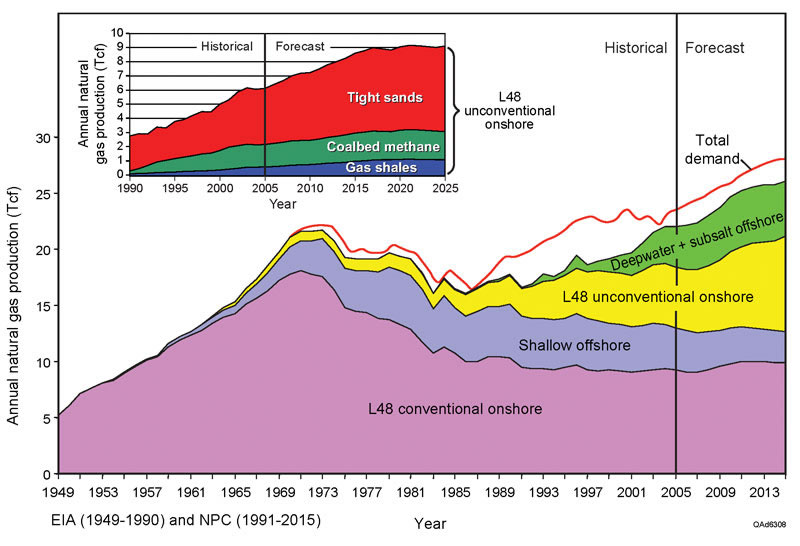
Today, unconventional natural gas already accounts for one-third of the annual domestic production of the slightly more than 18 trillion cubic feet (Tcf) of natural gas from the lower 48 states, according to DOE. Most unconventional gas is differentiated from traditional natural gas sources in that the gas is produced from reservoir rocks with poor permeability — so poor that drillers must routinely enhance permeability in the rocks surrounding each producing well. Unconventional resources occur in low-permeability sandstones (tight gas), within unusual host rocks such as shales (shale gas) or coal seams (coalbed methane), or within gas hydrates in offshore continental margins and onshore Arctic permafrost. Although the U.S. Energy Information Administration (EIA) and National Petroleum Council foresee slight declines in future production of conventional natural gas in the lower 48 states, both onshore and shallow offshore, unconventional natural gas, as well as deepwater and subsalt offshore gas, will continue to provide a greater share of the overall gas supply in the future.

The Need
Natural gas provides about 22 percent of total U.S. energy needs and is used primarily for industrial fuel and raw materials, electrical power generation and home heating, according to EIA. Natural gas is a cleaner-burning alternative to other fossil fuels used in power generation and can be considered, along with nuclear power and “clean coal” technologies, in near-term carbon-reduction strategies. Natural gas is also the best current starting material for hydrogen manufacture for both industrial use and fuel cells.
Ambrose, Potter and Briceno: Sources: EIA and NPC

Annual natural gas production in the U.S. lower 48 states in trillion cubic feet. Production from unconventional gas sources (predominantly tight gas) and deepwater/subsalt offshore will continue to increase. In contrast, production from the lower 48 conventional onshore and shallow offshore sources will decline slightly.

Despite abundant natural gas resources and production capacity in the United States, demand still exceeds supply, with the balance imported mostly via pipeline from Canada. The natural gas supply gap will grow to nearly 9 Tcf per year by 2025, according to Michelle Foss at the Center for Energy Economics in Houston, Texas.
Liquefied natural gas (LNG), transported from traditional high-quality reservoirs outside North America, is expected to make up for this growing shortfall. LNG is a form of natural gas that has been refrigerated to reduce volume. It is typically transported to coastal receiving terminals via large, double-hulled transport ships. When giant fields of natural gas are discovered far from markets or pipelines, transport of the gas in LNG form is a common strategy, and this form of international gas trade is growing rapidly. Significant sources of LNG include the Middle East, North and West Africa, the Caribbean, South America, Indonesia, Malaysia and Australia. The United States is expected to increase imports of LNG from 0.6 billion cubic feet per day in 2006 to 9.6 billion cubic feet per day by 2011, according to EIA.

The continuing growth of unconventional domestic gas supplies will lessen the need for LNG. These gas “plays” have already spurred a dramatic rise in drilling activity, with the U.S. gas-rig count surpassing 1,400 since August 2006, double the levels of 2002, according to Jeremy Platt, chair of the Energy Economics Committee of the Energy Minerals Division (EMD) of the American Association of Petroleum Geologists. This upsurge in drilling activity is attributable to rising natural gas prices. The sources of unconventional gas certainly vary, but many are currently economically viable.

The Sources
Unconventional natural gas differs from conventional natural gas and oil systems in terms of its “play elements,” or key geologic attributes. Major play elements for oil and gas deposits include reservoir quality, trap, source and migration. In conventional oil and natural gas deposits, most hydrocarbons originate from organic-rich source beds and migrate into either structural or stratigraphic traps sealed by low-permeability shales, mudstones or salt.
In contrast, unconventional gas systems, such as shale gas and coalbed methane, are self-sourcing, and gas molecules (principally methane) are trapped in pore networks and in adsorbed state on in-situ organic material. Shale gas and coalbed methane production come from a combination of desorbed gas and free gas flowing through fractures (or cleats in coal in the case of coalbed methane), rather than through the types of intergranular pore networks typically encountered in sandstone beds in conventional oil and gas deposits.

Because unconventional gas resources are generally lower-grade compared to conventional gas, more wells — closely spaced over large areas (whole counties or larger) — are required to produce them. Tens of thousands of new wells have been drilled in the United States for unconventional gas in the past decade. Cost-effective exploration and production strategies must take into account the unique set of play elements that exist for each type of unconventional gas reservoir. An in-depth look at the rock properties is vital to understanding the true complexity of these unusual reservoirs.

Tight Gas
Although tight-gas reservoirs — which account for the majority of unconventional U.S. gas production (about 5 Tcf per year) — produce gas from conventional host-rock lithologies (sandstones and limestones), the quality of the reservoir is a major limiting factor for how accessible the gas is. Tight gas reservoirs are commonly so impermeable that fractures, either natural or those that are intentionally induced in the well-completion process, or both, are necessary to boost producibility. Major tight-gas drilling programs are under way in Rocky Mountain basins as well as in eastern and southern Texas.

Stephen Laubach and his team at the Bureau of Economic Geology (BEG) at the University of Texas at Austin are investigating low-permeability sandstones in the deep subsurface and examining links between mechanical and chemical processes in open fractures that can serve as permeability pathways for gas migration to the well bore. Observations of microfractures in thin sections demonstrate that fracturing and mineral cementation are linked processes. Laubach’s team learned that, ironically, fractures can be both clogged (bad news) or propped open (good news) by quartz cementation. Research efforts are now directed at predicting areas of enhanced fracturing where the cracks remain partially open to fluid flow.

Coalbed Methane
Coalbed methane also provides significant contributions to the U.S. unconventional gas supply, accounting for approximately 10 percent of the nation’s methane resources. With at least 750 Tcf of domestic coalbed methane resources recently discovered, more than 550 Tcf of which is in the western United States, coalbed methane production has climbed from negligible amounts in the mid-1980s to almost 2 Tcf per year, according to DOE. Despite this rapid increase, there are indications that production is beginning to flatten, introducing the challenges of searching for new coalbed methane targets and enhancing production in marginal areas.

Coalbed methane production in the United States and Canada is centered in the West.
Coalbed methane has a unique set of factors that affect production, including the type of coal, as well as cleat and fracture development, which together control migration of gas to the well bore. Coal-seam thickness and continuity also play a role in coalbed methane resource size by controlling reservoir volumes and extent. For example, the greatest coalbed methane production in the Cretaceous Fruitland Formation in the San Juan Basin in New Mexico and Colorado coincides with thick coal seams that accumulated landward (southwestward) of ancient shorelines of the shallow sea that once covered this region about 73 million years ago.

Shale Gas
Shale gas plays have recently made a significant impact on unconventional gas production, especially from the Barnett Shale in the Fort Worth Basin in Texas, where estimated resources are approximately 26 Tcf, according to the U.S. Geological Survey. The Fort Worth Basin is one of about 20 shale gas basins across the United States where total domestic shale gas resources are thought to range from 500 Tcf to 780 Tcf, according to Schlumberger, Inc.
Despite this enormous resource, the percentage of gas recovered by today’s production methods in shale gas reservoirs is low (typically less than 15 percent of estimated gas in place), and controls on shale gas producibility and recovery are still not well-understood. Work continues on modeling fluid flow in nanometer-scale pores in shale gas reservoirs, where classical equations that describe fluid flow through porous media may not be valid, according to Farzam Javadpour at the Alberta Research Council in Canada.

Shale gas research is expanding rapidly as a result of successes in the Barnett in Texas and the age-equivalent Fayetteville Shale in northern Arkansas, and the push to repeat those successes elsewhere. This research covers a wide spectrum of issues. Fundamental depositional controls on mudstones are being reexamined by geologists such as Juergen Schieber at Indiana University in Bloomington. Other major areas of study include pore and fracture development, physical rock properties of shales, and burial/thermal history with related hydrocarbon expulsion. All of these areas of research will help determine production strategies during the lifetime of shale gas plays, targeting recovery of a larger fraction of in-place resources.

Still, there are challenges to this production. The need for safe and efficient disposal of waste water produced during production can be a significant cost factor for producing both coalbed methane and shale gas. Many coalbed methane wells (for example, in the Powder River Basin in Wyoming) require the production of substantial volumes of water before methane becomes mobile and migrates to the well bore. Water is commonly used to fracture the rocks to enhance production in shale gas reservoirs such as the Barnett Shale, where an individual horizontal well can require up to 3 million gallons of water for multiple “frac jobs” in the well-completion process. The Railroad Commission of Texas reports that about 2.6 billion gallons of water were used for frac jobs in the Barnett Shale in 2006. Basinwide, this amounts to 2 percent of total water usage, but in some areas in the Fort Worth Basin, frac water is 10 to 20 percent of the local usage from the Trinity aquifer, according to Jean-Philippe Nicot of BEG. Most of this frac water is produced with the gas and must be disposed of by deep injection. One implication for the oil and gas industry, particularly in the Barnett Shale play, is that operators may eventually have to rely on fracturing techniques that use reconditioned, produced water or less water in general.

Gas hydrates —The New Frontier
Although commercial production has already been established from shale gas and coalbed methane, gas hydrates are truly a frontier resource. Hydrates occur predominantly as methane trapped inside ice-lattice molecular structures in deepwater seafloor sediments. Because of the high-pressure and low-temperature conditions of the seafloor, hydrate methane is a concentrated energy source, with an energy density of 42 percent of that of LNG, according to Bob Hardage of BEG. Although estimates of gas-hydrate resources are uncertain, many experts think that these resources are enormous, and the potential North American resource may be many thousands of trillion cubic feet.

Although natural gas from hydrates is not yet economically feasible to produce, it has been produced successfully in pilot wells in permafrost regions of Russia and Canada. Lessons learned from these investigations could result in viable commercial production by 2015, according to Art Johnson, chair of the EMD Gas Hydrates Committee. However, several safety and technical issues need to be resolved before gas hydrates can become a viable source of unconventional gas. For example, seafloor stability must be assured, as large-scale slumping of shallow, hydrate-bearing strata during production could potentially damage production facilities and release large amounts of methane into the water column and eventually into the atmosphere. Methane, volume-for-volume, is about 20 times more potent than carbon dioxide as a greenhouse gas, so unintended releases must be guarded against.

Important technical issues for gas hydrates include the need for improved petrophysical characterization — a difficult proposition, however. The three-dimensional distribution of gas hydrates can be complex, occurring either in disseminated or tabular form. Realistic modeling of this distribution has a significant bearing on an accurate determination of gas saturation and, thus, on potential resource size. One step in determining distribution of hydrates in sediments involves the correlation of gas-hydrate rock properties with seismic data.

The Future
Obviously, there are several sources of natural gas that are markedly different from conventional gas that may stave off some of the energy issues the United States will face in the coming years. The new unconventional sources are lower-grade, but very widespread in U.S. sedimentary basins. Natural gas consumption in the United States will continue to grow, driven by demand for electric power, home heating, industrial uses and cleaner-burning alternatives to oil and coal for transportation and electricity.
LNG imports, which EIA anticipates will grow from 1 percent of the U.S. natural gas supply to approximately 15 percent by 2025, will help to meet future demands. As these LNG imports come online, additional natural gas production from unconventional gas plays will help to fill supply gaps for the next several decades.

Ambrose, Potter and Briceno are all at the Bureau of Economic Geology at the University of Texas at Austin. The authors gratefully acknowledge Joel Lardon, who drafted the second figure, and Lana Dieterich, who helped edit the manuscript.

Wednesday, February 11, 2009

Is Shale Gas Still "Unconventional"?

The following article comes from the AAPG Explorer, November 2008. Of particular note in the discussion of the factors important to finding and producing this "shale gas", is a lack of a mention of the importance of actually drilling, or steering one of these "horizontal wells". This must be addressed and it is not as simple as it might seem. I hope to discuss this more in the future.
Peter

Understanding gains on ‘new’ reservoir
Shales Closing ‘Conventional’ Gap
(source)
At what point do unconventional resources become conventional resources?
If this is possible, gas shales are certainly closing the gap.

Even though operators have produced gas from shales since the first shale-gas well in the organic-rich Dunkirk Shale (Devonian) in New York in 1821, the recent interest in gas shales began in 1981 with the first Barnett Shale well, drilled in the Fort Worth Basin in northern Texas by Mitchell Energy Corporation. Gas shales have advanced to an economic gas play since the year 2000 thanks to a combination of high gas prices, shale reservoir characterization and advances in drilling and completion technology.

The sheer number of articles and conferences describing gas-shale plays in the United States and Canada attests to the high interest level.
As for importance, the Barnett Shale alone supplies about 7 percent of the United States’ annual dry-gas production.

The Marcellus Shale has helped raise the interest in shale plays.
Note the accompanying alphabetical list of many of the United States and Canada gas-shale plays in the news.

Gas shales span reservoir ages of Cambrian to Miocene, and shale formations such as the Barnett, Fayetteville and Woodford have become household names.
Some long-producing shales such as the Antrim, Huron and New Albany are seeing renewed interest – and the Haynesville Shale in Louisiana and Marcellus Shale in the Appalachian states are being compared to the Barnett Shale as the next big plays.
(The Late Devonian-Early Mississippian Bakken Shale in the Williston Basin is not on the list because it is primarily an oil play.)

Early lessons learned and shared concerning how to produce gas from shales have drastically shortened the learning curve when exporting the technology to new shale-gas plays.
One of these lessons was the importance of fractures (natural and induced) for gas production while avoiding fracture propagation into water-bearing formations with the occurrence of shale or carbonate fracture barriers.

Hydraulic slick-water fracturing and re-fracturing were the initial keys to completing the tight-shale reservoir. Today, horizontal wells – first applied to shales in 2003 – are now routinely applied to expose more of the shale to the well bore and use the shale boundaries as fracture barriers.

Recent technological advances applied to horizontal wells in shales include:
3-D seismic in determining lateral length and placement.
Multilaterals (drilling several laterals from a single well pad).
Multiple frac stages within a lateral.
Real-time microseismic monitoring to image hydraulic-fracture treatments.
Simul-fracs (simultaneous hydraulic fracturing of offset parallel horizontal wells about 1,000 feet apart).

Seismic is playing an increasing role in shale gas appraisal and development. In addition to imaging the basic structural geometry and faults, multi-trace attributes such as coherence and volumetric curvature are being used to detect smaller-scale faults, areas of more intense fracturing and collapse features such as sinkholes.

Of course, not all organic-rich shales will be economic gas shales, even with the application of innovative completion technology. What was once thought of as a hydrocarbon source rock or cap rock must now be evaluated as a gas reservoir.

Also, it is not enough to have a thick, organic-carbon rich black shale in the gas window. Other factors such as mineralogy (e.g., clay content and types) and petrographic properties (e.g., silt stringers, laminae, bitumen network) are important to produce gas from shales.
Fortunately, research on petrophysics, geomechanics and geochemistry conducted at universities, service companies and consortia is advancing our understanding of shales as reservoirs.

Much has been learned about how to evaluate shale as a gas source rock and reservoir. Some remaining questions include:
What is the optimum range of thermal maturity?
How low or high of thermal maturity is too low or too high?
What depth is too shallow or too deep to be economic?
How important is reservoir pressure?

Energy Minerals Division members have access to the EMD members-only Web site, which has semiannual gas-shale reports, a calendar of gas-shale conferences, an extensive list of published gas-shale literature, presentations, online reports, Web links and short course notes.
Check it out – and please let me know if you have suggestions on additions to the EMD Gas Shales Committee Web site.

United States and Canada Gas-Shale Plays
Antrim (Late Devonian; Michigan Basin, Michigan)
Baxter (Late Cretaceous; Vermillion Basin, Colorado, Wyoming)
Barnett (Mississippian; Fort Worth and Permian basins, Texas)
Bend (Pennsylvanian; Palo Duro Basin, Texas)
Cane Creek (Pennsylvanian; Paradox Basin, Utah)
Caney (Mississippian; Arkoma Basin, Oklahoma)
Chattanooga (Late Devonian; Alabama, Arkansas, Kentucky, Tennessee)
Chimney Rock (Pennsylvanian; Paradox Basin, Colorado, Utah)
Cleveland (Devonian; east Kentucky)
Clinton (Early Silurian; east Kentucky)
Cody (Cretaceous; Montana)
Colorado (Cretaceous; central Alberta, Saskatchewan)
Conasauga (Middle Cambrian; Black Warrior Basin, Alabama)
Duvernay (Late Devonian; west central Alberta)
Eagleford (Late Cretaceous; Maverick Basin, Texas)
Ellsworth (Late Devonian; Michigan Basin, Michigan)
Excello (Pennsylvanian; Kansas, Oklahoma)
Exshaw (Devonian-Mississippian; Alberta, northeast British Columbia)
Fayetteville (Mississippian; Arkoma Basin, Arkansas)
Fernie (Jurassic; west central Alberta, northeast British Columbia)
Floyd/Neal (Late Mississippian; Black Warrior Basin, Alabama, Mississippi)
Frederick Brook (Mississippian; New Brunswick, Nova Scotia)
Gammon (Late Cretaceous; Williston Basin, Montana)
Gordondale (Early Jurassic; northeast British Columbia)
Gothic (Pennsylvanian; Paradox Basin, Colorado, Utah)
Green River (Eocene; Colorado, Utah)
Haynesville/Bossier (Late Jurassic; Louisiana, east Texas)
Horn River (Middle Devonian; northeast British Columbia)
Horton Bluff (Early Mississippian; Nova Scotia)
Hovenweep (Pennsylvanian; Paradox Basin, Colorado, Utah)
Huron (Devonian; member of Ohio Shale; east Kentucky, Ohio, Virginia, West Virginia)
Klua/Evie (Middle Devonian; northeast British Columbia)
Lewis (Late Cretaceous; Colorado, New Mexico)
Mancos (Cretaceous; San Juan Basin, New Mexico, Uinta Basin, Utah)
Manning Canyon (Mississippian; central Utah)
Marcellus (Devonian; New York, Pennsylvania, West Virginia)
McClure (Miocene; San Joaquin Basin, California)
Monterey (Miocene; Santa Maria Basin, California)
Montney-Doig (Triassic; Alberta, northeast British Columbia)
Moorefield (Mississippian; Arkoma Basin, Arkansas)
Mowry (Cretaceous; Bighorn and Powder River basins, Wyoming)
Muskwa (Late Devonian; northeast British Columbia)
New Albany (Devonian-Mississippian; Illinois Basin, Illinois, Indiana)
Niobrara (Late Cretaceous; Denver Basin, Colorado)
Nordegg/Gordondale (Late Jurassic; Alberta, northeast British Columbia)
Ohio (Devonian; Appalachian Basin, east Kentucky, Ohio, West Virginia)
Pearsall (Cretaceous; Maverick Basin, Texas)
Percha (Devonian-Mississippian; west Texas)
Pierre (Cretaceous; Raton Basin, Colorado)
Poker Chip (Jurassic; west central Alberta, northeast British Columbia)
Queenston (Ordovician; New York)
Rhinestreet (Devonian; Appalachian Basin)
Second White Speckled (Late Cretaceous; southern Alberta)
Sunbury (Mississippian; Appalachian Basin)
Utica (Ordovician; New York, Quebec)
Wilrich/Buckinghorse/ Garbutt/Moosebar (Early Cretaceous; west central Alberta, northeast British Columbia)
Woodford (Late Devonian-Early Mississippian; Oklahoma, Texas)