Showing posts with label taxes. Show all posts

Friday, June 29, 2012

Huge Economic Impact Of Eagle Ford Shale, Largely Unknown Outside Of Texas

Much of this development and its significant economic impact is due to the combination of the relatively new technologies of horizontal drilling and hydraulic fracturing.  Amazingly, the oil and gas industry derives very little positive recognition from these feats, including equally important oil and gas development plays like the Marcellus Shale in the northeastern U.S., the Barnett Shale in north central Texas, the Haynesville Shale in northwestern Louisiana, and the Bakken Formation development in North Dakota.

The environmental lobbyists and global warming scare-mongers have been so effective with their propaganda they have managed to effectively squelch these great achievments and largely hide them from the American public.  As some might say, "go figure", are they with America or against her?
Peter

Eagle Ford Shale Generated More Than $25 Billion in Revenue for South Texas in 2011

UTSA projects the shale to create 117,000 jobs by 2021

Source: http://ccbr.iedtexas.org/

Eagle Ford Shale Report Download
Click to Downlaod the Eagle Ford Shale Impact Report
Written by Christi Fish
Associate Director of Media Relations, The University of Texas at San Antonio

SAN ANTONIO, May 9, 2012 – Development of oil and natural gas in the Eagle Ford Shale contributed $25 billion in total economic output to the region in 2011, according to a study released today by the Center for Community and Business Research at The University of Texas at San Antonio Institute for Economic Development (UTSA).
"The Eagle Ford Shale has proven to be one of the most important economic engines in the state," said Dr. Thomas Tunstall, director of the UTSA Center for Community & Business Research, and the study’s principal investigator. "In 2011 alone, the play generated over $25 billion in revenue, supported 47,000 full-time jobs in the area, and provided $257 million in local government revenue."
The study also concluded that in 2011 shale development:
  • Paid $3.1 billion in salaries and benefits to workers;
  • Provided more than $12.6 billion in gross regional product;
  • Added more than $358 million in state revenues, including $120.4 million in severance taxes;
  • And spurred a triple-digit sales tax revenue increase in various local counties.
    Download the Eagle Ford Shale Impact Presentation
    Download the Eagle Ford Shale Impact Presentation
"We view the Eagle Ford activity as an economic opportunity of a lifetime," said Mario Hernandez, president of the San Antonio Economic Development Foundation. "The key goal is the increase in investment and jobs. And if the communities will partner with the private companies that are creating these jobs, it can be a win-win for everybody."
The increased revenue from the Eagle Ford Shale is rebuilding local communities. New schools and new hospitals are being built, and new training programs have been launched to maximize hiring from the local workforce. The study projects the creation of approximately 117,000 full-time jobs by 2021.
View the video recording of the Eagle Ford Shale Impact Presentation and Study Release from May 9, 2012

Sunday, June 3, 2012

Oil And Gas Industry To The Rescue

Pssssst......spread the word.....the oil and gas industry is creating jobs, hiring people, paying taxes instead of spending taxpayers money, and producing inexpensive (natural gas) energy.  In addition to that good news, the myth of man-caused global warming is finally being put to rest, (see here) and things are looking up, a lot more than they have been the last few years anyway.   Let's keep this kind of activity going.
Peter


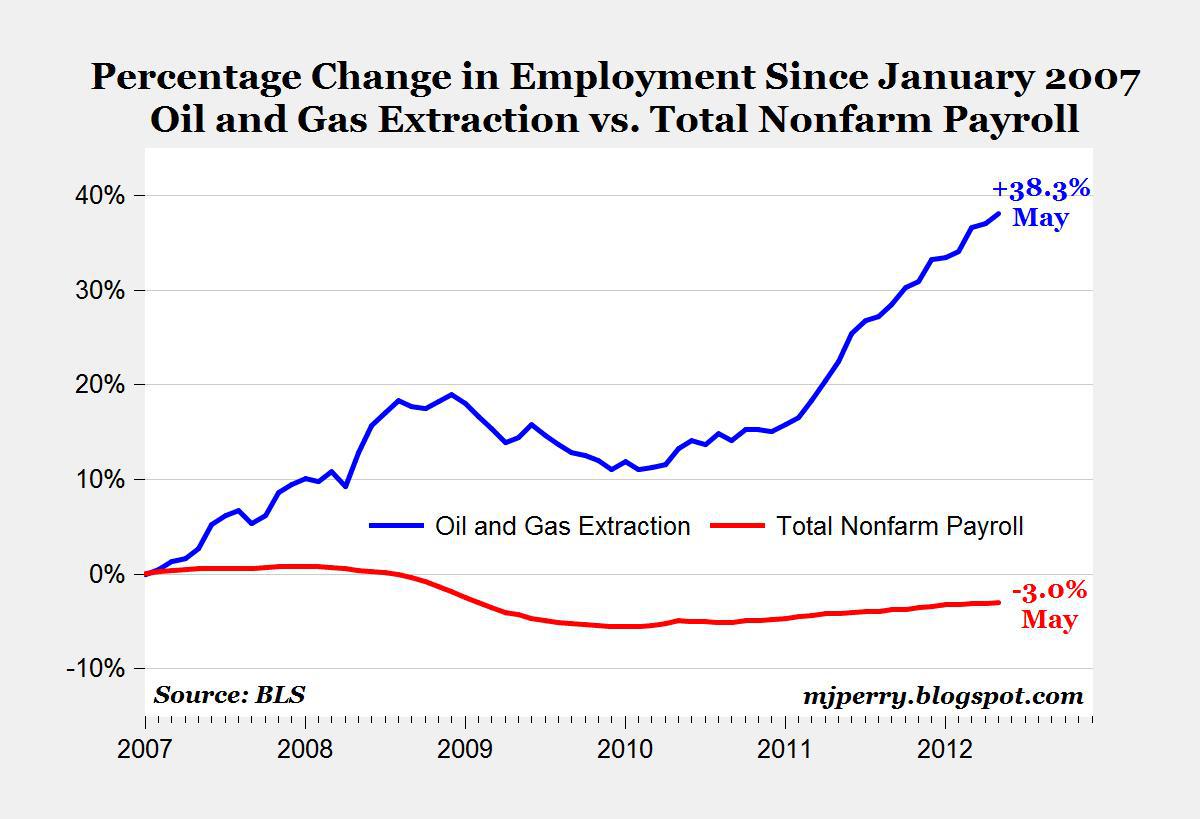
While yesterday's disappointing employment report reflects an economy struggling to create jobs during an extended, sub-par "jobless recovery," it's been a much rosier employment picture in one of America's most successful "shovel-ready" job-creating industries: Oil and Gas Extraction.
The chart above displays the monthly percentage changes in employment levels since January 2007 for oil and gas extraction jobs compared to total nonfarm payroll jobs. As of last month, total nonfarm payroll employment is 3.0%, and 4.1 million jobs, below the January 2007 level. In contrast, the explosion of new oil and gas jobs has increased employment in that industry by more than 38% since January 2007. Over the last 12 months, oil and gas companies have added 21,800 new workers, at a rate of almost 100 new hires every business day. And this just accounts for the new jobs created that involve the actual drilling, extraction and production of oil and gas.
A recent study found that for every one new job added in oil and gas extraction activities, there were three new additional jobs created elsewhere in the economy. The report also found that "the jobs-multiplier effect of U.S. oil and natural gas activity is higher than many other U.S. industries, including the financial, telecommunications, software and non-residential construction sectors. This is the result of the energy industry’s long supply chains and relatively high levels of spending by employees and suppliers." As a result of the multiplier effect, the U.S. economy has potentially been adding almost 400 new jobs per day over the last year due to increased oil and gas production.
Imagine what the jobless rate might be today, and imagine all of the additional shovel-ready, energy-related jobs (direct and indirect jobs) that could have been created over the last several years in the oil and gas industry (and its supporting industries), if the Obama administration: a) hadn't been so unfriendly to the low-cost, job-creating, dependable fossil fuel industry (think Keystone XL pipeline for example) that doesn't require picking the pockets of the taxpayers; and b) instead been so over-friendly to the subsidy-dependent, high-cost, unreliable but politically-favored "green" energies. On the other hand, imagine what the jobless rate might be today if we hadn't had the tremendous "energy-stimulus" to the U.S. economy that has resulted over the last few years from increased oil and gas drilling due to technological advances of hydraulic fracturing and horizontal drilling, and taking place mostly on private land?

Tuesday, February 28, 2012

What Goes Into The Price Of Gasoline

This is a question that goes through nearly everyone's mind at some point when they fill their vehicle with gasoline at the pump.  As prices rise this also fuels much passion, often in the form of anger directed at the "big oil companies" who are "ripping us off", or worse.  Does the average person understand what really goes into, or determines the price of a gallon of gasoline?  No.

It turns out that the price of the raw material, in this case crude oil,  amounts to around 80% of the cost of gasoline.  Simply put, if oil goes up, gasoline goes up.  Are there other factors?  Yes, many, such as refining, transportation, marketing, and of course taxes.  But the oil companies control all those things, right?  Again, no.  It is more complicated than that.  Many different, independent companies and factors come into play as crude oil comes from the Earth and follows a path to end up as gasoline in the fuel tank of your car.  The following article goes into more detail on this.

The key point here, and the one I want to emphasize, and of which I know the most, is what goes into the price of crude oil.  Oil must be found (discovered), produced, and delivered to a refinery where it is transformed into gasoline and many other important fuels and products.  So it is a case of supply and demand.  Economics 101.  To lower the price supply must increase or demand must decrease.

First, understand that the market for oil is worldwide; everyone wants it and no one country or company controls all of it, though many might like to.  The demand for oil cannot really be controlled.  People all over the world find motor vehicles more efficient than walking or using animal power.  They also like things like light, heat and air conditioning, to name just a few of the uses of crude oil and its products.  So to have much of an effect on the price of crude oil and thus gasoline, supply becomes the key factor.  It amazes me how few people understand this.  We must increase the supply of crude oil if we are to lower the cost of gasoline.  It really is as simple as that.

Geologists and geophysicists know how to find oil.  Engineers know how to drill wells, move the oil to refineries, transform it to fuels, and deliver it to consumers.  What is the problem then?  The problem is anything that restricts supply.  This usually means politics and governments, from local, to state to Federal (National), to international.  So if you want lower gasoline prices, get involved in the politics of increasing the supply of crude oil.  If you don't get involved, bite your tongue and take a back seat.

Solar energy can't replace crude oil, nor can wind, geothermal, nuclear, coal, or Obama's recent ludicrous suggestion, algae-derived bio-fuel.  Educate yourselves on this subject and become active, and then vote.  Don't leave this all up to politicians, because they often want what is best for them, not us.

The following article comes from ExxonMobil and in detail, breaks down in what goes into the price of gasoline.  I think it is accurate and very well done.  My opinion is mine alone.
Peter


What am I paying for in the price of a gallon of gasoline?

January 27, 2012 | Posted by Ken Cohen

I’m asked this question a lot. And I know a lot of drivers ask themselves this question whent they pull up to the pump.
The answer is based on the economics of supply and demand and how products are manufactured and sold – along with what the government takes in taxes. Let’s take a look, based on the U.S. Energy Information Administration’s breakdown of the estimated average price of a gallon of gas in December 2011, which was $3.27.

 Raw materials = $2.62

The cost of the raw materials used to make a product has a major impact on the final product price. The raw material for gasoline is crude oil. The price of crude oil is set by global markets, where buyers and sellers constantly react to supply and demand factors. Oil is just one of many commodities traded every day in the global market. Others are the corn that affects the price of food and the cotton that affects the price of clothing.
Crude oil is by far the largest factor in the price of a gallon of gasoline – accounting for 80 percent of the $3.27 average retail price per gallon in December, according to the EIA.

To put that in another way – about $2.62 of the average gallon of gas in this example is set before a refiner even touches the raw material.
Where I find many people get confused is that they assume oil companies are producing all the oil that goes into their own refineries – and therefore can control gas prices by controlling the supply chain. That’s not the case.

U.S. crude oil production in 2010 was 5.5 million barrels per day. But U.S. refineries processed 15.2 million barrels of oil per day – almost three times more oil than was produced in the U.S. That means U.S. refiners, like ExxonMobil, have to purchase millions of barrels of crude oil – at market prices – to produce gasoline and other products for American consumers. For example, in 2010, ExxonMobil spent $198 billion purchasing oil around the world for its refining operations.
Manufacturing the product

Like any product, there are costs to manufacture it – so the manufacturer tries to recover those costs, plus make a profit, when it goes to sell the product.
The refining portion of a gallon of gasoline has, on average, accounted for about 11 percent of the price in 2011, according to the EIA data through December. That means a little less than 40 cents per gallon would be due to refiners’ costs – wages, equipment, financing and others – plus their profits.

As the EIA figures show, however, refining doesn’t always produce a profit. In December, the data indicate that the U.S. market price for gasoline coming out of refineries was on average about 7 cents per gallon (-2 percent) below the refiners’ cost of crude oil alone, and before accounting for their costs of upgrading the crude into gasoline. In other words, refineries faced a market where domestic gasoline prices were very weak relative to global crude prices.
How does that happen? Refiners are “price takers” that operate on relatively low profit margins that are highly dependent on the market demand for petroleum products. That means at times, the value of a petroleum product coming out of the refinery isn’t enough to cover the costs of obtaining and refining the crude oil.

Distributing and marketing the product = $0.33
Products then have to get from the manufacturing site to the retail site. When gasoline leaves the refinery, it is shipped largely via pipelines to local terminals. There, distributors load their trucks and transport the gasoline to a service station. Naturally, each step in the distribution chain includes labor, capital equipment and other expenses that must be recovered by operators. Of course, these operators must also compete to sustain their profitability while also paying taxes.

Retailers then set the price at the pump, based on recovering these costs of getting gasoline to the service station and the costs of marketing it to consumers. They also have to generate enough money to pay their taxes and make a profit to keep their business running. And on top of that, they have to collect mandatory state and federal gasoline taxes from the consumer (which we’ll break down in the next section).
So who are the retailers setting the prices? When consumers pull into an Exxon or Mobil station, they assume it’s ExxonMobil. But we own only about 5 percent of the stations with our name on them. About 95 percent of the stations carrying the Exxon or Mobil brand are actually owned by network retailers or local business owners – not ExxonMobil.

Taxes = $0.39
So how much does the government make on a gallon of gas?

In this example, retailers collected state and federal gasoline taxes of 39 cents per gallon on average. Total gas taxes per gallon range by state – from lows of less than 30 cents per gallon to highs of more than 60 cents per gallon in places like New York and California.
How does this compare to what a company like ExxonMobil makes on a gallon of gasoline? As we saw earlier, sometimes a company or an operation may lose money. Other times, it may make money. A competitive market just provides an opportunity, not a guaranteed profit. In the first two quarters of 2011, for example, ExxonMobil made 7 cents and 8 cents a gallon , respectively, on the gasoline, diesel and other petroleum products it refined and sold in the United States.

What actions could help lower gas prices?
Again, let’s go back to the economics of supply and demand that govern the crude oil market, since it’s the largest determinant of the price at the pump.

There are many global factors that affect the crude oil market. But adding more supplies of crude oil to the global marketplace can help put downward pressure on the price of a barrel of oil. The United States has abundant supplies of oil, from the deep-water regions of the Gulf of Mexico to the tight oil resources throughout North Dakota and Montana. Combined with Canada’s oil resources (one of the largest in the world), North America has enormous potential to add new reliable supplies to the market. And, the U.S. has one of the largest and most advanced refinery systems in the world.
But first, the oil needs to get to market. There, we’ve often seen economics trumped by politics – even as the U.S. economy remains weak. The recent moratorium in the Gulf of Mexico, as well as the decision to deny the permit for the Keystone XL pipeline from Canada to U.S. refineries, are just two examples of U.S. political decisions that serve to keep supplies out of the market.

The economics behind a gallon of gas are pretty straightforward. It’s the policies behind access to U.S. energy resources that are less certain – but critical to our energy future.

Thursday, April 21, 2011

Save New York....and America: Allow "Fracking" and Oil an Gas Production

Are Americans going to allow a few ideological environmentalists with dubious motives further damage our economy, put us deeper in debt, cause more job losses, and prolong the recession?  Isn't America's real problem with our spend and (over) regulate politicians in Washington, DC?

It is the height of folly to forgo developing our own oil and gas resources while sending our money and jobs to foreign producers.  What can the average person do about rising energy and commodity prices?  First vote the current naive, anti-growth politicians out of office, in your hometown, your state and in Washington.  Replace them with optimistic people with can-do attitudes.  America can fight its way out of this economic morass we are in, or we can lie down and die.  I choose to fight.  I owe at least that much to my forefather(s).

The follow editorial summarizes the issue quite well.  Support Rep. Thomas Reed New York.
Peter

Published on Washington Examiner (http://washingtonexaminer.com)
--------------------------------------------------------------------------------

By The Examiner and by
Rep. Thomas Reed, a Republican who represents New York's 29th Congressional District.


Created Apr 14 2011 - 8:05pm

New York - and America - can profit from 'fracking' Marcellus Shale

It's no secret that we live in challenging times. Many sectors of our economy continue to struggle and our dependence on foreign energy sources continues to grow. However, there is some good news. Responsible development of the Marcellus Shale natural gas field has tremendous potential to help meet both of these challenges, and many, many more.

In 2009, the production of Marcellus Shale in Pennsylvania had an economic output of more than $3.8 billion, and generated more than $400 million in state and local tax revenues, while creating 48,000 new jobs. There is no reason to believe that we wouldn't see a similar positive effect in New York.


We need this economic development. The 2010 census numbers released recently were, unfortunately, no surprise. Western New York and the southern tier of New York experienced concentrated levels of population decline.


I don't believe this is because people don't want to live here, but because they cannot find substantial employment to support their families. It's quite simple: People go where the jobs are.


Penn State recently determined that counties in Pennsylvania where Marcellus development has taken place saw, on average, an 11 percent growth in sales tax revenue. Our local governments could derive much needed revenue from Marcellus Shale production.


Some fear hydraulic fracturing. The Finger Lakes region is my home. We all agree that we need to keep our natural resources safe and free from pollutants. The reality is that hydraulic fracturing has been used for more than 60 years on more than one million wells nationwide.


New York has a long association with gas production. For decades, producers developed natural gas resources from rock strata residing thousands of feet below the Marcellus, tapping formations such as the Trenton Black River and the Medina.


Nevertheless, concerns regarding groundwater contamination exist. Geologists tell us that our groundwater aquifer is thousands of feet above the shale containing natural gas and is separated by thousands of feet of impermeable rock.


This virtually eliminates any potential risk of groundwater contamination from the process of hydraulic fracturing. Further, the New York State Department of Environmental Conservation is no shrinking violet.


The DEC has a long, effective record of monitoring the energy industry. It will ensure that exploration and extraction is done safely.


The Pennsylvania Department of Environmental Protection just completed a study that found no radiation problem with drinking water in any of the seven rivers tested.  Any risk from industry wastewater is further mitigated by the fact that more fracturing fluid is being recycled and never goes to water treatment plants. Pennsylvania natural gas producers are recycling as much as 90 percent of their wastewater, an amount predicted to increase.


The same holds true in New York. Tens of thousands of natural gas wells have been produced in our state and the regulators charged with managing and overseeing their activities have proven that development can be done safely while protecting our environment.


In fact, the DEC recently noted there was "no record of any documented instance of groundwater contamination caused by hydraulic fracturing for gas well development in New York, despite the use of this technology in thousands of wells across the state during the past 50 or more years."


Other studies, including a 2004 U.S. Environmental Protection Agency study, have concluded that hydraulic fracturing poses no significant environmental risk to drinking water supplies. There is no reason to expect anything different in developing the Marcellus Shale in New York.


The time has come to take appropriate precautions and move forward. Development of domestic energy resources today will lower our dependence on foreign energy tomorrow. We need to realize the potential that Marcellus Shale holds for improving our struggling economy and reducing our reliance on foreign energy.


Rep. Thomas Reed is a Republican who represents New York's 29th Congressional District.

--------------------------------------------------------------------------------

Source URL: http://washingtonexaminer.com/opinion/op-eds/2011/04/new-york-and-america-can-profit-fracking-marcellus-shale

.

Friday, April 3, 2009

Marcellus Shale Gas Play: Part 6

Money. Who profits and who suffers? There is no question that this shale gas development with generate revenue for everyone, from individuals to local, state and federal governments. The answer to the question of who benefits and who suffers lies in how that money is managed. Governments are notorious for being wasteful; but that is wholly another issue.
Peter

Revenues
Due to Pennsylvania’s local tax structure, the revenue
impacts of Marcellus shale on Pennsylvania local
governments and taxpayers will likely be relatively
small compared to the cost and service impacts.
Natural gas exploration and drilling by itself will
provide relatively little new tax revenues to local
jurisdictions in Pennsylvania since natural gas is not

subject to local taxation in the Commonwealth. Neither
lease nor royalty income in Pennsylvania is subject to local
income taxes, nor do Pennsylvania
local jurisdictions benefit directly from higher local
retail sales since they lack authority to levy a local
sales tax.

Greater employment owing to natural gas activity
will of course increase local earned income taxes,
but because earned income taxes generally go to the
jurisdiction where taxpayers live rather than where
they work, the specific jurisdictions facing higher
service costs due to the Marcellus may not be those
who receive higher earned income tax revenues. Most
Pennsylvanians do not work in the same municipality
where they live and there is little reason to expect
new natural gas workers to be any different.

Real property tax collections will increase some
due to new building construction associated with the
Marcellus; but, because reassessment is typically
infrequent in Pennsylvania counties, rising real
property values due to Marcellus will not have an
immediate impact on property tax collections. Under
current law natural gas will not significantly increase
the local tax base, and thus will not significantly
increase local tax revenues.

Tax collections by the state government will
increase in Pennsylvania through the corporate income
tax and sales tax, but these collections will have little
direct benefit to the local jurisdictions, which will face
higher service costs due to natural gas exploration.
In other words, local jurisdictions with natural gas
wells very likely will face higher demands for services
and thus higher costs, and yet receive little new
revenues to pay for those services. The result could be
higher local taxes (paid for by everyone, not just those
directly benefiting from lease or royalty revenues)
or cuts in other services.

Because Pennsylvania law
limits municipalities’ and counties’ abilities to employ
land-use planning tools to influence the location
of natural gas drilling activities, local governments
will have little ability to prevent or affect drilling in
locations, which will significantly affect local service
costs and taxes.

It is important to recognize that school districts
and the county and municipal governments that own
land leased for natural gas extraction may receive
significant revenues from leasing and royalties, so
they will receive some benefits. Yet the amount they
receive will not relate directly to the overall costs they
may experience across their jurisdiction.

In addition,
some may be tempted to use these windfalls for
basic operations (keeping taxes low in the years the
monies are received) rather than to use the monies
for capital expenditures and other investments in
their communities’ future. The natural gas money
provides a great opportunity for local jurisdictions to
improve infrastructure, such as by creating parks or
other investments to be enjoyed by current and future
generations.

Clean and Green Act
Under Pennsylvania law, county governments
administer the Clean and Green program, which
provides preferential tax assessments for eligible
farm- and forestland. County governments have some
discretion in how they interpret the law, which at the
time of this writing is silent about whether leasing
land for natural gas drilling makes the land ineligible
for Clean and Green (and, if so, whether the rollback
is on the entire enrolled parcel or only on the acreage
directly affected by the drilling).

County commissioners
and assessment offices need to carefully think
about how they will treat such land and the impact of
that decision on landowners, neighbors, taxpayers,
Clean and Green land, and gas leasing activity.
In Harrisburg there currently is policy discussion
about whether to revise the Clean and Green Act to
provide more clarity on issues of interpretation. For
more information, visit the Pennsylvania Department
of Agriculture Web site, http://www.agriculture.state.pa.us/.

Infrastructure
The potential impact of the increased drilling associated
with the Marcellus shale extends beyond the
wells, pipelines, and other natural-gas-related sites
and equipment. The economic and social changes a
region will experience once the industry has established
itself in the area may lead to stress on local
infrastructure, such as increases in road traffic, school
enrollment, and housing needs.

Obtaining seismic data also generates revenue for landowners.

Access Roads
Once a well site is chosen and established, private
access roads will be built to enable the necessary
large equipment and trucks to reach and service that
particular well. In addition to these newly constructed
roadways to the well pad, the initial preparation to
begin drilling and producing gas delivers a considerable
amount of heavy traffic to surrounding local
roads.

It is important to remember, however, that
after site construction, the wells will still generate
consistent truck traffic and road use. Holding tanks
on site for water by-products created during drilling
must be emptied at least once, if not several times,
per week and will be hauled to treatment or injection
facilities. Since wells produce year-round, road use
and truck traffic on both access and local roads will
be occurring year-round.

Compressors
Compressors are used to increase the gas pressure
from the wells before being shipped to market and can
produce significant amounts of unwanted noise. Since
compressors run nonstop, this can create concerns for
local officials who handle noise disturbances. Some
well sites will house the compressors in buildings to
decrease the output of noise, which can improve the
problem but also results in the creation of permanent
structures on site.

Pipelines
Any gas produced from wells is valueless unless it
reaches market. Pipelines are necessary for moving
the gas and are laid to travel from the site out to
central gathering points where the lines continue
transporting larger quantities of gas from numerous
wells to market. The pipeline construction affects
environmental and aesthetic aspects of the area and
generates additional construction sites and associated
disturbances.

Pipelines should be acknowledged as permanent
infrastructure of the gas industry and their
construction should be strategic and efficient.
Local officials need to concern themselves with
influencing pipeline construction in hopes of minimizing
potentially unnecessary lines. Excessive lines
across local landscapes could result from poorly
planned or disjointed networks of pipelines.
Pipelines are needed to collect the gas and move it to the end-users.

Population Change and Impacts on the
Community
Housing, Schools, Crime

As indicated by the experience in Texas and
Wyoming, it is important for local officials to prepare
for the population changes that may occur due to
the Marcellus. As noted in the studies conducted in
similar circumstances across the country, some of
the major associated changes in the community will
likely be:

• The need for adequate housing stock. If an inadequate
amount of housing is an issue, the influx of
workers will not live in the community, therefore
affecting the large array of possible economic
benefits for local business and government.

• Impacts on schools and service industries will
change the dynamic of the community as well,
seeing student population increases, higher
government infrastructure expenses, etc.

• An increase in crime, particularly nonviolent
crimes such as driving under the influence and
drug violations.

• Social tension or animosity between “newcomers”
and “old timers,” or between residents gaining
personally from natural gas and others in the
community who feel they are not benefitting.

• Local officials should reevaluate their comprehensive
plan, official map, and other planning
tools they use in their communities to cater to or
prepare for these changes. In addition, education
and communication can be important tools to deal
with potential changes in the social fabric of the
community.