Showing posts with label drilling. Show all posts

Friday, September 14, 2012

Drilling On A Large Scale....The Future Is Here

Innovation, efficiency, economy, safety, progress....the American way.  Hats off to all the hard-working people in this industry who make such things possible.
Peter


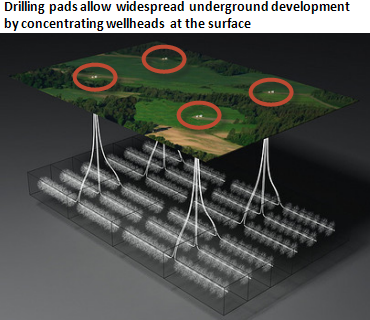
Three-dimensional representation of oil or natural gas development of a large underground area, from four drilling pads on the surface, as described in the article text
Source: U.S. Energy Information Administration, reproduced with permission from Statoil.
Note: Three-dimensional representation of oil or natural gas development of a large underground area, from four drilling pads on the surface (depicted within the red ovals).
 

Developments in drilling methods and technology are leading to efficiency gains for oil and natural gas producers. For example, "pad" drilling techniques allow rig operators to drill groups of wells more efficiently, because improved rig mobility reduces the time it takes to move from one well location to the next, while reducing the overall surface footprint. A drilling pad is a location which houses the wellheads for a number of horizontally drilled wells. The benefit of a drilling pad is that operators can drill multiple wells in a shorter time than they might with just one well per site.
Moving a drilling rig between two well sites previously involved disassembling the rig and reassembling it at the new location ("rigging down" and "rigging up") even if the new location was only a few yards away. Today, a drilling pad may have five to ten wells, which are horizontally drilled in different directions, spaced fairly close together at the surface. Once one well is drilled, the fully constructed rig can be lifted and moved a few yards over to the next well location using hydraulic walking or skidding systems, as demonstrated by Range Resources.

In the picture above, each of the four drilling pads hosts six horizontal wells. Pad drilling allows producers to target a significant area of underground resources while minimizing impact on the surface. Concentrating the wellheads also helps the producer reduce costs associated with managing the resources above-ground and moving the production to market.

Bentek Energy, LLC analysis shows that drilling operators are achieving efficiency gains in the well-drilling process. In June 2012, operators in the Eagle Ford shale formation averaged about 19 days to drill a horizontal well, down from an average of 23 days in 2011. Reducing the time it takes to drill wells can save oil and gas producers a significant amount of money. In the North Dakota section of the Bakken formation, the increase in drilling rigs in the area has begun to slow, but production levels continue to reach record highs each month.

Recent studies by the University of Pittsburgh and Rigzone, as well as analysis of financial reports from E&P companies Abraxas, EQT, and El Paso, show that drilling costs alone are only a portion of the total drilling and completion expenses that producers face. EIA analysis of average Bakken, Eagle Ford, and Marcellus well-related expenses finds that total costs per horizontal well can vary between approximately $6.5 million and $9 million. The cost of completing and hydraulic fracturing typically exceeds the cost of drilling the well.

One of the industry's more recent innovations, pad-to-pad moves, underscores the efficiency gains from rig mobility and pad drilling. During the drilling operation pictured below, rig operator Nabors Industries transported a fully-assembled drilling rig about one mile between drill sites. The cost of rigging down and rigging back up can be high enough that producers may find it more efficient to build a road between two pads, transport the rig intact, and have it arrive ready to drill the next well.
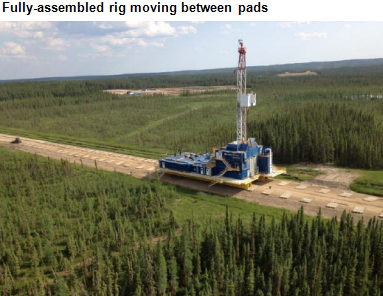
image of a fully constructed rig being moved between two drilling pads, as described in the article text
Source: Reproduced with permission from Nabors Industries Ltd.


Thursday, July 12, 2012

The Permian Basin, Born Again

In the Permian Basin, drilling and production is rising while the price of oil is falling.  That is good for some, not so good for others.  All told, it looks to me that by combining "horizontal" drilling with careful and selective hydraulic fracturing, the future looks bright for increasing activity and production, which is good for everyone.
Peter


source: http://www.eia.gov/todayinenergy/detail.cfm?id=7030

July 10, 2012

Rising production in the Permian basin

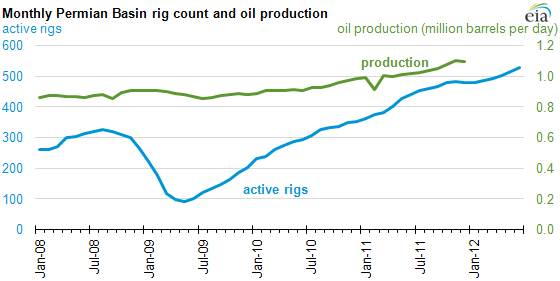
graph of Monthly Permian Basin rig count and oil production, as described in the article text
Sources: U.S Energy Information Administration, based on Baker Hughes and HPDI, LLC.
Notes: Graph includes rig counts through June 2012 and oil production through December 2011. Active rigs include rigs drilling for both crude oil and natural gas.


The source for the crude oil production data series published on July 10 was websites of the Railroad Commission of Texas and the New Mexico Energy, Minerals and Natural Resources Department. On July 11 the source was changed to HPDI, LLC, because HPDI, LLC collects both that data and production data that has not yet been processed by the Railroad Commission of Texas.

The Permian Basin—a long-time oil and natural gas producing region in west Texas and eastern New Mexico—is showing signs of new life. The active rig count has grown from 100 rigs in mid-2009 to over 500 rigs in May 2012. According to data from HPDI, oil production from the Permian has increased fairly steadily over the past few years, reaching the 1 million barrels per day (bbl/d) threshold in 2011—the first time since 1998.
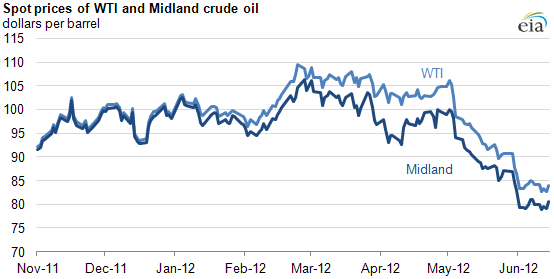
graph of Spot prices of WTI and Midland crude oil, as described in the article text
Sources: U.S. Energy Information Administration, based on Bloomberg.


Growing oil production in the Permian Basin and other Texas plays, most notably the Eagle Ford shale, may be starting to strain existing takeaway capacity and is creating a need for Texas oil to serve more distant refineries. While new pipeline projects are scheduled to come online, current transportation constraints have caused Permian crude oil, which is priced in Midland, Texas, to sell at a significant discount to WTI beginning in January 2012.

The Weather May Be Hot, But The Battle Over Fracking Is Really Heating Up

There is a full-court press being mounted by the Obama Administration, using the Environmental Protection Agency (EPA), and the  whole gamut of environmental extremists, to shut down or at least severely inhibit and control the entire fossil fuel industry, not just natural gas drilling and production.  They care nothing about the economic health of the country, or the world for that matter.

Read on.  This irrational nonsense about the "dangers" of fracking needs to be challenged by everyone, on every level.  In particular, go to the following article and read the comments.  I like this one:
Peter

5. spinoneone
We know, from her own comments and admissions, that Lisa Jackson has a mission with regard to the production of any carbon fuel – stop it at all cost. So, one can reasonably assume that the “conclusion” to the Congressionally mandated report has already been written. Now EPA needs to scramble around and find some supporting evidence and data.
  • Bingo. There’s the real agenda. There’s a convergence of interest between the rich moonbat left and OPEC to stop fracking. It’s got nothing to do with fracking itself. Fracking is not the issue, and never was.

Study: EPA’s Probe Into Fracking’s Effect on Drinking Water Isn’t So Clean

PLUS: Celeb anti-frackers to descend on D.C. to demand Congress end the shale extraction technique altogether.
by
Bridget Johnson
Bio
 
July 10, 2012 - 3:50 pm
 
An industry-funded independent investigation of the Environmental Protection Agency’s long-running probe into the effects of hydraulic fracturing found numerous flaws in everything from the EPA’s scope to its lack of consultation with oil and gas companies.
“The study released today by Battelle—a highly respected independent science and technology organization—identifies numerous concerns with EPA’s ongoing hydraulic fracturing study,” said Rep. Andy Harris (R-Md.), chairman of the House Science, Space, and Technology Subcommittee on Energy and Environment.
The 166-page Battelle study, submitted to the American Petroleum Institute and America’s National Gas Alliance, focused on the 2010 urging of a House conference committee that the EPA “carry out a study on the relationship between hydraulic fracturing and drinking water using a credible approach that relies on the best available science, as well as independent sources of information.”

continued here: http://pjmedia.com/blog/study-epas-probe-into-frackings-effect-on-drinking-water-isnt-so-clean/?singlepage=true

Sunday, June 3, 2012

Oil And Gas Industry To The Rescue

Pssssst......spread the word.....the oil and gas industry is creating jobs, hiring people, paying taxes instead of spending taxpayers money, and producing inexpensive (natural gas) energy.  In addition to that good news, the myth of man-caused global warming is finally being put to rest(see here) and things are looking up, a lot more than they have been the last few years anyway.   Let's keep this kind of activity going.
Peter


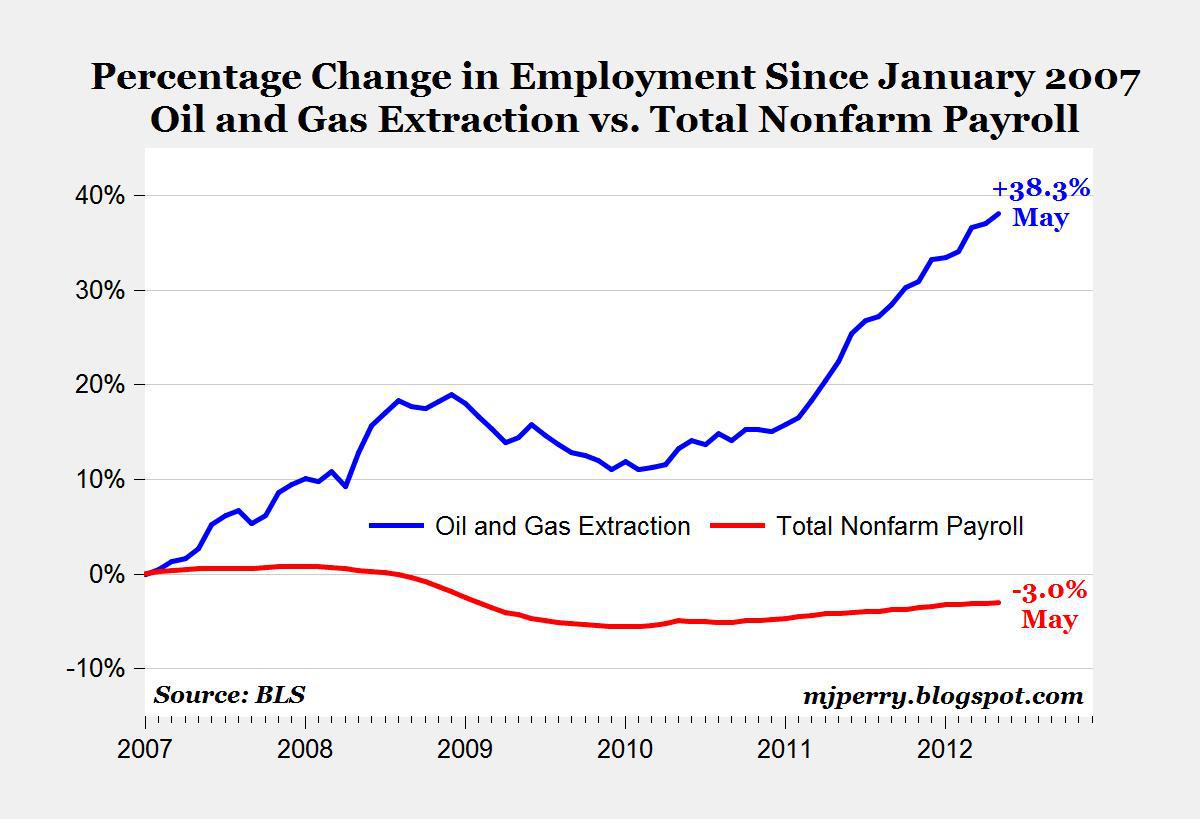
While yesterday's disappointing employment report reflects an economy struggling to create jobs during an extended, sub-par "jobless recovery," it's been a much rosier employment picture in one of America's most successful "shovel-ready" job-creating industries: Oil and Gas Extraction.
The chart above displays the monthly percentage changes in employment levels since January 2007 for oil and gas extraction jobs compared to total nonfarm payroll jobs. As of last month, total nonfarm payroll employment is 3.0%, and 4.1 million jobs, below the January 2007 level. In contrast, the explosion of new oil and gas jobs has increased employment in that industry by more than 38% since January 2007. Over the last 12 months, oil and gas companies have added 21,800 new workers, at a rate of almost 100 new hires every business day. And this just accounts for the new jobs created that involve the actual drilling, extraction and production of oil and gas.
A recent study found that for every one new job added in oil and gas extraction activities, there were three new additional jobs created elsewhere in the economy. The report also found that "the jobs-multiplier effect of U.S. oil and natural gas activity is higher than many other U.S. industries, including the financial, telecommunications, software and non-residential construction sectors. This is the result of the energy industry’s long supply chains and relatively high levels of spending by employees and suppliers." As a result of the multiplier effect, the U.S. economy has potentially been adding almost 400 new jobs per day over the last year due to increased oil and gas production.
Imagine what the jobless rate might be today, and imagine all of the additional shovel-ready, energy-related jobs (direct and indirect jobs) that could have been created over the last several years in the oil and gas industry (and its supporting industries), if the Obama administration: a) hadn't been so unfriendly to the low-cost, job-creating, dependable fossil fuel industry (think Keystone XL pipeline for example) that doesn't require picking the pockets of the taxpayers; and b) instead been so over-friendly to the subsidy-dependent, high-cost, unreliable but politically-favored "green" energies. On the other hand, imagine what the jobless rate might be today if we hadn't had the tremendous "energy-stimulus" to the U.S. economy that has resulted over the last few years from increased oil and gas drilling due to technological advances of hydraulic fracturing and horizontal drilling, and taking place mostly on private land?

Wednesday, May 2, 2012

Optimistic Future For Oil And Gas Drilling And Production In Ohio

Let's keep a close eye on what is going on in Ohio as this development takes place.  I must caution however, beware of the hype.  Salespeople have been known to exaggerate the value of products they are selling.
Peter

            
New map showing revised gas-oil drilling prospects in Ohio creates stir

By Bob Downing
Beacon Journal staff writer


A relatively simple multi-colored map is creating a buzz in eastern Ohio.
Some counties’ residents are ecstatic at the possibility they might be sitting atop lucrative deposits of natural gas/oil products. Others are dismayed to learn smaller volumes of gas and oil might lie deep under their feet than previously estimated.

At the center of what’s happening is a newly released map from the Ohio Department of Natural Resources’ Division of Geological Survey. It shows excellent drilling potential under much of Stark County. Large tracts of Tuscarawas, Coshocton and Trumbull counties also rate excellent. So, too, does eastern Portage County.
Larry Wickstrom, one of four men involved in developing the map, says he is a little flabbergasted by all the attention it is getting.

The map is “just the addition of new information ... and fine-tuning what we have,” he said. It is merely the state’s best guess as to what might be found thousands of feet underground.
Areas outside the main development area could still be productive, he advised, and the map probably will change as state geologists get even more information.

The map, relying on new data, shows a slightly different footprint in eastern Ohio for Utica shale, identifying a core area for drilling that covers 10.8 million acres from Ashtabula County south into Guernsey County.

Much of the drilling in Ohio has been located in Carroll, Harrison, Columbiana and Jefferson counties. Those four counties generally rate good to very good, according to the new data.
Summit, Medina, Wayne and Portage counties are all in the good area. Most of Cuyahoga, Lake and Lorain counties are now excluded.

The map was unveiled to little fanfare in March at a statewide meeting of the Ohio Oil and Gas Association and has gotten increasing attention as word of its existence has spread. It is based largely on the level of hydrocarbons found in Utica shale cores the state owns.

Over the years, more than 40,000 wells have been drilled through the Utica shale to deeper formations. The state has stored those core samples at Alum Creek State Park near Delaware.
Occasionally, researchers would sample the cores. Then about three years ago, the samples started generating increased interest from drilling companies.

Companies took core samples to have them analyzed in their labs. Because they paid for the studies, the companies were allowed to keep their research private for a year before giving the data to the state.

As the information began trickling in, state geologists took the new data and began revising its maps.
To date, energy companies have drilled 60 horizontal wells into the Utica shale in Ohio, and a total of 194 permits have received state approval. That total includes 10 permits in Stark, six in Portage and one in Medina counties.

State officials have predicted that more than 2,250 wells could be drilled in Ohio by the end of 2015.
One big question that remains unanswered is whether there is enough pressure in the western part of the Utica shale formation, where it is thinner, to send oil up well shafts, Wickstrom said.
Most of the drilling companies have not begun to prospect the potentially oil-rich area that generally lies west of Interstate 77.

The exception is Oklahoma-based Devon Energy Corp., which has applied for state permits for wells in Medina, Ashland and Knox counties. The company has said it is more interested in Ohio’s oil than its natural gas.

Chesapeake Energy Corp. is the No. 1 player in Ohio and is attracted by the so-called wet gases: ethane, butane and propane that are found in Utica shale. That makes Ohio financially attractive at a time when natural gas prices remain very low.

Records show landowners can get signing bonuses of up to $5,800 an acre plus royalties as high as 21 percent on what’s produced by wells. The average leasing bonus in Ohio is about $2,500 an acre.

Bob Downing can be reached at 330-996-3745 or bdowning@thebeaconjournal.com.