Showing posts with label North Dakota. Show all posts

Friday, September 14, 2012

Drilling On A Large Scale....The Future Is Here

Innovation, efficiency, economy, safety, progress....the American way.  Hats off to all the hard-working people in this industry who make such things possible.
Peter


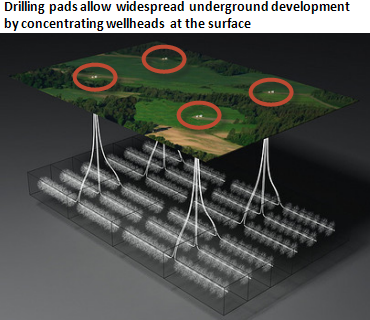
Three-dimensional representation of oil or natural gas development of a large underground area, from four drilling pads on the surface, as described in the article text
Source: U.S. Energy Information Administration, reproduced with permission from Statoil.
Note: Three-dimensional representation of oil or natural gas development of a large underground area, from four drilling pads on the surface (depicted within the red ovals).
 

Developments in drilling methods and technology are leading to efficiency gains for oil and natural gas producers. For example, "pad" drilling techniques allow rig operators to drill groups of wells more efficiently, because improved rig mobility reduces the time it takes to move from one well location to the next, while reducing the overall surface footprint. A drilling pad is a location which houses the wellheads for a number of horizontally drilled wells. The benefit of a drilling pad is that operators can drill multiple wells in a shorter time than they might with just one well per site.
Moving a drilling rig between two well sites previously involved disassembling the rig and reassembling it at the new location ("rigging down" and "rigging up") even if the new location was only a few yards away. Today, a drilling pad may have five to ten wells, which are horizontally drilled in different directions, spaced fairly close together at the surface. Once one well is drilled, the fully constructed rig can be lifted and moved a few yards over to the next well location using hydraulic walking or skidding systems, as demonstrated by Range Resources.

In the picture above, each of the four drilling pads hosts six horizontal wells. Pad drilling allows producers to target a significant area of underground resources while minimizing impact on the surface. Concentrating the wellheads also helps the producer reduce costs associated with managing the resources above-ground and moving the production to market.

Bentek Energy, LLC analysis shows that drilling operators are achieving efficiency gains in the well-drilling process. In June 2012, operators in the Eagle Ford shale formation averaged about 19 days to drill a horizontal well, down from an average of 23 days in 2011. Reducing the time it takes to drill wells can save oil and gas producers a significant amount of money. In the North Dakota section of the Bakken formation, the increase in drilling rigs in the area has begun to slow, but production levels continue to reach record highs each month.

Recent studies by the University of Pittsburgh and Rigzone, as well as analysis of financial reports from E&P companies Abraxas, EQT, and El Paso, show that drilling costs alone are only a portion of the total drilling and completion expenses that producers face. EIA analysis of average Bakken, Eagle Ford, and Marcellus well-related expenses finds that total costs per horizontal well can vary between approximately $6.5 million and $9 million. The cost of completing and hydraulic fracturing typically exceeds the cost of drilling the well.

One of the industry's more recent innovations, pad-to-pad moves, underscores the efficiency gains from rig mobility and pad drilling. During the drilling operation pictured below, rig operator Nabors Industries transported a fully-assembled drilling rig about one mile between drill sites. The cost of rigging down and rigging back up can be high enough that producers may find it more efficient to build a road between two pads, transport the rig intact, and have it arrive ready to drill the next well.
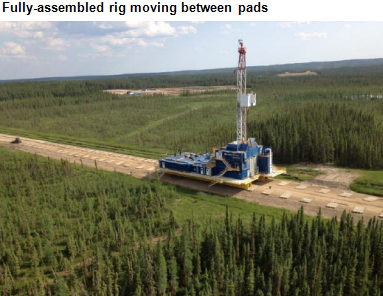
image of a fully constructed rig being moved between two drilling pads, as described in the article text
Source: Reproduced with permission from Nabors Industries Ltd.


Monday, August 6, 2012

While The Overall Economy Is Looking Dark, Oil And Gas Industry Is Looking Bright

Imagine what the production figures would look like if we had an Administration in Washington that actually supported the oil and gas industry instead of fighting it every step of the way?
Peter


An oil revolution is taking place in the US West and Mid-Continent


July 1, 2012
Fred Lawrence and Ron Planting, IPAA, Washington, DC
While the blockbuster plays in states such as Texas and North Dakota make the biggest headlines for increases in US crude oil production, there's no denying that developments in other states together add up to significant gains. Just like the other plays, many of these involved the technological advances of horizontal drilling and multi-stage hydraulic fracturing. The US map shown here indicates how widespread horizontal drilling has become.

Oil states

After North Dakota and Texas, there is a significant tier of states where crude oil production is increasing on a steady basis (See Figure 1). Six states in the western half of the US combined have increased US oil production by about 240,000 barrels per day (b/d) since early 2007. These include:
  • Oklahoma – Crude oil production has risen about 70,000 b/d from January 2007 through February 2012 (the latest available from the Energy Information Administration).
  • Colorado and New Mexico – Each saw increases of about 50,000 b/d over that period.
  • Utah and Kansas – Each had 30,000 b/d increases.
  • Wyoming – While Wyoming's net gain over the period was just 10,000 b/d, the state has seen a steady increase of twice that figure since bottoming out in mid-2009.
Since January 2007, these six states have increased crude oil production from a little more than 650,000 b/d to almost 900,000 b/d, an increase of nearly 37% collectively over a five-year span. This is roughly equivalent to the amount of oil produced by Colombia and Indonesia.

To read the remainder of the article click on the following link.

source: http://www.ogfj.com/articles/print/volume-9/issue-07/features/an-oil-revolution-is-taking-place.html

Thursday, August 2, 2012

Bakken Oil Boom Continuing

Until there is a viable alternative to oil, the increase in production all over the United States, not just from the Bakken, can only be seen as good for America.  The following are some of the numbers and facts, from the Federal Reserve Bank of  Minneapolis.  Click on the following link to see more data and graphs.
Peter

The Bakken Oil Boom

The Bakken oil boom dwarfs previous oil production expansions in Montana and North Dakota. Explore a range of economic, demographic and financial data for the Bakken, and learn about factors driving jobs and other forms of development in the oil patch of North Dakota and Montana.
Location of oil patch in the Ninth District
 
Oil Drilling Rigs
June 2012Pct. change from a year earlier
North Dakota20024%
Montana21108%
Summary
Oil drilling in Montana and North Dakota picked up beginning in 2004 until prices dropped below $60 per barrel in 2008, considered the break-even price for shale drilling and oil production at the time. Drilling accelerated again once oil prices recovered.
Oil production
 
Data Dashboard
Production (millions of barrels)
May 2012Pct. change from a year earlier
Bakken Oil Counties18.979%
Rest of Montana0.6 -24%
Rest of North Dakota2.0 1%
Summary
The Bakken area represents most of oil production in Montana and North Dakota.

The Bakken area

Detailed map of the oil patch in the Ninth District
Oil map thumbnail
Data on Demographic, Economic and Financial Activity in the Bakken [pdf]
This document reviews a range of demographic, economic and financial data for the Bakken. We compare the Bakken with the rest of Montana and the rest of North Dakota, as of June 20, 2012.

More about oil in the Ninth District

Frac sand mining spurs rural rail
fedgazette Roundup, July 19, 2012
Sand surge
fedgazette, July 16, 2012
In Minnesota and Wisconsin, frac sand mining has lifted local economies—and stirred opposition

Desperately seeking workers in the oil patch
fedgazette, April 18, 2012
Jobs go begging in booming western North Dakota and northeastern Montana

No room at the inn
fedgazette, April 18, 2012
For newcomers to oil country, their first job is finding a place to live
Faces and places from the oil patch
fedgazette, April 18, 2012
Slideshow
After the oil rush
fedgazette, September 1, 2009
In the Williston Basin, less drilling activity has created uncertainty about the future

Location of the Bakken in the Ninth District

Location of oil patch in the Ninth District

Jobs in the oil patch


Video: fedgazette Senior Writer Phil Davies talks about jobs in the oil patch

Thursday, July 26, 2012

Hess Improves Production And Technique In Completing Bakken Oil Wells

For those interested in some of the finer details of operations in producing oil from the Bakken Formation, horizontal drilling, completions, and hydraulic fracturing, the following article is interesting and valuable.  Here is a link to the original article:
http://seekingalpha.com/article/722661-bakken-update-hess-has-made-a-big-change-to-its-completion-design?goback=%2Egde_156898_member_138170874

The author, Mr. Filloon does his research and seems very knowledgeable about the oil and gas industry.  I'm quite certain he obtains his information from publicly available sources.  He provides his analysis as a service to the investment community.
Peter


<>2011 Hess Southern Williams County Results


Name Date Choke Stages Water Proppant 60Day IP 120Day IP
En-Weyrauch 154-93-1918H-3 10/11 30/64 N/A N/A N/A 488 369
En-Frandson 154-93-2116H-3 8/11 28/64 38 84203 3986800 939 780
En-Weyrauch 154-93-1918H-2 6/11 22/64 22 48161 1931448 501 367
En-Weyrauch 154-93-1918H-1 4/11 22/64 22 40421 1097939 504 435
En-Weyrauch 154-93-2932H-1 12/11 38/64 N/A N/A N/A 1101 825
En-Weyrauch A-154-93-2017H-1 11/11 42/64 38 61305 3995800 653 479
En-Weyrauch 154-93-3031H-2 12/11 34/64 38 71049 3991720 1003 787
En-Weyrauch 154-93-3031H-1 12/11 30/64 38 41472 1741722 1148 837
Hess Corporation (HES) is a very large and well-run oil producer. In 1957, it discovered oil in North Dakota and has become one of its biggest players. I had previously discussed Hess and its very conservative completion methods early in 2011. At this time, Hess was using 20 to 22 stage fracs with lower amounts of water and proppant. This was also consistent with Continental Resources, Inc.'s (CLR) well design, which I covered in this article.
The table to the top of this article shows a change from these lower number of stages to 38. This is consistent with Brigham (STO), which I covered in this article. Not only was this a big move, it has improved results significantly, and in some cases doubled old IP rates. One issue I had in researching Hess' results, was its lack of documentation with respect to well design. For those specific wells, I place N/A in the appropriate space.
In the second half of 2011, it used varying amounts of water and proppant. This variance has not always produced better results with increased water and proppant, which I found somewhat puzzling. Well orientation and lateral length are different for each well, sometimes by 1,000 feet. Another finding is Hess' move to a more moderate choke, which is consistent with Newfield Exploration Co.'s (NFX) well design, which I covered here. This has also been consistent with other Bakken operators.
In the table below, we see even more changes to design as Hess has used more than 100,000 barrels of water. It has also moved to above 3.2 million pounds of proppant. This move is consistent of Brigham, Kodiak Oil & Gas Corp (KOG) and Exxon Mobil Corporation (XOM).
<>2012 Hess Southern Williams County Results
Name Date Choke Stages Water Proppant IP Rate
En-Weyrauch C-154-93-2932H-2 3/12 22/64 38 34396 1995429 60Day=911
En-Madisyn 154-94-0607H-1 5/12 27/64 38 93122 3137554 41Day=892
En-Thompson Trust 154-94-1930H-1 4/12 36/64 N/A N/A N/A 54Day=1548
En-Weyrauch A154-93-2017H-2 1/12 33/64 N/A N/A N/A 60Day=801
Ca-Halvorson 154-95-0409H-1 5/12 34/64 38 101929 3203698 32Day=1610
In summary, Hess is moving forward at a quick pace to increase IP rates and EURs. It is not surprising as many operators are spending more per well in the hopes of increasing profits in the short and long term. The surprise isn't the change, but the amount of change. Hess' move has been much quicker than others in the Williston Basin, so it is my guess that Hess believes it is important enough to make a bigger move. These results could be different in other areas such as Mountrail or McKenzie counties, but this will take more research.
Disclosure: I have no positions in any stocks mentioned, and no plans to initiate any positions within the next 72 hours.
Additional disclosure: IP Rates are measured in barrels of oil per day. Water volumes are measured in barrels. Proppant amounts are measured in pounds. N/A is used on any well without sufficient information. This is not a buy recommendation.

Wednesday, July 18, 2012

Oil Boom And Technological Miracles In North Dakota

The following is an excellent article explaining  the oil shale boom in North Dakota and the fracking process, and aimed at the lay public.
Peter

It’s not just an oil boom, it’s an industrial revolution

By CLAY JENKINSON  BismarckTribune.com
July 15, 2012 2:00 am •
 
Note: This is the first of several columns Clay Jenkinson will write about his recent tour of the Bakken Oil Fields.

Last week I had the opportunity to visit the Bakken oil fields north and west of Belfield with Ron Ness of the North Dakota Petroleum Council and Blaine Hoffman of the Whiting Oil and Gass Corporation. In the course of a long day we visited two oil rigs, a fracking operation at another site, a plant that collects the gasses that would otherwise have been flared at the well sites, and several Whiting properties in the Badlands that have been reclaimed after all oil extraction at the site has been concluded. It was an amazing, and amazingly generous, tour. I am immensely grateful to have had the opportunity to see the industrial profile of the oil boom through the eyes of such remarkable and dedicated professionals.

I want to pause first to worship human technology. At some point not many thousand years ago we were wandering around the African savannah plucking berries from shrubs, beating off intruders with clubs, and trying not to let the fire go out because it was so darned hard to get it started again. Today, a guy with a joystick can direct steel well pipe 12,000 feet into the earth, and then TURN a 90 degree corner (with stiff steel pipe), so that, with the same joystick, he can feel his way to a 3-15 foot vein of oil bearing shale thousands of feet away from the turn. Think about this for a moment. We can send down a straw more than two miles into the earth, through some very dense and unyielding formations, and then turn a corner and wander laterally until we reach an exceedingly narrow formation that the entire population of North Dakota could never reach with shovels if they did nothing else for the rest of their lives.

And that’s just the beginning. Then we send water and a sand-bearing goo down that endless pipe at incredibly high pressure to fracture the oil bearing shale (like a window fan blowing open the pages of a closed book). This releases the oil that is bound up in that shale.

Two quick conclusions. First, humans must really have an infinite thirst for oil—they go to such lengths and expense to get to it. Second, human ingenuity and creativity (plus the opposable thumb) are magnificent evolutionary tools. We can deposit a live man on the surface of the moon, clone a living goat, talk to someone at the other end of the planet on a device no larger than a cigarette pack, and journey to the center of the earth with a metal probe. After spending a day in the presence of any cutting edge technology, it is virtually impossible not to conclude that human ingenuity is a limitless resource that can solve virtually any problem, and that as long as the United States continues to train and turn loose the human creative spirit at current (Steve Jobs) levels, we will be the masters of the world. There would seem to be a techno-fix for absolutely everything, and yet, as Woody Allen might say, we still can’t balance the budget or get a good pastrami sandwich in Duluth.

The fracking technology is literally breathtaking. It is also very recent. It has allowed Ron Ness (and others) to project—using currently available technology—that it will be possible to recover 12-20 billion barrels of oil in western North Dakota. If that is true, the state of North Dakota alone has as much oil as the nations of Qatar or Angola, and a fifth (possibly a quarter) as much recoverable oil as the nations of Iraq and Kuwait. If we come to extract a million barrels a day, that’s three years to a billion barrels. That would seem to indicate somewhere between 20 and 60 years of steady oil extraction before the North Dakota fields play out. And this only represents currently available technology, in a field where the technology is becoming more sophisticated almost by the month.
It is going to require tens of thousands of fracking wells to get all that oil up out of the ground, not to mention storage and shipping facilities, pipelines, rail lines and spurs, refineries, plants to handle the derivatives, water storage and treatment facilities, much wider and more ruggedized roads, and a housing and amenities infrastructure that is going to stagger the imagination. Dickinson is probably going to be a city of 50,000 people (for decades), Williston more, and Watford City, Stanley, Killdeer, Belfield, and other formerly sleepy villages are going to be transformed into something never before seen on the plains of North Dakota.

You know the old Chinese curse: “may you live in interesting times.” While he was hunting in 1789, French king Louis XVI was told of the fall of the Bastille in Paris. “So it is a rebellion?” he said. “No, sire,” replied the Duke de la Rochefoucauld-Liancourt "it is a revolution."

The first and most important thing you need to know about this oil boom is that it cannot and must not be compared to the previous booms in the 1950s and the 1980s. The volume is almost infinitely greater. The amount of industrial activity a fracking well requires, as opposed to a traditional well, is greater by magnitudes. It takes approximately 2,000 truck “events” to bring a single well to production. At this point there is virtually no geological gamble in fracking. We know where the oil bearing shale is. All we have to do is thread our way to it and fracture it, and voila: black gold. In the Bakken boom, it would be more accurate to say we are mining the oil than drilling here and there in hopes of finding a pool (as in previous booms). Because fracking is a more exact science, the wells can be lined up along drilling corridors, every X-thousand feet. This creates remarkable efficiencies in service roads and pipelines, and enables the industry to collect the gasses that have previously been burned off (flared) at the wellhead. Thanks to the real or perceived global scarcity of oil, this boom is very unlikely to collapse. Indeed, this time OPEC does not have sufficient production slack to conspire to undercut the world oil price and lure us back into Saudi oil addiction.

For all of its disturbances, dislocations, and growing pains, if we manage this right and protect our people and our landscape to the maximum extent possible under the circumstances, Bakken oil is going to be one of the greatest gifts that ever came to the people of North Dakota.
It’s not an oil boom. It’s an industrial revolution.

(Clay Jenkinson is the Theodore Roosevelt Center scholar at Dickinson State University, as well as Distinguished Scholar of the Humanities at Bismarck State College and director of the Dakota Institute. Clay can be reached at Jeffysage@aol.com or through his website, Jeffersonhour.org.)

Friday, July 6, 2012

Oil and Gas Industry Creates Jobs: America Should Be Proud And Thankful

Let's look at the bright side of things in America: the oil and gas industry.  During these unusually hot summer days I wonder how many people understand how the electricity is generated that powers their air conditioners enabling them to live so comfortably.  The same applies to heating in the winter, and the abundance of food made available to us year-round.  The source of these wonders is mostly oil and gas and coal.  And of course the production of these commodities creates jobs, which creates taxes, which pays (at least partly) the government's bills.  Let's take some time to be thankful for the oil and gas industry and all the people making this possible.
Peter


Oil and Gas: America’s Brightest Job Spot

“For many American families, struggling to make ends meet in the jobless recovery, energy development is an answer to a prayer. The fact that the oil and gas boom has been done without taxpayer subsidies—and despite reactionary public policies at the federal level and in some states (such as New York)—means that more economic opportunity is on tap.”
In this so-called “jobless” recovery, aka the Great Recession, an estimated 20 million American workers are unemployed or underemployed. One out of every two college students cannot find work in their chosen fields. Competition for well-paying jobs is likely to become even tougher when thousands of men and women in uniform return home from Afghanistan and look for ways to support their families.

Although many U.S. industries have been reluctant to hire new workers due to political and economic uncertainty, the oil and natural gas industry is booming worldwide. Jobs are available on offshore rigs, at service companies that support energy production activities, and onshore where technologies are unlocking energy supplies from impermeable rock deep underground.

Hydraulic fracturing, directional drilling, and 3- and 4-D computer modeling, among other high technologies, are helping to produce oil and natural gas from shale formations that once were believed to be too difficult or too expensive to tap. In the process, they are creating jobs at large and small companies in dozens of states. In the bigger scheme of things, this renaissance means that the hydrocarbon energy era has an open-ended future.

In North Dakota, where drillers are producing crude oil from the Bakken Shale, workers are finding jobs offering wages that are significantly higher than the national average. Truck drivers are being paid $80,000 a year to start. Some workers on oil rigs are being paid six figures. And yet many jobs are going begging. According to the mayor of Williston, “A lot of jobs get filled every day, but it’s like for every job you fill, another job and a half opens up.” In April, North Dakota had a jobless rate of 3.0 percent, the lowest in the country.

In Pennsylvania’s Marcellus Shale region, tens of thousands of jobs have been created, opening opportunities for unskilled laborers to obtain training and earn excellent wages. According to the state’s Department of Labor and Industry (Center for Workforce Information and Analysis), jobs for drill operators are expected to grow by nearly 85 percent this year, while the job growth rate otherwise in Pennsylvania is projected to be less than three percent.

The expansion of the oil and natural gas industry is also occurring at Texas’s Eagle Ford, Louisiana’s Haynesville Shale, Arkansas’ Fayetteville Shale and other energy-rich rock formations. Taken together, they are increasing domestic energy supplies, making energy more affordable, and spawning subsidiary investments in the private sector creating additional jobs.

A steel plant in Ohio is adding 200 jobs to produce more drill pipe. A new ethane plant in Texas, which will use natural gas to produce plastics, is expected to generate 400 jobs. Frito-Lay is purchasing natural gas-powered trucks to deliver consumer products around the country. New cleaner-burning gas-fired power plants are being built to replace old coal-fueled electricity generating facilities. (But expect coal-fired power to improve its technology too to remain competitive in many respects.)

These jobs are being created by companies, not the federal government. And they are based on “made in the USA” technologies that have the potential to greatly increase nation’s energy security and alter the world’s balance of power. As U.S. oil and natural gas supplies increase, some experts believe American energy independence is on the horizon.

Philip Verleger, an economist at the Peterson Institute for International Economics, believes the United States could be energy self-sufficient in the next 10-plus years and could become a net energy exporter.

Yet, some environmental groups are reluctant to embrace this good news scenario. They see domestic energy’s success as a threat to their green agenda. In their continuing push to reduce carbon dioxide emissions, they are working to stop hydraulic fracturing, shut in oil and natural gas wells, and in the process, slow or stop progress.

Their strategy is to promote fear of hydraulic fracturing worldwide. Concerns over groundwater contamination have prompted France and Bulgaria to ban fracturing and other countries are considering moratoria. Yet, despite efforts to find a link between fracking and drinking water pollution, U.S. Environmental Protection Agency (EPA) investigations have found no credible evidence to support the claim
.
Energy experts believe the reluctance of other countries to develop their shale resources is giving the United States a market advantage, prompting interest in exporting liquid natural gas (LNG) from the Gulf Coast. Italy, Lithuania, and Poland are building terminals to accept LNG imports, and LNG imports to the European Union are expected to grow by nearly 75 percent by 2035. Energy expert Daniel Yergin calls Europe “an obvious market” for U.S. LNG.

The home-grown energy renaissance could become a major reversal of fortune, wiping out 40 years of worry over U.S. reliance on foreign energy sources. According to an analysis by Wood Mackenzie, it also could create an additional one million jobs by 2018 if the government opened more onshore and offshore areas to exploration and development.

For many American families, struggling to make ends meet in the jobless recovery, energy development is an answer to a prayer. The fact that the oil and gas boom has been done without taxpayer subsidies—and despite reactionary public policies at the federal level and in some states (such as New York)—means that more economic opportunity is on tap.
—————-
Note: An earlier version of this op-ed appeared in The Hill (Washington, DC

Wednesday, May 30, 2012

New Producing Formation In North Dakota's Williston Basin

Horizontal drilling and hydraulic fracturing open up a wealth of oil and gas producing opportunities never before thought possible.
Peter


N.D. drillers aiming for sandy section below Bakken

Oil drillers working in the rich Bakken and Three Forks formations that are fueling North Dakota's unprecedented oil rush are now aiming for crude in a sandy layer between the two.
By: James MacPherson, Associated Press

source: http://www.grandforksherald.com/event/article/id/237228/
BISMARCK — Oil drillers working in the rich Bakken and Three Forks formations that are fueling North Dakota's unprecedented oil rush are now aiming for crude in a sandy layer between the two.

Geologists say the layer, which is being called the Pronghorn, is about 60-feet thick.

Denver-based Whiting Petroleum Corp. has several horizontal wells aimed at Pronghorn in western North Dakota, and initial results are positive, company chairman and CEO James Volker said during a panel discussion at the Williston Basin Petroleum Conference and Expo.

Some wells were pumping at rates "every bit as good" as the Bakken, said Volker, who was joined on the panel by Harold Hamm, chairman and CEO of Oklahoma City-based Continental Resources Inc., and Dave Roberts, executive vice president of Marathon Oil Corp.

The executives said North Dakota — which is now the nation's No. 2 oil producer, behind only Texas — is a model for oil development in the U.S. They pledged that their companies would act as good stewards.

The layer has often been attributed to the Three Forks formation, and referred to as the Three Forks-Sanish, but it's more correctly part of the Bakken formation directly above it, North Dakota Geological Survey geologist Julie LeFever said. She said the state's Geological Survey is now referring to the layer at the Pronghorn and asked that companies and geologists do the same to avoid confusion.

The three-day expo, which concluded Thursday, drew more than 4,000 people from 47 states and several countries to Bismarck, said Ron Ness, president of the North Dakota Petroleum Council.

Among the attendees was Tony La Russa, the former St. Louis Cardinals manager who guided the team to the World Series title last year. Invited by Hamm, he said he was curious to see the oil patch and how things have changes since he was last in the state 50 years ago.

"There is a lot of excitement and a lot of people coming to North Dakota," he said.


Copyright 2012 The Associated Press.